

indigenous bacterium, it is observed within the intestinal tract of 10% of healthy
adults. Spores grow between 4 and 50
C and germinate at 1–59
C; heating it to
100
C for 10 min can inactivate most spores, but they are able to endure heating to
100
C for up to 30 min. This species is widely distributed in natural environments,
and spores form in the soil.
Pseudomonas putida
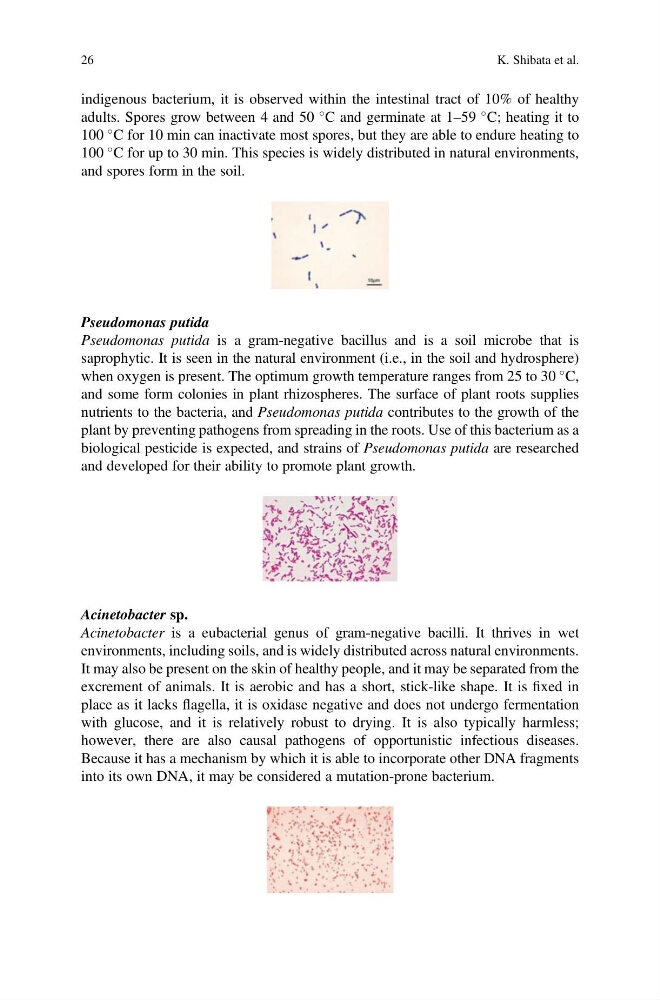
Pseudomonas putida is a gram-negative bacillus and is a soil microbe that is
saprophytic. It is seen in the natural environment (i.e., in the soil and hydrosphere)
when oxygen is present. The optimum growth temperature ranges from 25 to 30
C,
and some form colonies in plant rhizospheres. The surface of plant roots supplies
nutrients to the bacteria, and Pseudomonas putida contributes to the growth of the
plant by preventing pathogens from spreading in the roots. Use of this bacterium as a
biological pesticide is expected, and strains of Pseudomonas putida are researched
and developed for their ability to promote plant growth.
Acinetobacter sp.
Acinetobacter is a eubacterial genus of gram-negative bacilli. It thrives in wet
environments, including soils, and is widely distributed across natural environments.
It may also be present on the skin of healthy people, and it may be separated from the
excrement of animals. It is aerobic and has a short, stick-like shape. It is fixed in
place as it lacks flagella, it is oxidase negative and does not undergo fermentation
with glucose, and it is relatively robust to drying. It is also typically harmless;
however, there are also causal pathogens of opportunistic infectious diseases.
Because it has a mechanism by which it is able to incorporate other DNA fragments
into its own DNA, it may be considered a mutation-prone bacterium.
26
K. Shibata et al.
adults. Spores grow between 4 and 50
C and germinate at 1–59
C; heating it to
100
C for 10 min can inactivate most spores, but they are able to endure heating to
100
C for up to 30 min. This species is widely distributed in natural environments,
and spores form in the soil.
Pseudomonas putida
Pseudomonas putida is a gram-negative bacillus and is a soil microbe that is
saprophytic. It is seen in the natural environment (i.e., in the soil and hydrosphere)
when oxygen is present. The optimum growth temperature ranges from 25 to 30
C,
and some form colonies in plant rhizospheres. The surface of plant roots supplies
nutrients to the bacteria, and Pseudomonas putida contributes to the growth of the
plant by preventing pathogens from spreading in the roots. Use of this bacterium as a
biological pesticide is expected, and strains of Pseudomonas putida are researched
and developed for their ability to promote plant growth.
Acinetobacter sp.
Acinetobacter is a eubacterial genus of gram-negative bacilli. It thrives in wet
environments, including soils, and is widely distributed across natural environments.
It may also be present on the skin of healthy people, and it may be separated from the
excrement of animals. It is aerobic and has a short, stick-like shape. It is fixed in
place as it lacks flagella, it is oxidase negative and does not undergo fermentation
with glucose, and it is relatively robust to drying. It is also typically harmless;
however, there are also causal pathogens of opportunistic infectious diseases.
Because it has a mechanism by which it is able to incorporate other DNA fragments
into its own DNA, it may be considered a mutation-prone bacterium.
26
K. Shibata et al.