

3.3.1 Microalgal Producers
Chlorella sp.
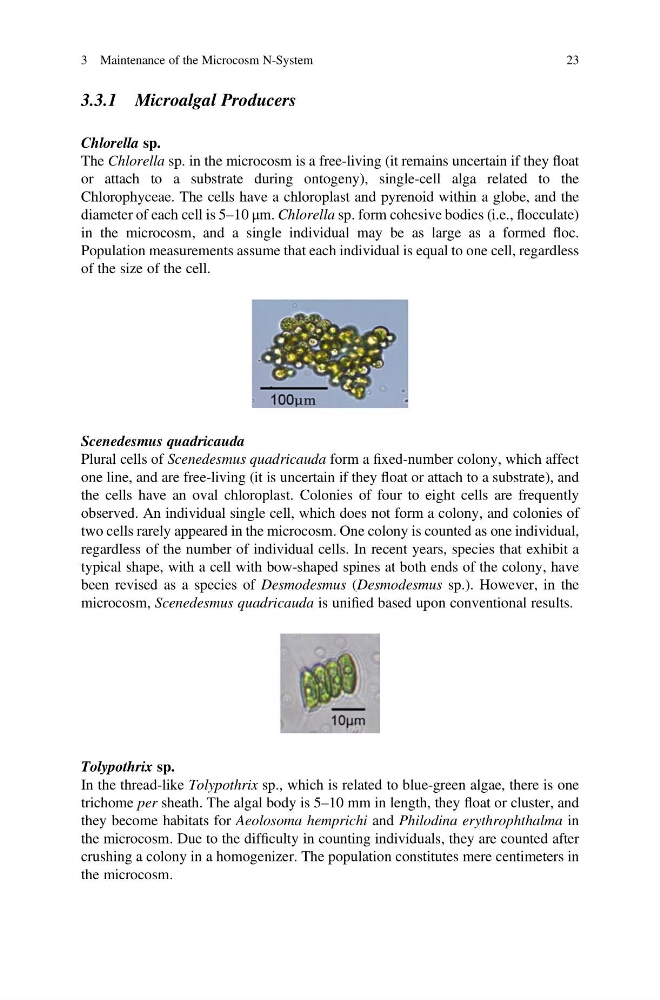
The Chlorella sp. in the microcosm is a free-living (it remains uncertain if they float
or attach to a substrate during ontogeny), single-cell alga related to the
Chlorophyceae. The cells have a chloroplast and pyrenoid within a globe, and the
diameter of each cell is 5–10 μm. Chlorella sp. form cohesive bodies (i.e., flocculate)
in the microcosm, and a single individual may be as large as a formed floc.
Population measurements assume that each individual is equal to one cell, regardless
of the size of the cell.
Scenedesmus quadricauda
Plural cells of Scenedesmus quadricauda form a fixed-number colony, which affect
one line, and are free-living (it is uncertain if they float or attach to a substrate), and
the cells have an oval chloroplast. Colonies of four to eight cells are frequently
observed. An individual single cell, which does not form a colony, and colonies of
two cells rarely appeared in the microcosm. One colony is counted as one individual,
regardless of the number of individual cells. In recent years, species that exhibit a
typical shape, with a cell with bow-shaped spines at both ends of the colony, have
been revised as a species of Desmodesmus (Desmodesmus sp.). However, in the
microcosm, Scenedesmus quadricauda is unified based upon conventional results.
Tolypothrix sp.
In the thread-like Tolypothrix sp., which is related to blue-green algae, there is one
trichome per sheath. The algal body is 5–10 mm in length, they float or cluster, and
they become habitats for Aeolosoma hemprichi and Philodina erythrophthalma in
the microcosm. Due to the difficulty in counting individuals, they are counted after
crushing a colony in a homogenizer. The population constitutes mere centimeters in
the microcosm.
3 Maintenance of the Microcosm N-System
23
Chlorella sp.
The Chlorella sp. in the microcosm is a free-living (it remains uncertain if they float
or attach to a substrate during ontogeny), single-cell alga related to the
Chlorophyceae. The cells have a chloroplast and pyrenoid within a globe, and the
diameter of each cell is 5–10 μm. Chlorella sp. form cohesive bodies (i.e., flocculate)
in the microcosm, and a single individual may be as large as a formed floc.
Population measurements assume that each individual is equal to one cell, regardless
of the size of the cell.
Scenedesmus quadricauda
Plural cells of Scenedesmus quadricauda form a fixed-number colony, which affect
one line, and are free-living (it is uncertain if they float or attach to a substrate), and
the cells have an oval chloroplast. Colonies of four to eight cells are frequently
observed. An individual single cell, which does not form a colony, and colonies of
two cells rarely appeared in the microcosm. One colony is counted as one individual,
regardless of the number of individual cells. In recent years, species that exhibit a
typical shape, with a cell with bow-shaped spines at both ends of the colony, have
been revised as a species of Desmodesmus (Desmodesmus sp.). However, in the
microcosm, Scenedesmus quadricauda is unified based upon conventional results.
Tolypothrix sp.
In the thread-like Tolypothrix sp., which is related to blue-green algae, there is one
trichome per sheath. The algal body is 5–10 mm in length, they float or cluster, and
they become habitats for Aeolosoma hemprichi and Philodina erythrophthalma in
the microcosm. Due to the difficulty in counting individuals, they are counted after
crushing a colony in a homogenizer. The population constitutes mere centimeters in
the microcosm.
3 Maintenance of the Microcosm N-System
23