

no-effect concentration can be obtained, as compared to the methods currently
available (i.e., assessment based on a single species). In assessing the effects of
chemical substances on ecosystems, it is difficult to avoid the current testing
methods for algae, crustaceans, and fish, which are exemplified in the Whole
Effluent Toxicity (WET) test. Using an ecosystem model that includes parallel
food chains and energy flows allows us to accumulate knowledge on the decomposition and persistence of chemical substances and on the recovery and disruption of
associated ecosystem functions. In short, it is expected that the advantage of
microcosms will be appreciated when establishing an approach that numerically
assesses ecosystem impacts. The WET test assesses toxicity, including complex
effects, by testing water that contains multiple chemical substances rather than
assessing the toxicity of each chemical substance in isolation. Although species
located in different niches within a food chain are used for the assay, it is a singlespecies test, and, as previously reported, a drawback of WET testing is that it is
conducted under conditions in which material cycles, energy flows, and interactions
among different species—the basic components of an ecosystem—are all absent.
Microcosms are systems in which multiple species coexist, allowing researchers to
assess the risk of chemical substances at the ecosystem level, and the safety
coefficients obtained are considered different from those obtained from conventional
approaches, as shown in previous studies on the correlations in both mesocosm and
microcosm tests. It is expected that further accumulation of data will allow for the
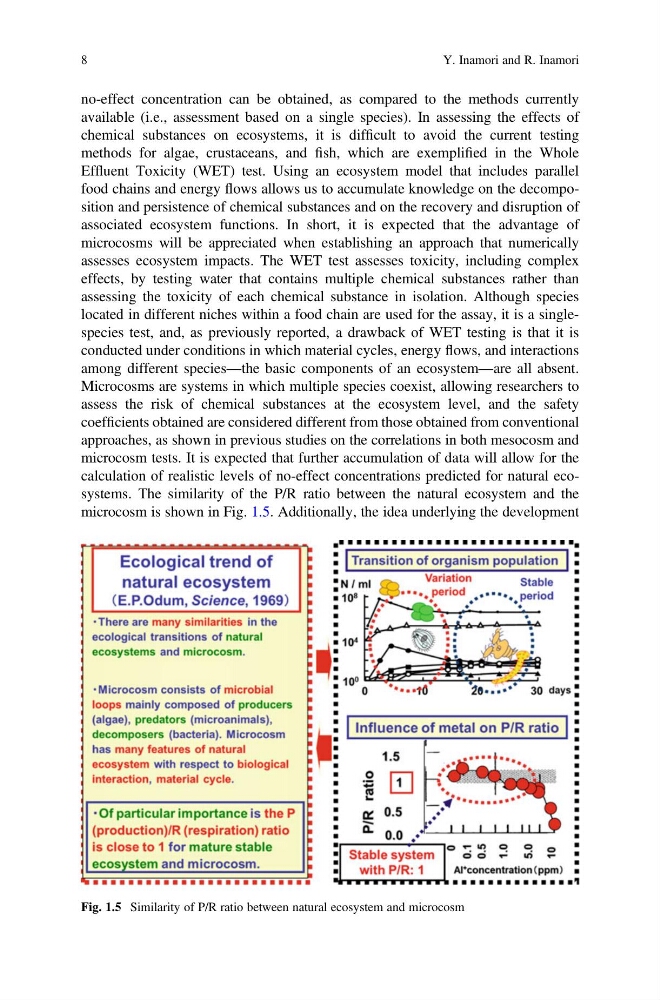
calculation of realistic levels of no-effect concentrations predicted for natural ecosystems. The similarity of the P/R ratio between the natural ecosystem and the
microcosm is shown in Fig. 1.5. Additionally, the idea underlying the development
Fig. 1.5 Similarity of P/R ratio between natural ecosystem and microcosm
8
Y. Inamori and R. Inamori
available (i.e., assessment based on a single species). In assessing the effects of
chemical substances on ecosystems, it is difficult to avoid the current testing
methods for algae, crustaceans, and fish, which are exemplified in the Whole
Effluent Toxicity (WET) test. Using an ecosystem model that includes parallel
food chains and energy flows allows us to accumulate knowledge on the decomposition and persistence of chemical substances and on the recovery and disruption of
associated ecosystem functions. In short, it is expected that the advantage of
microcosms will be appreciated when establishing an approach that numerically
assesses ecosystem impacts. The WET test assesses toxicity, including complex
effects, by testing water that contains multiple chemical substances rather than
assessing the toxicity of each chemical substance in isolation. Although species
located in different niches within a food chain are used for the assay, it is a singlespecies test, and, as previously reported, a drawback of WET testing is that it is
conducted under conditions in which material cycles, energy flows, and interactions
among different species—the basic components of an ecosystem—are all absent.
Microcosms are systems in which multiple species coexist, allowing researchers to
assess the risk of chemical substances at the ecosystem level, and the safety
coefficients obtained are considered different from those obtained from conventional
approaches, as shown in previous studies on the correlations in both mesocosm and
microcosm tests. It is expected that further accumulation of data will allow for the
calculation of realistic levels of no-effect concentrations predicted for natural ecosystems. The similarity of the P/R ratio between the natural ecosystem and the
microcosm is shown in Fig. 1.5. Additionally, the idea underlying the development
Fig. 1.5 Similarity of P/R ratio between natural ecosystem and microcosm
8
Y. Inamori and R. Inamori