

scale, an aquatic ecosystem that is spatially controllable, and joins laboratory testing
and outdoor monitoring (Fig. 1.3). Material circulation and the flow of energy
among a variety of organisms are thought to be important in performing an impact
assessment of a given ecosystem, which is why there is a limit to rating systems that
consist of single species, such as the alga, fish, and water fleas used for ecosystem
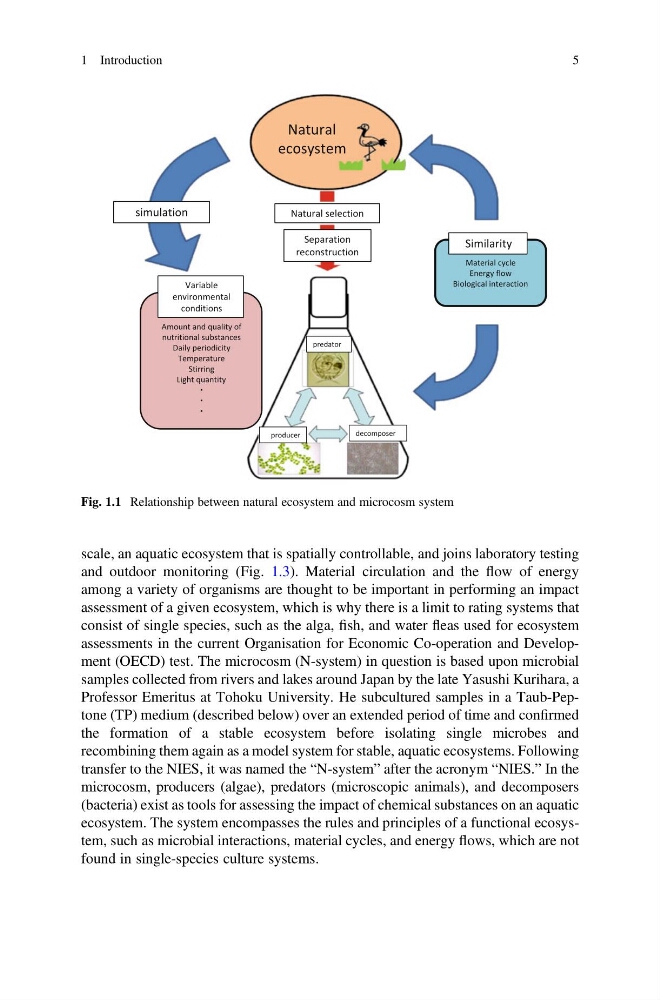
assessments in the current Organisation for Economic Co-operation and Development (OECD) test. The microcosm (N-system) in question is based upon microbial
samples collected from rivers and lakes around Japan by the late Yasushi Kurihara, a
Professor Emeritus at Tohoku University. He subcultured samples in a Taub-Peptone (TP) medium (described below) over an extended period of time and confirmed
the formation of a stable ecosystem before isolating single microbes and
recombining them again as a model system for stable, aquatic ecosystems. Following
transfer to the NIES, it was named the “N-system” after the acronym “NIES.” In the
microcosm, producers (algae), predators (microscopic animals), and decomposers
(bacteria) exist as tools for assessing the impact of chemical substances on an aquatic
ecosystem. The system encompasses the rules and principles of a functional ecosystem, such as microbial interactions, material cycles, and energy flows, which are not
found in single-species culture systems.
Natural
ecosystem
Material cycle
Energy flow
Biological interaction
Similarity
Natural selection
Separation
reconstruction
simulation
Amount and quality of
nutritional substances
Daily periodicity
Temperature
Stirring
Light quantity
Variable
environmental
conditions
predator
producer
decomposer
Fig. 1.1 Relationship between natural ecosystem and microcosm system
1 Introduction
5
and outdoor monitoring (Fig. 1.3). Material circulation and the flow of energy
among a variety of organisms are thought to be important in performing an impact
assessment of a given ecosystem, which is why there is a limit to rating systems that
consist of single species, such as the alga, fish, and water fleas used for ecosystem
assessments in the current Organisation for Economic Co-operation and Development (OECD) test. The microcosm (N-system) in question is based upon microbial
samples collected from rivers and lakes around Japan by the late Yasushi Kurihara, a
Professor Emeritus at Tohoku University. He subcultured samples in a Taub-Peptone (TP) medium (described below) over an extended period of time and confirmed
the formation of a stable ecosystem before isolating single microbes and
recombining them again as a model system for stable, aquatic ecosystems. Following
transfer to the NIES, it was named the “N-system” after the acronym “NIES.” In the
microcosm, producers (algae), predators (microscopic animals), and decomposers
(bacteria) exist as tools for assessing the impact of chemical substances on an aquatic
ecosystem. The system encompasses the rules and principles of a functional ecosystem, such as microbial interactions, material cycles, and energy flows, which are not
found in single-species culture systems.
Natural
ecosystem
Material cycle
Energy flow
Biological interaction
Similarity
Natural selection
Separation
reconstruction
simulation
Amount and quality of
nutritional substances
Daily periodicity
Temperature
Stirring
Light quantity
Variable
environmental
conditions
predator
producer
decomposer
Fig. 1.1 Relationship between natural ecosystem and microcosm system
1 Introduction
5