

To evaluate the influence of the chemical substance LAS on the model ecosystem
hydrosphere, LAS was added to the system at 0, 1, 5, and 10 mg/L. Based on
fluctuations in the P/R ratio and the persistence of aquatic organisms, an impact
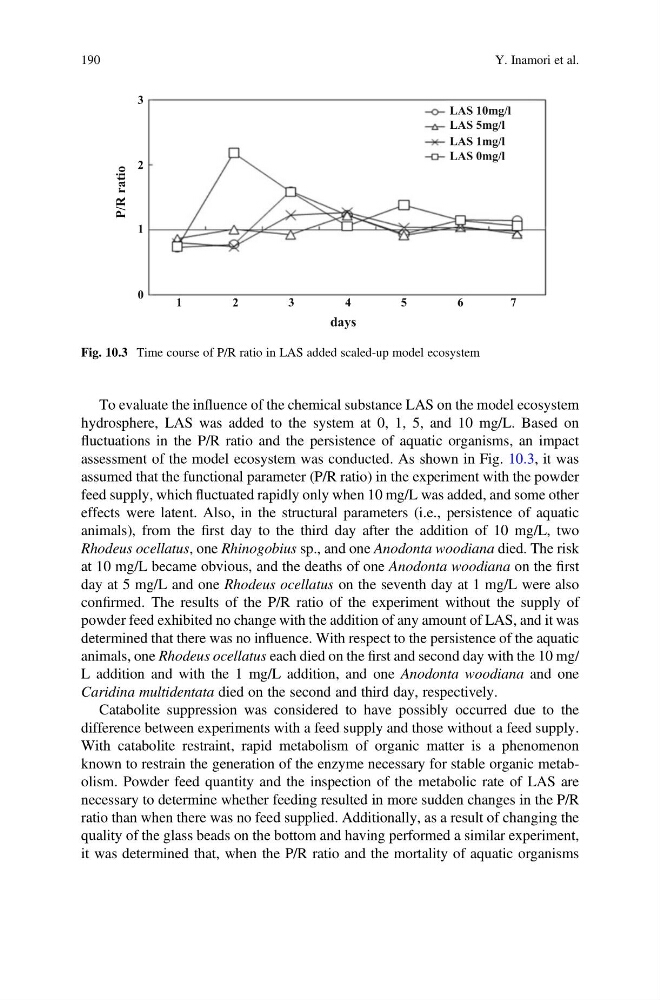
assessment of the model ecosystem was conducted. As shown in Fig. 10.3, it was
assumed that the functional parameter (P/R ratio) in the experiment with the powder
feed supply, which fluctuated rapidly only when 10 mg/L was added, and some other
effects were latent. Also, in the structural parameters (i.e., persistence of aquatic
animals), from the first day to the third day after the addition of 10 mg/L, two
Rhodeus ocellatus, one Rhinogobius sp., and one Anodonta woodiana died. The risk
at 10 mg/L became obvious, and the deaths of one Anodonta woodiana on the first
day at 5 mg/L and one Rhodeus ocellatus on the seventh day at 1 mg/L were also
confirmed. The results of the P/R ratio of the experiment without the supply of
powder feed exhibited no change with the addition of any amount of LAS, and it was
determined that there was no influence. With respect to the persistence of the aquatic
animals, one Rhodeus ocellatus each died on the first and second day with the 10 mg/
L addition and with the 1 mg/L addition, and one Anodonta woodiana and one
Caridina multidentata died on the second and third day, respectively.
Catabolite suppression was considered to have possibly occurred due to the
difference between experiments with a feed supply and those without a feed supply.
With catabolite restraint, rapid metabolism of organic matter is a phenomenon
known to restrain the generation of the enzyme necessary for stable organic metabolism. Powder feed quantity and the inspection of the metabolic rate of LAS are
necessary to determine whether feeding resulted in more sudden changes in the P/R
ratio than when there was no feed supplied. Additionally, as a result of changing the
quality of the glass beads on the bottom and having performed a similar experiment,
it was determined that, when the P/R ratio and the mortality of aquatic organisms
LAS 10mg/l
LAS 0mg/l
LAS 1mg/l
LAS 5mg/l
3
2
1
0
1
2
3
4
5
6
7
P/R ratio
days
Fig. 10.3 Time course of P/R ratio in LAS added scaled-up model ecosystem
190
Y. Inamori et al.
hydrosphere, LAS was added to the system at 0, 1, 5, and 10 mg/L. Based on
fluctuations in the P/R ratio and the persistence of aquatic organisms, an impact
assessment of the model ecosystem was conducted. As shown in Fig. 10.3, it was
assumed that the functional parameter (P/R ratio) in the experiment with the powder
feed supply, which fluctuated rapidly only when 10 mg/L was added, and some other
effects were latent. Also, in the structural parameters (i.e., persistence of aquatic
animals), from the first day to the third day after the addition of 10 mg/L, two
Rhodeus ocellatus, one Rhinogobius sp., and one Anodonta woodiana died. The risk
at 10 mg/L became obvious, and the deaths of one Anodonta woodiana on the first
day at 5 mg/L and one Rhodeus ocellatus on the seventh day at 1 mg/L were also
confirmed. The results of the P/R ratio of the experiment without the supply of
powder feed exhibited no change with the addition of any amount of LAS, and it was
determined that there was no influence. With respect to the persistence of the aquatic
animals, one Rhodeus ocellatus each died on the first and second day with the 10 mg/
L addition and with the 1 mg/L addition, and one Anodonta woodiana and one
Caridina multidentata died on the second and third day, respectively.
Catabolite suppression was considered to have possibly occurred due to the
difference between experiments with a feed supply and those without a feed supply.
With catabolite restraint, rapid metabolism of organic matter is a phenomenon
known to restrain the generation of the enzyme necessary for stable organic metabolism. Powder feed quantity and the inspection of the metabolic rate of LAS are
necessary to determine whether feeding resulted in more sudden changes in the P/R
ratio than when there was no feed supplied. Additionally, as a result of changing the
quality of the glass beads on the bottom and having performed a similar experiment,
it was determined that, when the P/R ratio and the mortality of aquatic organisms
LAS 10mg/l
LAS 0mg/l
LAS 1mg/l
LAS 5mg/l
3
2
1
0
1
2
3
4
5
6
7
P/R ratio
days
Fig. 10.3 Time course of P/R ratio in LAS added scaled-up model ecosystem
190
Y. Inamori et al.