

the risk associated with the introduction of chemical substances in the model
ecosystem. To construct an optimum, scaled-up model hydrosphere ecosystem,
which consisted of plants, fish, bivalve mollusks, and crustaceans, the abundance
input organisms, submerged plants, feed quantity, and bottom sediment quality were
selected. Additionally, experiments were conducted to determine whether it is
possible to maintain the number of initial input organisms with a constant abundance
of individuals under the 24-h light condition without setting an L/D cycle. As a
result, there were periods in which input organisms could survive continuously for
more than 1 week, but high mortality indicates that the experimental aquatic
ecosystem was far from stable. Therefore, when the abundance of organisms varied
due to mortality, an experiment for evaluating the number of viable organisms was
conducted without introducing new organisms. As a result, there were no fatalities
for 10 days for three Rhodeus ocellatus, two Rhinogobius sp., four Caridina
multidentata, and two Anodonta woodiana at the time that the powdered potato
feed was supplied under the experimental condition with the highest survivorship.
We determined abundance to be a viable input. Furthermore, the viable abundance
under the L/D ¼ 12 hr./12 hr. condition that was similar to natural conditions was
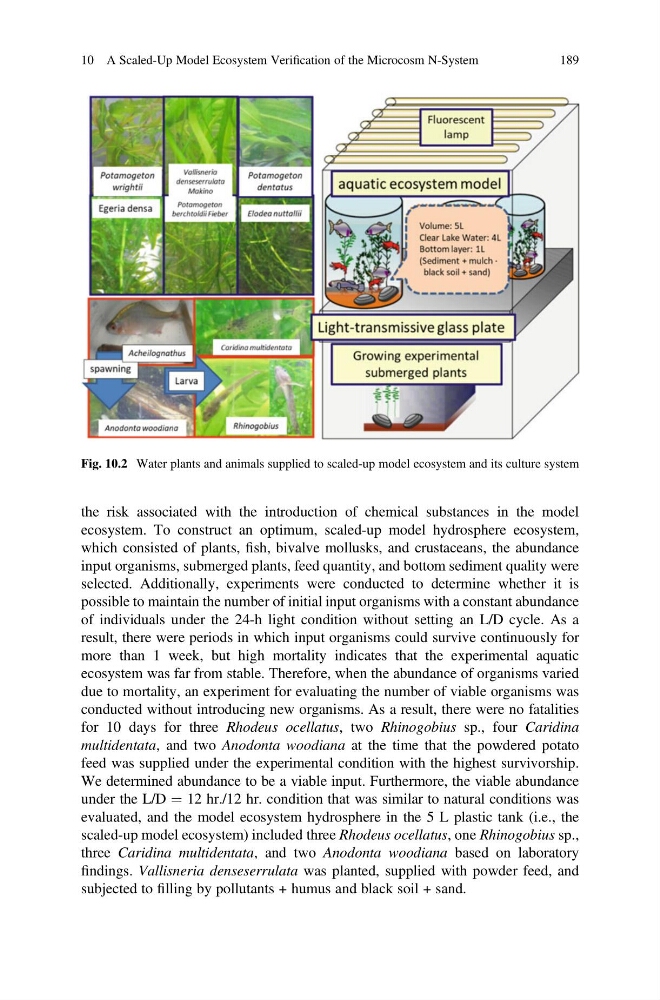
evaluated, and the model ecosystem hydrosphere in the 5 L plastic tank (i.e., the
scaled-up model ecosystem) included three Rhodeus ocellatus, one Rhinogobius sp.,
three Caridina multidentata, and two Anodonta woodiana based on laboratory
findings. Vallisneria denseserrulata was planted, supplied with powder feed, and
subjected to filling by pollutants + humus and black soil + sand.
Fig. 10.2 Water plants and animals supplied to scaled-up model ecosystem and its culture system
10 A Scaled-Up Model Ecosystem Verification of the Microcosm N-System
189
ecosystem. To construct an optimum, scaled-up model hydrosphere ecosystem,
which consisted of plants, fish, bivalve mollusks, and crustaceans, the abundance
input organisms, submerged plants, feed quantity, and bottom sediment quality were
selected. Additionally, experiments were conducted to determine whether it is
possible to maintain the number of initial input organisms with a constant abundance
of individuals under the 24-h light condition without setting an L/D cycle. As a
result, there were periods in which input organisms could survive continuously for
more than 1 week, but high mortality indicates that the experimental aquatic
ecosystem was far from stable. Therefore, when the abundance of organisms varied
due to mortality, an experiment for evaluating the number of viable organisms was
conducted without introducing new organisms. As a result, there were no fatalities
for 10 days for three Rhodeus ocellatus, two Rhinogobius sp., four Caridina
multidentata, and two Anodonta woodiana at the time that the powdered potato
feed was supplied under the experimental condition with the highest survivorship.
We determined abundance to be a viable input. Furthermore, the viable abundance
under the L/D ¼ 12 hr./12 hr. condition that was similar to natural conditions was
evaluated, and the model ecosystem hydrosphere in the 5 L plastic tank (i.e., the
scaled-up model ecosystem) included three Rhodeus ocellatus, one Rhinogobius sp.,
three Caridina multidentata, and two Anodonta woodiana based on laboratory
findings. Vallisneria denseserrulata was planted, supplied with powder feed, and
subjected to filling by pollutants + humus and black soil + sand.
Fig. 10.2 Water plants and animals supplied to scaled-up model ecosystem and its culture system
10 A Scaled-Up Model Ecosystem Verification of the Microcosm N-System
189