

change in the population in the 50% addition system. Conversely, Chlorella sp.
(a producer), Scenedesmus quadricauda (a producer), and Tolypothrix sp.
(a producer) decreased in their abundance, and the abundance of Philodina
erythrophthalma (a predator) increased in the 100% addition system. From these
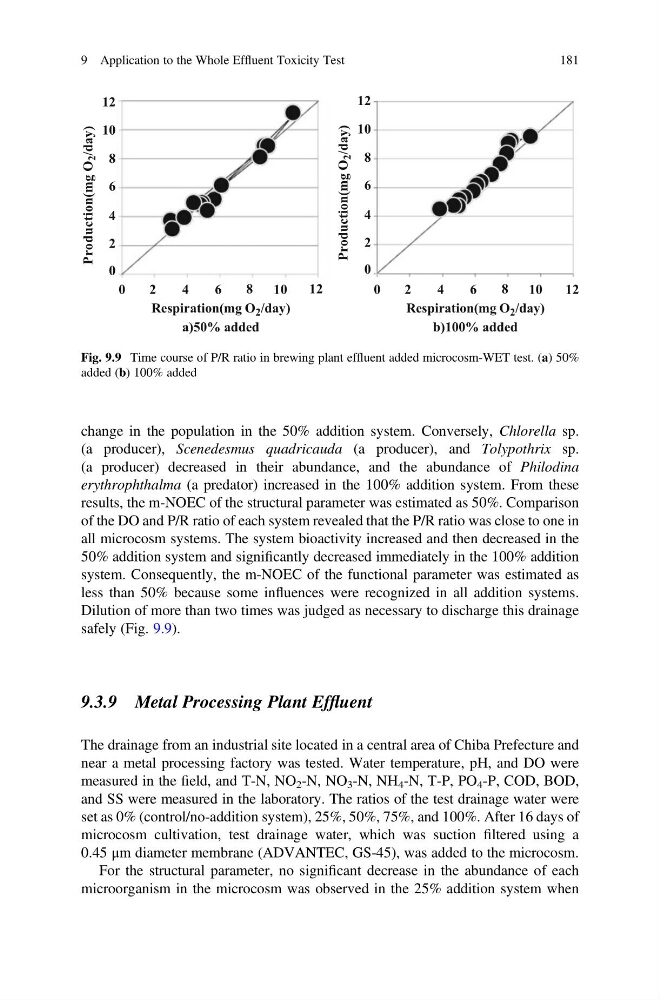
results, the m-NOEC of the structural parameter was estimated as 50%. Comparison
of the DO and P/R ratio of each system revealed that the P/R ratio was close to one in
all microcosm systems. The system bioactivity increased and then decreased in the
50% addition system and significantly decreased immediately in the 100% addition
system. Consequently, the m-NOEC of the functional parameter was estimated as
less than 50% because some influences were recognized in all addition systems.
Dilution of more than two times was judged as necessary to discharge this drainage
safely (Fig. 9.9).
9.3.9 Metal Processing Plant Effluent
The drainage from an industrial site located in a central area of Chiba Prefecture and
near a metal processing factory was tested. Water temperature, pH, and DO were
measured in the field, and T-N, NO 2 -N, NO 3 -N, NH 4 -N, T-P, PO 4 -P, COD, BOD,
and SS were measured in the laboratory. The ratios of the test drainage water were
set as 0% (control/no-addition system), 25%, 50%, 75%, and 100%. After 16 days of
microcosm cultivation, test drainage water, which was suction filtered using a
0.45 μm diameter membrane (ADVANTEC, GS-45), was added to the microcosm.
For the structural parameter, no significant decrease in the abundance of each
microorganism in the microcosm was observed in the 25% addition system when
a)50% added
Respiration(mg O 2 /day)
n(mg O
2 /day)
o
i
t
c
u
d
o
r
P
12
10
8
6
4
2
0
0
2
4
6
8
10
12
b)100% added
Respiration(mg O 2 /day)
Production(mg O
2 /day)
12
10
8
6
4
2
0
0
2
4
6
8
10
12
Fig. 9.9 Time course of P/R ratio in brewing plant effluent added microcosm-WET test. (a) 50%
added (b) 100% added
9 Application to the Whole Effluent Toxicity Test
181
(a producer), Scenedesmus quadricauda (a producer), and Tolypothrix sp.
(a producer) decreased in their abundance, and the abundance of Philodina
erythrophthalma (a predator) increased in the 100% addition system. From these
results, the m-NOEC of the structural parameter was estimated as 50%. Comparison
of the DO and P/R ratio of each system revealed that the P/R ratio was close to one in
all microcosm systems. The system bioactivity increased and then decreased in the
50% addition system and significantly decreased immediately in the 100% addition
system. Consequently, the m-NOEC of the functional parameter was estimated as
less than 50% because some influences were recognized in all addition systems.
Dilution of more than two times was judged as necessary to discharge this drainage
safely (Fig. 9.9).
9.3.9 Metal Processing Plant Effluent
The drainage from an industrial site located in a central area of Chiba Prefecture and
near a metal processing factory was tested. Water temperature, pH, and DO were
measured in the field, and T-N, NO 2 -N, NO 3 -N, NH 4 -N, T-P, PO 4 -P, COD, BOD,
and SS were measured in the laboratory. The ratios of the test drainage water were
set as 0% (control/no-addition system), 25%, 50%, 75%, and 100%. After 16 days of
microcosm cultivation, test drainage water, which was suction filtered using a
0.45 μm diameter membrane (ADVANTEC, GS-45), was added to the microcosm.
For the structural parameter, no significant decrease in the abundance of each
microorganism in the microcosm was observed in the 25% addition system when
a)50% added
Respiration(mg O 2 /day)
n(mg O
2 /day)
o
i
t
c
u
d
o
r
P
12
10
8
6
4
2
0
0
2
4
6
8
10
12
b)100% added
Respiration(mg O 2 /day)
Production(mg O
2 /day)
12
10
8
6
4
2
0
0
2
4
6
8
10
12
Fig. 9.9 Time course of P/R ratio in brewing plant effluent added microcosm-WET test. (a) 50%
added (b) 100% added
9 Application to the Whole Effluent Toxicity Test
181