

9.3.8 Brewing Plant Effluent
The drainage from an industrial site located in a northwestern area of Chiba
Prefecture that was near a brewing factory was tested. Water temperature, pH, and
DO were measured in the field, and T-N, NO 2 -N, NO 3 -N, NH 4 -N, T-P, PO 4 -P,
COD, BOD, and SS were measured in the laboratory. The ratios of the test drainage
water were set as 0% (control/no-addition system), 25%, 50%, 75%, and 100%.
After 16 days of microcosm cultivation, test drainage water, which was suction
filtered using a 0.45 μm diameter membrane (ADVANTEC, GS-45), was added to
the microcosm. The species composition on the 30th day (N30) was contrasted with
that of the control system. Whether the species abundance ratio to the control system
in each microcosm for each microorganisms in the addition systems increased or
decreased was evaluated.
As a structural parameter, all constituent species for the microcosm existed in all
addition systems. With respect to increases and decreases in the abundance of each
microorganism in comparison with the control system, there was no significant
Production(mg O
2 /day)
Respiration(mg O 2 /day)
16
14
12
10
8
4
2
0
6
0
2
4
6
8 10
16
12 14
Production(mg O
2 /day)
Respiration(mg O 2 /day)
16
14
12
10
8
4
2
0
6
0 2 4 6 8 10
16
12 14
Respiration(mg O 2 /day)
Production(mg O
2 /day)
16
14
12
10
8
4
2
0
6
0
2 4 6 8 10
16
12 14
Respiration(mg O 2 /day)
Production(mg O
2 /day)
16
14
12
10
8
4
2
0
6
0 2 4 6 8 10
16
12 14
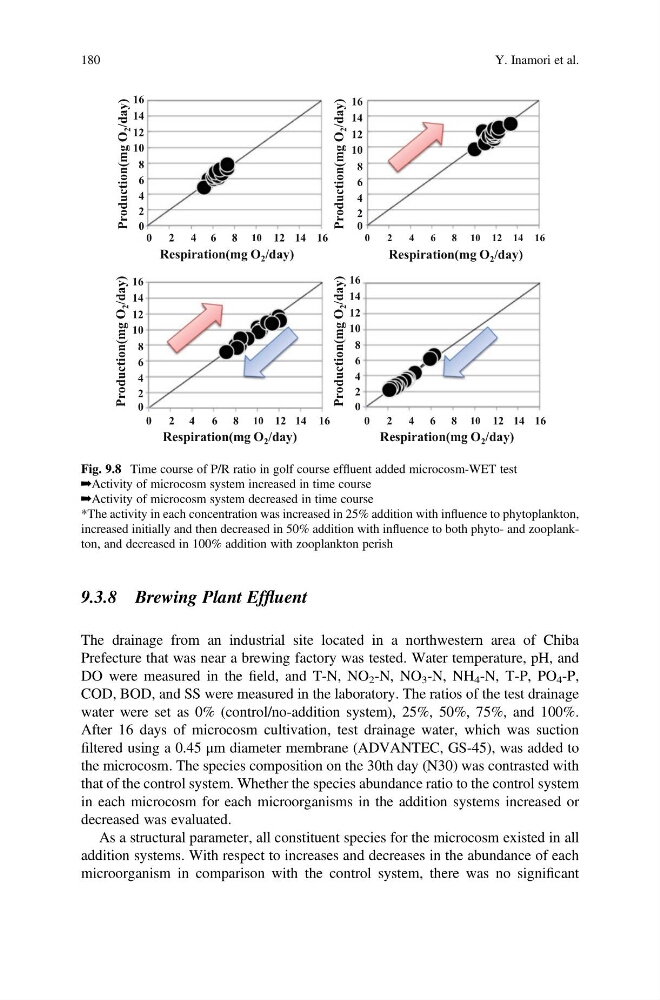
Fig. 9.8 Time course of P/R ratio in golf course effluent added microcosm-WET test
➡Activity of microcosm system increased in time course
➡Activity of microcosm system decreased in time course
*The activity in each concentration was increased in 25% addition with influence to phytoplankton,
increased initially and then decreased in 50% addition with influence to both phyto- and zooplankton, and decreased in 100% addition with zooplankton perish
180
Y. Inamori et al.
The drainage from an industrial site located in a northwestern area of Chiba
Prefecture that was near a brewing factory was tested. Water temperature, pH, and
DO were measured in the field, and T-N, NO 2 -N, NO 3 -N, NH 4 -N, T-P, PO 4 -P,
COD, BOD, and SS were measured in the laboratory. The ratios of the test drainage
water were set as 0% (control/no-addition system), 25%, 50%, 75%, and 100%.
After 16 days of microcosm cultivation, test drainage water, which was suction
filtered using a 0.45 μm diameter membrane (ADVANTEC, GS-45), was added to
the microcosm. The species composition on the 30th day (N30) was contrasted with
that of the control system. Whether the species abundance ratio to the control system
in each microcosm for each microorganisms in the addition systems increased or
decreased was evaluated.
As a structural parameter, all constituent species for the microcosm existed in all
addition systems. With respect to increases and decreases in the abundance of each
microorganism in comparison with the control system, there was no significant
Production(mg O
2 /day)
Respiration(mg O 2 /day)
16
14
12
10
8
4
2
0
6
0
2
4
6
8 10
16
12 14
Production(mg O
2 /day)
Respiration(mg O 2 /day)
16
14
12
10
8
4
2
0
6
0 2 4 6 8 10
16
12 14
Respiration(mg O 2 /day)
Production(mg O
2 /day)
16
14
12
10
8
4
2
0
6
0
2 4 6 8 10
16
12 14
Respiration(mg O 2 /day)
Production(mg O
2 /day)
16
14
12
10
8
4
2
0
6
0 2 4 6 8 10
16
12 14
Fig. 9.8 Time course of P/R ratio in golf course effluent added microcosm-WET test
➡Activity of microcosm system increased in time course
➡Activity of microcosm system decreased in time course
*The activity in each concentration was increased in 25% addition with influence to phytoplankton,
increased initially and then decreased in 50% addition with influence to both phyto- and zooplankton, and decreased in 100% addition with zooplankton perish
180
Y. Inamori et al.