

9.3.5 River Water Containing Germicides and Pesticides
River water that flowed after dispersion and was sampled for a day was targeted for
evaluation before spraying the insecticide, DEP 50%, and the sterilizer, tricyclazole
20%, over the rice field. An inorganic salt solution and 5 mg/L of polypeptone and
Taub’s basal medium was added to the river water, which was then filtered and
sterilized. An inorganic salt solution and 50 mg/L of polypeptone and Taub’s basal
medium were poured by 20 mL amounts into the experimental system. Finally, a
TP 50 nutrient medium was used for the control system, and the microcosm was
subcultured in a TP 50 nutrient medium with a microcosm seed at 2800 lux
(L/D ¼ 12 h/12 h), 25
C, without stirring.
In the river water before pesticide dispersion, an increase was seen in the bacteria
as in the control system until microcosm culturing began on the fourth day, but it
tended to decrease sharply after the seventh day. Additionally, with respect to the
producer, a notable increase was seen in the abundance of Chlorella sp. However, in
Tolypothrix sp., an increase in abundance was controlled, and, for the predators
Cyclidium glaucoma, Lecane sp., Philodina erythrophthalma, and Aeolosoma
hemprichi, survival was possible, but the increase in Aeolosoma hemprichi was
half that in the control system. Therefore, there were many things that dispersed, and
a patchy cluster was characteristic of this microcosm in which high predation activity
of Philodina erythrophthalma on Chlorella sp. was observed. The possibility that
even the river water before the pesticide dispersion had an influence on the microcosm ecosystem was thus suggested.
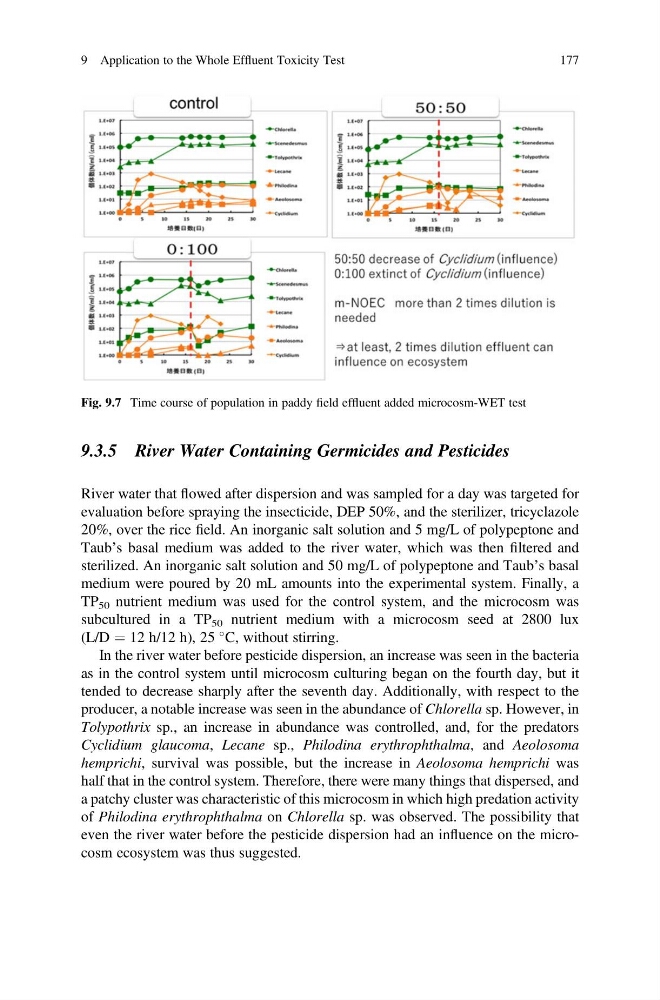
Fig. 9.7 Time course of population in paddy field effluent added microcosm-WET test
9 Application to the Whole Effluent Toxicity Test
177
River water that flowed after dispersion and was sampled for a day was targeted for
evaluation before spraying the insecticide, DEP 50%, and the sterilizer, tricyclazole
20%, over the rice field. An inorganic salt solution and 5 mg/L of polypeptone and
Taub’s basal medium was added to the river water, which was then filtered and
sterilized. An inorganic salt solution and 50 mg/L of polypeptone and Taub’s basal
medium were poured by 20 mL amounts into the experimental system. Finally, a
TP 50 nutrient medium was used for the control system, and the microcosm was
subcultured in a TP 50 nutrient medium with a microcosm seed at 2800 lux
(L/D ¼ 12 h/12 h), 25
C, without stirring.
In the river water before pesticide dispersion, an increase was seen in the bacteria
as in the control system until microcosm culturing began on the fourth day, but it
tended to decrease sharply after the seventh day. Additionally, with respect to the
producer, a notable increase was seen in the abundance of Chlorella sp. However, in
Tolypothrix sp., an increase in abundance was controlled, and, for the predators
Cyclidium glaucoma, Lecane sp., Philodina erythrophthalma, and Aeolosoma
hemprichi, survival was possible, but the increase in Aeolosoma hemprichi was
half that in the control system. Therefore, there were many things that dispersed, and
a patchy cluster was characteristic of this microcosm in which high predation activity
of Philodina erythrophthalma on Chlorella sp. was observed. The possibility that
even the river water before the pesticide dispersion had an influence on the microcosm ecosystem was thus suggested.
Fig. 9.7 Time course of population in paddy field effluent added microcosm-WET test
9 Application to the Whole Effluent Toxicity Test
177