

able to exist alone. It is therefore insufficient to evaluate the influence of added
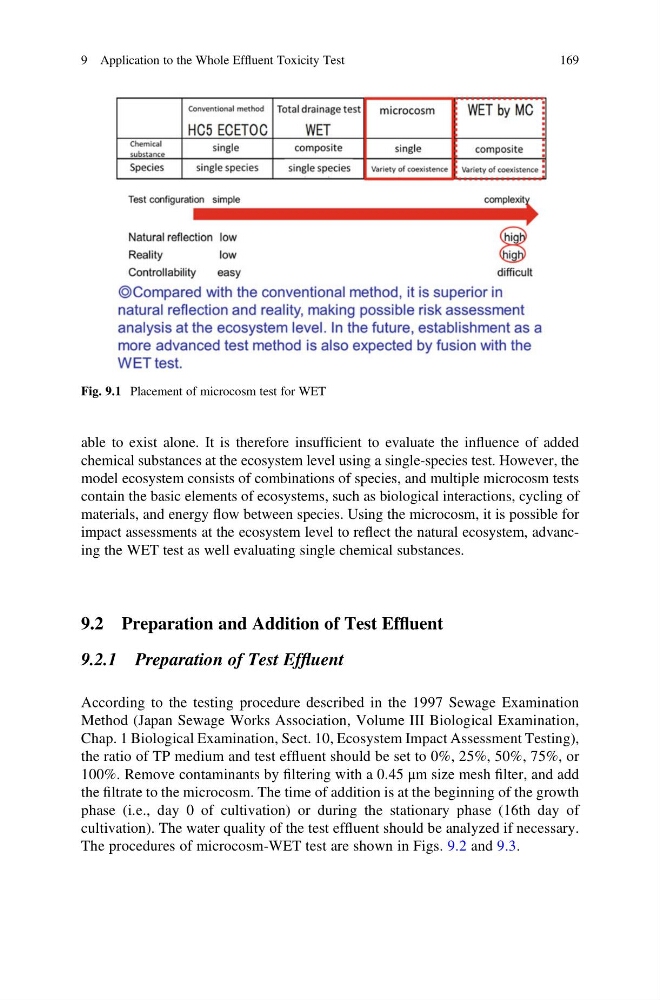
chemical substances at the ecosystem level using a single-species test. However, the
model ecosystem consists of combinations of species, and multiple microcosm tests
contain the basic elements of ecosystems, such as biological interactions, cycling of
materials, and energy flow between species. Using the microcosm, it is possible for
impact assessments at the ecosystem level to reflect the natural ecosystem, advancing the WET test as well evaluating single chemical substances.
9.2 Preparation and Addition of Test Effluent
9.2.1 Preparation of Test Effluent
According to the testing procedure described in the 1997 Sewage Examination
Method (Japan Sewage Works Association, Volume III Biological Examination,
Chap. 1 Biological Examination, Sect. 10, Ecosystem Impact Assessment Testing),
the ratio of TP medium and test effluent should be set to 0%, 25%, 50%, 75%, or
100%. Remove contaminants by filtering with a 0.45 μm size mesh filter, and add
the filtrate to the microcosm. The time of addition is at the beginning of the growth
phase (i.e., day 0 of cultivation) or during the stationary phase (16th day of
cultivation). The water quality of the test effluent should be analyzed if necessary.
The procedures of microcosm-WET test are shown in Figs. 9.2 and 9.3.
Fig. 9.1 Placement of microcosm test for WET
9 Application to the Whole Effluent Toxicity Test
169
chemical substances at the ecosystem level using a single-species test. However, the
model ecosystem consists of combinations of species, and multiple microcosm tests
contain the basic elements of ecosystems, such as biological interactions, cycling of
materials, and energy flow between species. Using the microcosm, it is possible for
impact assessments at the ecosystem level to reflect the natural ecosystem, advancing the WET test as well evaluating single chemical substances.
9.2 Preparation and Addition of Test Effluent
9.2.1 Preparation of Test Effluent
According to the testing procedure described in the 1997 Sewage Examination
Method (Japan Sewage Works Association, Volume III Biological Examination,
Chap. 1 Biological Examination, Sect. 10, Ecosystem Impact Assessment Testing),
the ratio of TP medium and test effluent should be set to 0%, 25%, 50%, 75%, or
100%. Remove contaminants by filtering with a 0.45 μm size mesh filter, and add
the filtrate to the microcosm. The time of addition is at the beginning of the growth
phase (i.e., day 0 of cultivation) or during the stationary phase (16th day of
cultivation). The water quality of the test effluent should be analyzed if necessary.
The procedures of microcosm-WET test are shown in Figs. 9.2 and 9.3.
Fig. 9.1 Placement of microcosm test for WET
9 Application to the Whole Effluent Toxicity Test
169