

result of the mass addition of Philodina erythrophthalma, the color of the culture
medium changed suddenly from light green to brown, and a brown solid accumulated at the bottom of the flask. Under microscopic observation, there were recognizable decolorized dead cells of Chlorella sp. Everywhere, and many were
observed as crumbling. This is due to the excretion of much Philodina
erythrophthalma which predated on Chlorella sp. At this point, both Philodina
erythrophthalma and Chlorella sp. became extinct, and only bacteria and
Tolypothrix sp. survived. As a result, in the flask with Philodina erythrophthalma
introduced as the top predator species, Chlorella sp. decreased its population density
by 45%, but Scenedesmus quadricauda did not. Although both Aeolosoma
hemprichi and Philodina erythrophthalma are top predators in the microcosm
N-system, Aeolosoma hemprichi is an aggregate feeder, while Philodina
erythrophthalma is a bacterial feeder. Therefore, the effect of the top predator’s
predation type contributes significantly to the ecosystem of the microcosm. The top
predator may keep down a proper population of microalga, and, in the case of top
predator introduction, a possibility that could ameliorate algal blooms was
demonstrated.
As a structural parameter, in either case, it is thought that the predator-prey
interaction was constructed equally in the control system, without being removed
from a system. The population of Philodina erythrophthalma slightly decreased in
either 1-times quantity or 10-times quantity additions to a system by the 30th day
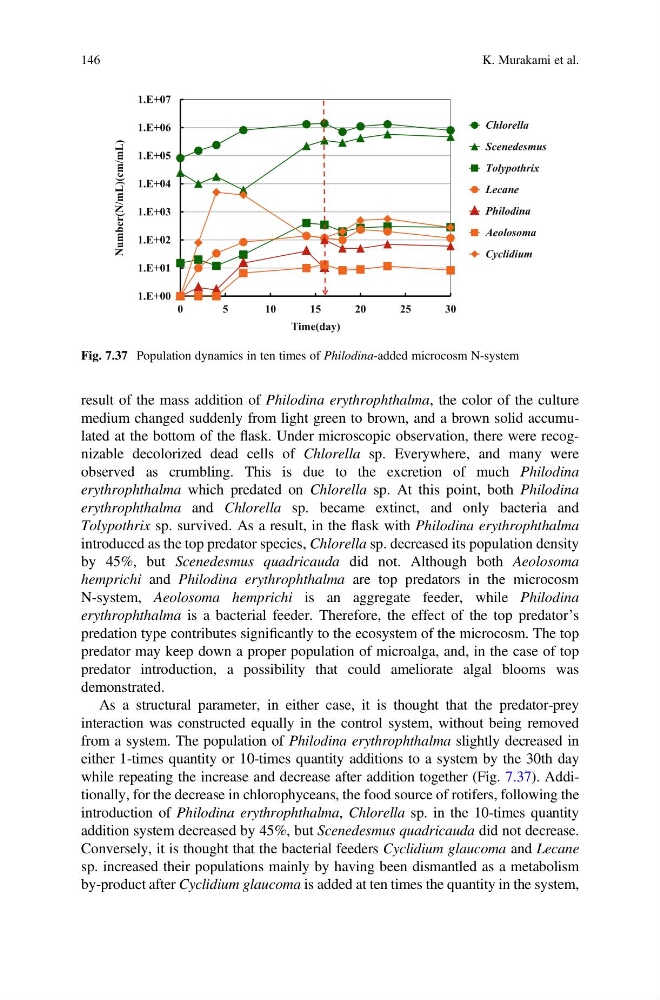
while repeating the increase and decrease after addition together (Fig. 7.37). Additionally, for the decrease in chlorophyceans, the food source of rotifers, following the
introduction of Philodina erythrophthalma, Chlorella sp. in the 10-times quantity
addition system decreased by 45%, but Scenedesmus quadricauda did not decrease.
Conversely, it is thought that the bacterial feeders Cyclidium glaucoma and Lecane
sp. increased their populations mainly by having been dismantled as a metabolism
by-product after Cyclidium glaucoma is added at ten times the quantity in the system,
1.E+00
1.E+01
1.E+02
1.E+03
1.E+04
1.E+05
1.E+06
1.E+07
0
5
10
15
20
25
30
Number(N/mL)(cm/mL)
Time(day)
Chlorella
Scenedesmus
Tolypothrix
Lecane
Philodina
Aeolosoma
Cyclidium
Fig. 7.37 Population dynamics in ten times of Philodina-added microcosm N-system
146
K. Murakami et al.
medium changed suddenly from light green to brown, and a brown solid accumulated at the bottom of the flask. Under microscopic observation, there were recognizable decolorized dead cells of Chlorella sp. Everywhere, and many were
observed as crumbling. This is due to the excretion of much Philodina
erythrophthalma which predated on Chlorella sp. At this point, both Philodina
erythrophthalma and Chlorella sp. became extinct, and only bacteria and
Tolypothrix sp. survived. As a result, in the flask with Philodina erythrophthalma
introduced as the top predator species, Chlorella sp. decreased its population density
by 45%, but Scenedesmus quadricauda did not. Although both Aeolosoma
hemprichi and Philodina erythrophthalma are top predators in the microcosm
N-system, Aeolosoma hemprichi is an aggregate feeder, while Philodina
erythrophthalma is a bacterial feeder. Therefore, the effect of the top predator’s
predation type contributes significantly to the ecosystem of the microcosm. The top
predator may keep down a proper population of microalga, and, in the case of top
predator introduction, a possibility that could ameliorate algal blooms was
demonstrated.
As a structural parameter, in either case, it is thought that the predator-prey
interaction was constructed equally in the control system, without being removed
from a system. The population of Philodina erythrophthalma slightly decreased in
either 1-times quantity or 10-times quantity additions to a system by the 30th day
while repeating the increase and decrease after addition together (Fig. 7.37). Additionally, for the decrease in chlorophyceans, the food source of rotifers, following the
introduction of Philodina erythrophthalma, Chlorella sp. in the 10-times quantity
addition system decreased by 45%, but Scenedesmus quadricauda did not decrease.
Conversely, it is thought that the bacterial feeders Cyclidium glaucoma and Lecane
sp. increased their populations mainly by having been dismantled as a metabolism
by-product after Cyclidium glaucoma is added at ten times the quantity in the system,
1.E+00
1.E+01
1.E+02
1.E+03
1.E+04
1.E+05
1.E+06
1.E+07
0
5
10
15
20
25
30
Number(N/mL)(cm/mL)
Time(day)
Chlorella
Scenedesmus
Tolypothrix
Lecane
Philodina
Aeolosoma
Cyclidium
Fig. 7.37 Population dynamics in ten times of Philodina-added microcosm N-system
146
K. Murakami et al.