

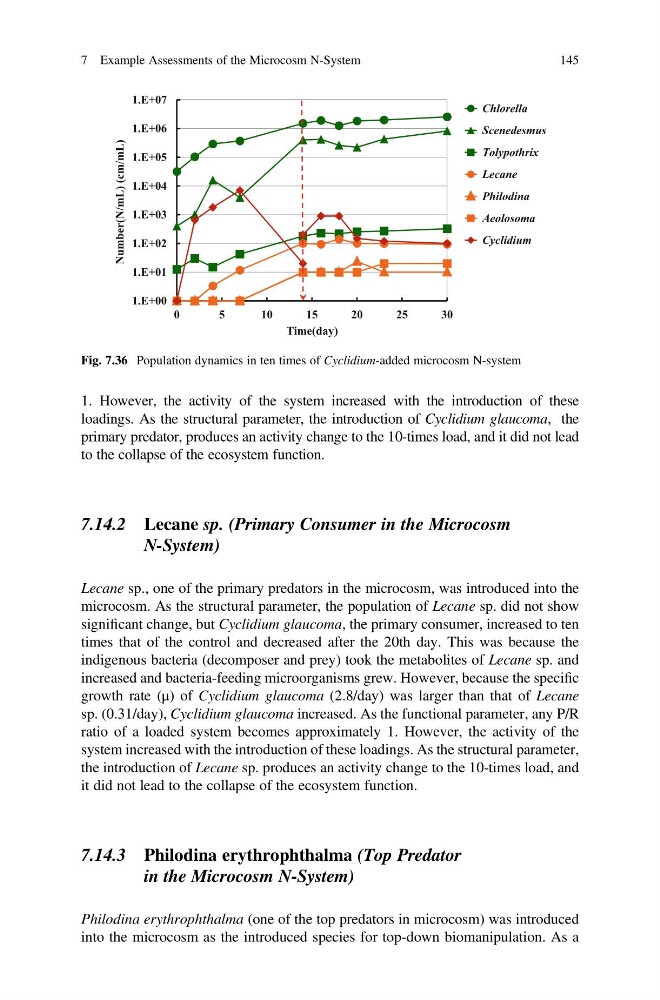
1. However, the activity of the system increased with the introduction of these
loadings. As the structural parameter, the introduction of Cyclidium glaucoma, the
primary predator, produces an activity change to the 10-times load, and it did not lead
to the collapse of the ecosystem function.
7.14.2 Lecane sp. (Primary Consumer in the Microcosm
N-System)
Lecane sp., one of the primary predators in the microcosm, was introduced into the
microcosm. As the structural parameter, the population of Lecane sp. did not show
significant change, but Cyclidium glaucoma, the primary consumer, increased to ten
times that of the control and decreased after the 20th day. This was because the
indigenous bacteria (decomposer and prey) took the metabolites of Lecane sp. and
increased and bacteria-feeding microorganisms grew. However, because the specific
growth rate (μ) of Cyclidium glaucoma (2.8/day) was larger than that of Lecane
sp. (0.31/day), Cyclidium glaucoma increased. As the functional parameter, any P/R
ratio of a loaded system becomes approximately 1. However, the activity of the
system increased with the introduction of these loadings. As the structural parameter,
the introduction of Lecane sp. produces an activity change to the 10-times load, and
it did not lead to the collapse of the ecosystem function.
7.14.3 Philodina erythrophthalma (Top Predator
in the Microcosm N-System)
Philodina erythrophthalma (one of the top predators in microcosm) was introduced
into the microcosm as the introduced species for top-down biomanipulation. As a
1.E+00
1.E+01
1.E+02
1.E+03
1.E+04
1.E+05
1.E+06
1.E+07
0
5
10
15
20
25
30
Number(N/mL) (cm/mL)
Time(day)
Chlorella
Scenedesmus
Tolypothrix
Lecane
Philodina
Aeolosoma
Cyclidium
Fig. 7.36 Population dynamics in ten times of Cyclidium-added microcosm N-system
7 Example Assessments of the Microcosm N-System
145
loadings. As the structural parameter, the introduction of Cyclidium glaucoma, the
primary predator, produces an activity change to the 10-times load, and it did not lead
to the collapse of the ecosystem function.
7.14.2 Lecane sp. (Primary Consumer in the Microcosm
N-System)
Lecane sp., one of the primary predators in the microcosm, was introduced into the
microcosm. As the structural parameter, the population of Lecane sp. did not show
significant change, but Cyclidium glaucoma, the primary consumer, increased to ten
times that of the control and decreased after the 20th day. This was because the
indigenous bacteria (decomposer and prey) took the metabolites of Lecane sp. and
increased and bacteria-feeding microorganisms grew. However, because the specific
growth rate (μ) of Cyclidium glaucoma (2.8/day) was larger than that of Lecane
sp. (0.31/day), Cyclidium glaucoma increased. As the functional parameter, any P/R
ratio of a loaded system becomes approximately 1. However, the activity of the
system increased with the introduction of these loadings. As the structural parameter,
the introduction of Lecane sp. produces an activity change to the 10-times load, and
it did not lead to the collapse of the ecosystem function.
7.14.3 Philodina erythrophthalma (Top Predator
in the Microcosm N-System)
Philodina erythrophthalma (one of the top predators in microcosm) was introduced
into the microcosm as the introduced species for top-down biomanipulation. As a
1.E+00
1.E+01
1.E+02
1.E+03
1.E+04
1.E+05
1.E+06
1.E+07
0
5
10
15
20
25
30
Number(N/mL) (cm/mL)
Time(day)
Chlorella
Scenedesmus
Tolypothrix
Lecane
Philodina
Aeolosoma
Cyclidium
Fig. 7.36 Population dynamics in ten times of Cyclidium-added microcosm N-system
7 Example Assessments of the Microcosm N-System
145