

with Bacillus cereus as one of the indigenous bacteria additions, all species of
microorganisms increased in abundance. From an estimation of B 16–30 , all microorganisms increased similarly to N 30 . In the case of the Escherichia coli addition, the
trends of N 30 and B 16–30 were almost the same as in the case of the Bacillus cereus
addition. In addition, from the attenuation patterns of other foreign bacteria as
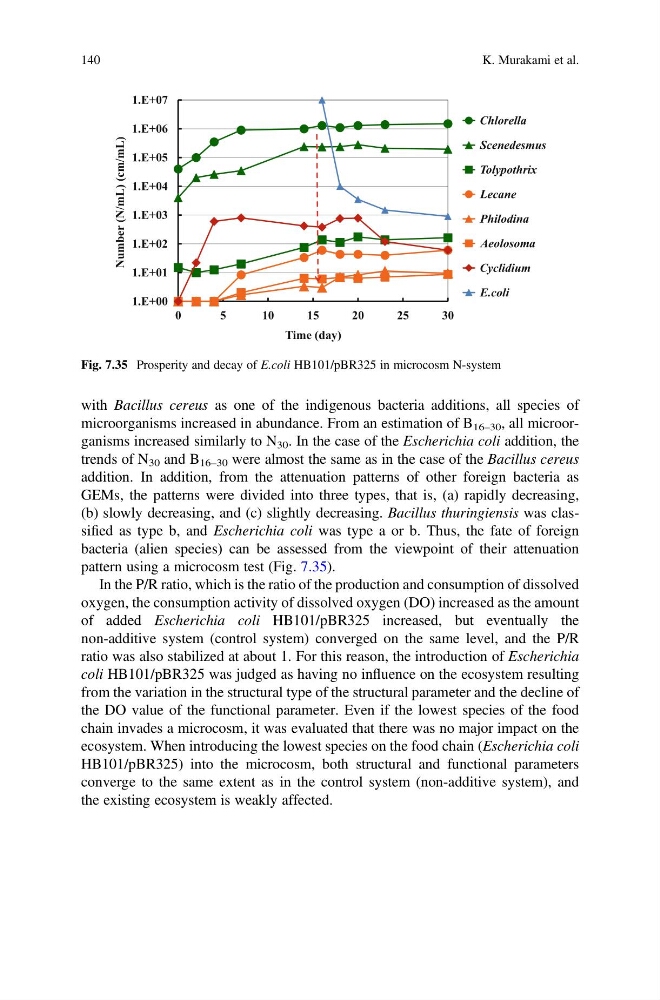
GEMs, the patterns were divided into three types, that is, (a) rapidly decreasing,
(b) slowly decreasing, and (c) slightly decreasing. Bacillus thuringiensis was classified as type b, and Escherichia coli was type a or b. Thus, the fate of foreign
bacteria (alien species) can be assessed from the viewpoint of their attenuation
pattern using a microcosm test (Fig. 7.35).
In the P/R ratio, which is the ratio of the production and consumption of dissolved
oxygen, the consumption activity of dissolved oxygen (DO) increased as the amount
of added Escherichia coli HB101/pBR325 increased, but eventually the
non-additive system (control system) converged on the same level, and the P/R
ratio was also stabilized at about 1. For this reason, the introduction of Escherichia
coli HB101/pBR325 was judged as having no influence on the ecosystem resulting
from the variation in the structural type of the structural parameter and the decline of
the DO value of the functional parameter. Even if the lowest species of the food
chain invades a microcosm, it was evaluated that there was no major impact on the
ecosystem. When introducing the lowest species on the food chain (Escherichia coli
HB101/pBR325) into the microcosm, both structural and functional parameters
converge to the same extent as in the control system (non-additive system), and
the existing ecosystem is weakly affected.
1.E+00
1.E+01
1.E+02
1.E+03
1.E+04
1.E+05
1.E+06
1.E+07
0
5
10
15
20
25
30
Number (N/mL) (cm/mL)
Time (day)
Chlorella
Scenedesmus
Tolypothrix
Lecane
Philodina
Aeolosoma
Cyclidium
E.coli
Fig. 7.35 Prosperity and decay of E.coli HB101/pBR325 in microcosm N-system
140
K. Murakami et al.
microorganisms increased in abundance. From an estimation of B 16–30 , all microorganisms increased similarly to N 30 . In the case of the Escherichia coli addition, the
trends of N 30 and B 16–30 were almost the same as in the case of the Bacillus cereus
addition. In addition, from the attenuation patterns of other foreign bacteria as
GEMs, the patterns were divided into three types, that is, (a) rapidly decreasing,
(b) slowly decreasing, and (c) slightly decreasing. Bacillus thuringiensis was classified as type b, and Escherichia coli was type a or b. Thus, the fate of foreign
bacteria (alien species) can be assessed from the viewpoint of their attenuation
pattern using a microcosm test (Fig. 7.35).
In the P/R ratio, which is the ratio of the production and consumption of dissolved
oxygen, the consumption activity of dissolved oxygen (DO) increased as the amount
of added Escherichia coli HB101/pBR325 increased, but eventually the
non-additive system (control system) converged on the same level, and the P/R
ratio was also stabilized at about 1. For this reason, the introduction of Escherichia
coli HB101/pBR325 was judged as having no influence on the ecosystem resulting
from the variation in the structural type of the structural parameter and the decline of
the DO value of the functional parameter. Even if the lowest species of the food
chain invades a microcosm, it was evaluated that there was no major impact on the
ecosystem. When introducing the lowest species on the food chain (Escherichia coli
HB101/pBR325) into the microcosm, both structural and functional parameters
converge to the same extent as in the control system (non-additive system), and
the existing ecosystem is weakly affected.
1.E+00
1.E+01
1.E+02
1.E+03
1.E+04
1.E+05
1.E+06
1.E+07
0
5
10
15
20
25
30
Number (N/mL) (cm/mL)
Time (day)
Chlorella
Scenedesmus
Tolypothrix
Lecane
Philodina
Aeolosoma
Cyclidium
E.coli
Fig. 7.35 Prosperity and decay of E.coli HB101/pBR325 in microcosm N-system
140
K. Murakami et al.