

Male
1. Testis one, reflexed.
2. Spicules paired, separate, and slightly curved ventrally. Spicule
head short, offset from lamina by a constriction.
3. Gubernaculum usually about half as long as spicule length.
4. Bursa peloderan with nine pairs of genital papillae.
Infective Juvenile
1. Third-stage infective juvenile (IJ) usually with sheath (cuticle of
second-stage juvenile). Sheath with anterior tessellate arrangement and longitudinal ridges.
2. IJ cuticle striated with one even band marginated by two edges
in lateral fields.
3. Head with prominent dorsal tooth. Mouth and anus closed.
4. Stoma seeming as a closed chamber with parallel walls.
5. Esophagus and intestine condensed.
6. Excretory pore posterior to nerve ring. Symbiotic bacterial cells
found in intestine.
7. Tail pointed.
Identification
of Heterorhabditis Species
After a Heterorhabditis species is recognized using the following
key, the identity should be confirmed by associating its morphometrics with the data from original descriptions.
Ratios and abbreviations used in the following key are:
IJ ¼ infective juvenile.
EP ¼ distance from anterior end to excretory pore.
T ¼ Tail length.
E% ¼ EP/T Â 100.
GS% ¼ gubernaculum length divided by spicule length  100.
μm ¼ micrometers.
Key to Species
of the Genus
Heterorhabditis (Fig. 13)
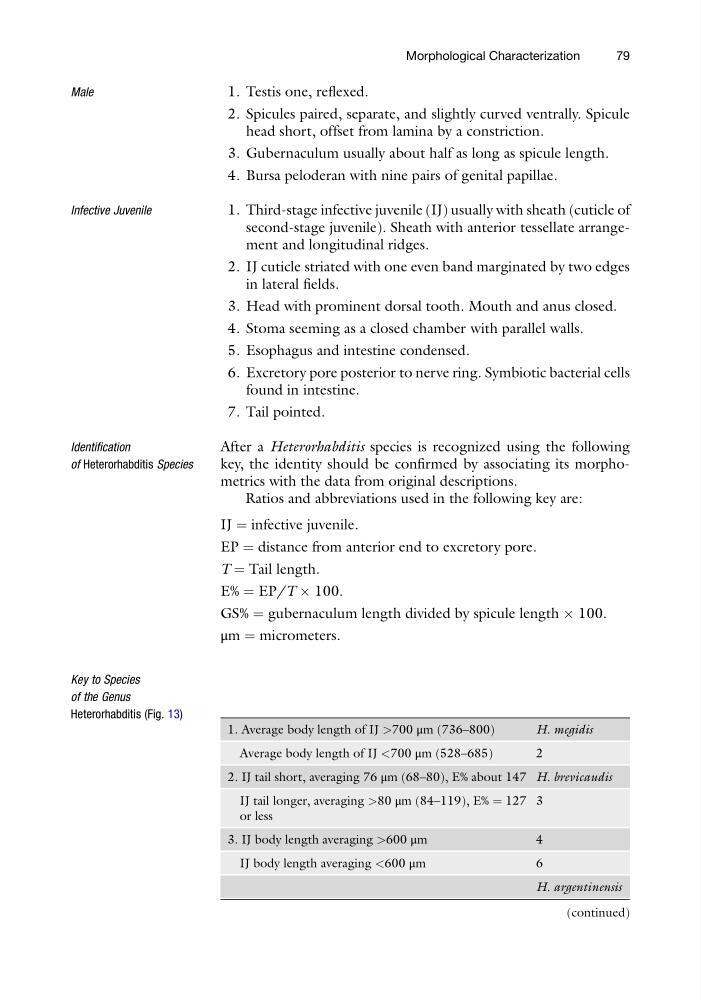
1. Average body length of IJ >700 μm (736–800)
H. megidis
Average body length of IJ <700 μm (528–685)
2
2. IJ tail short, averaging 76 μm (68–80), E% about 147 H. brevicaudis
IJ tail longer, averaging >80 μm (84–119), E% ¼ 127
or less
3
3. IJ body length averaging >600 μm
4
IJ body length averaging <600 μm
6
H. argentinensis
(continued)
Morphological Characterization
79
1. Testis one, reflexed.
2. Spicules paired, separate, and slightly curved ventrally. Spicule
head short, offset from lamina by a constriction.
3. Gubernaculum usually about half as long as spicule length.
4. Bursa peloderan with nine pairs of genital papillae.
Infective Juvenile
1. Third-stage infective juvenile (IJ) usually with sheath (cuticle of
second-stage juvenile). Sheath with anterior tessellate arrangement and longitudinal ridges.
2. IJ cuticle striated with one even band marginated by two edges
in lateral fields.
3. Head with prominent dorsal tooth. Mouth and anus closed.
4. Stoma seeming as a closed chamber with parallel walls.
5. Esophagus and intestine condensed.
6. Excretory pore posterior to nerve ring. Symbiotic bacterial cells
found in intestine.
7. Tail pointed.
Identification
of Heterorhabditis Species
After a Heterorhabditis species is recognized using the following
key, the identity should be confirmed by associating its morphometrics with the data from original descriptions.
Ratios and abbreviations used in the following key are:
IJ ¼ infective juvenile.
EP ¼ distance from anterior end to excretory pore.
T ¼ Tail length.
E% ¼ EP/T Â 100.
GS% ¼ gubernaculum length divided by spicule length  100.
μm ¼ micrometers.
Key to Species
of the Genus
Heterorhabditis (Fig. 13)
1. Average body length of IJ >700 μm (736–800)
H. megidis
Average body length of IJ <700 μm (528–685)
2
2. IJ tail short, averaging 76 μm (68–80), E% about 147 H. brevicaudis
IJ tail longer, averaging >80 μm (84–119), E% ¼ 127
or less
3
3. IJ body length averaging >600 μm
4
IJ body length averaging <600 μm
6
H. argentinensis
(continued)
Morphological Characterization
79