

elevated structures are sometimes visible at the base of each lip;
amphidial opening small.
3. Stoma wide but shallow; cheilorhabdions exist, forming a ring,
in lateral view resembling two refractile dots.
4. Other parts of the stoma fused to form a collapsed posterior
portion. Posterior part of stoma enclosed by esophagus.
5. Esophagus without metacorpus; isthmus slender; basal bulb
swollen; valve in basal bulb reduced.
6. Nerve ring at the center of isthmus.
7. Excretory pore generally posterior to end of esophagus.
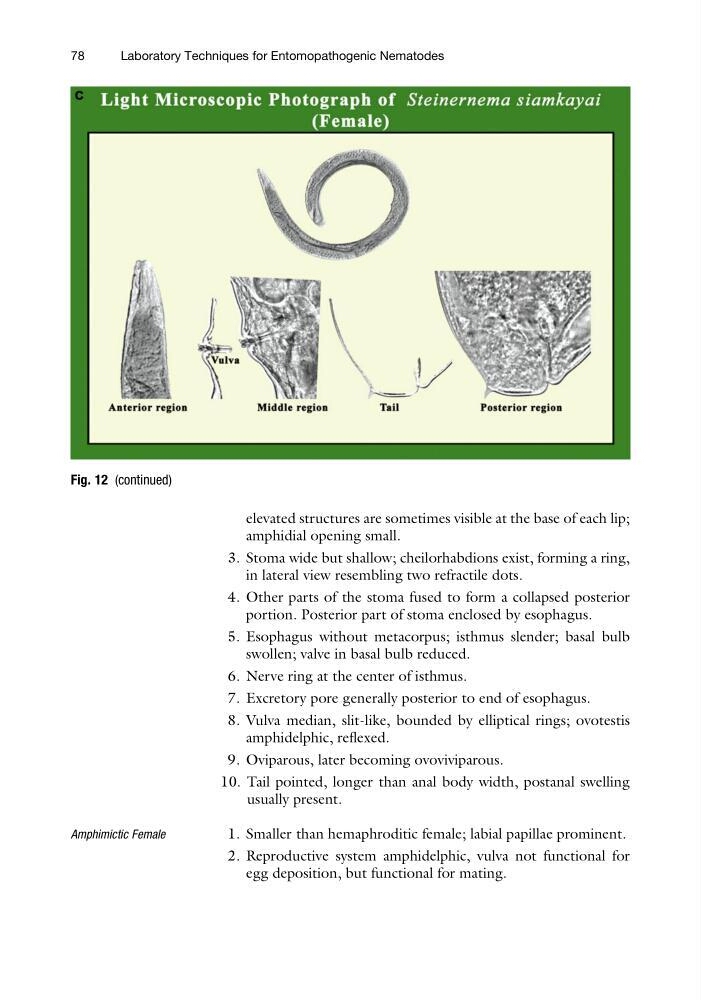
8. Vulva median, slit-like, bounded by elliptical rings; ovotestis
amphidelphic, reflexed.
9. Oviparous, later becoming ovoviviparous.
10. Tail pointed, longer than anal body width, postanal swelling
usually present.
Amphimictic Female
1. Smaller than hemaphroditic female; labial papillae prominent.
2. Reproductive system amphidelphic, vulva not functional for
egg deposition, but functional for mating.
Fig. 12 (continued)
78
Laboratory Techniques for Entomopathogenic Nematodes
amphidial opening small.
3. Stoma wide but shallow; cheilorhabdions exist, forming a ring,
in lateral view resembling two refractile dots.
4. Other parts of the stoma fused to form a collapsed posterior
portion. Posterior part of stoma enclosed by esophagus.
5. Esophagus without metacorpus; isthmus slender; basal bulb
swollen; valve in basal bulb reduced.
6. Nerve ring at the center of isthmus.
7. Excretory pore generally posterior to end of esophagus.
8. Vulva median, slit-like, bounded by elliptical rings; ovotestis
amphidelphic, reflexed.
9. Oviparous, later becoming ovoviviparous.
10. Tail pointed, longer than anal body width, postanal swelling
usually present.
Amphimictic Female
1. Smaller than hemaphroditic female; labial papillae prominent.
2. Reproductive system amphidelphic, vulva not functional for
egg deposition, but functional for mating.
Fig. 12 (continued)
78
Laboratory Techniques for Entomopathogenic Nematodes