

the soil particles. Rhizosphere soil around small roots of plants and
root hair is a mainly abundant habitat for many forms of
nematodes.
2.2 Soil Sampling
Approach
2.2.1 Random Sampling
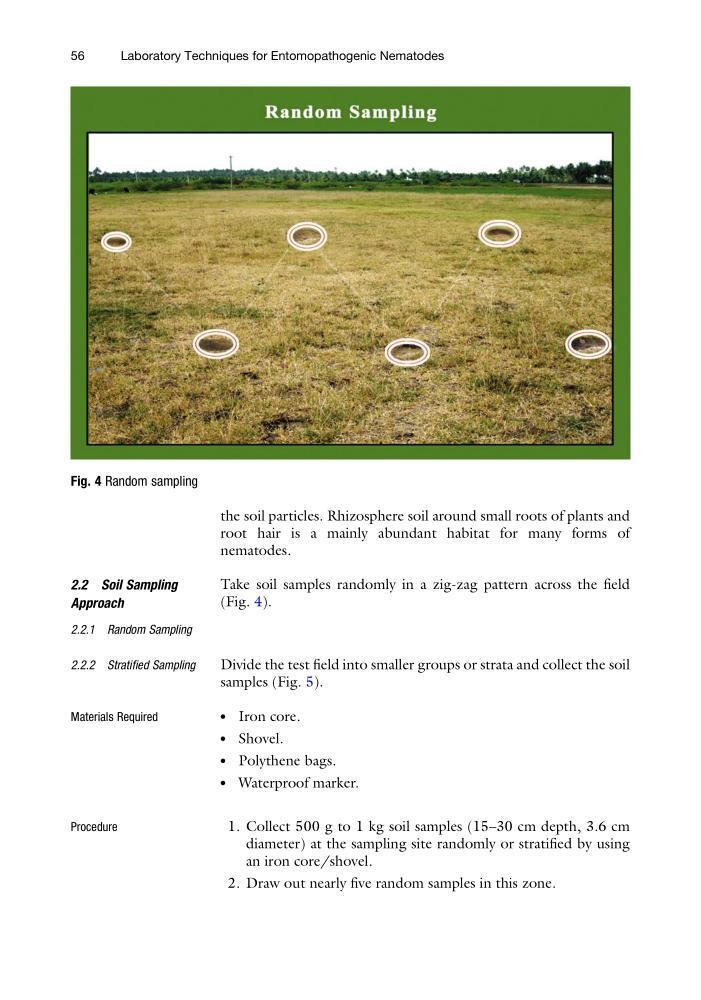
Take soil samples randomly in a zig-zag pattern across the field
(Fig. 4).
2.2.2 Stratified Sampling
Divide the test field into smaller groups or strata and collect the soil
samples (Fig. 5).
Materials Required
l
Iron core.
l
Shovel.
l
Polythene bags.
l
Waterproof marker.
Procedure
1. Collect 500 g to 1 kg soil samples (15–30 cm depth, 3.6 cm
diameter) at the sampling site randomly or stratified by using
an iron core/shovel.
2. Draw out nearly five random samples in this zone.
Fig. 4 Random sampling
56
Laboratory Techniques for Entomopathogenic Nematodes
root hair is a mainly abundant habitat for many forms of
nematodes.
2.2 Soil Sampling
Approach
2.2.1 Random Sampling
Take soil samples randomly in a zig-zag pattern across the field
(Fig. 4).
2.2.2 Stratified Sampling
Divide the test field into smaller groups or strata and collect the soil
samples (Fig. 5).
Materials Required
l
Iron core.
l
Shovel.
l
Polythene bags.
l
Waterproof marker.
Procedure
1. Collect 500 g to 1 kg soil samples (15–30 cm depth, 3.6 cm
diameter) at the sampling site randomly or stratified by using
an iron core/shovel.
2. Draw out nearly five random samples in this zone.
Fig. 4 Random sampling
56
Laboratory Techniques for Entomopathogenic Nematodes