

7. Use the fifth or late instar larvae for experimental studies,
otherwise they will undergo the pupa stage.
8. Place the pupa in the plastic containers comprising pleated wax
paper, which serves as an oviposition spot for the female moths.
9. The moths start laying eggs after 3–5 days of their emergence
and usually have a typical life span of 1–2 weeks at 26
C.
10. Remove eggs periodically from the paper with a razor blade
and allocate them to a plastic container.
Note:
(a) Clean the hands with disinfectant solution or alcohol to avoid
contamination.
(b) Wipe all the surface area of the plastic tray using ethanol.
(c) Galleria are easily susceptible to bacterial and fungal infection,
so culture with more attention.
(d) Change of diet during third or fourth instars of Galleria is
important.
(e) Overcrowd leads to dead and decay of larvae, this will affect
other normal larvae.
(f) Remove any dead larvae during rearing with sterilized forceps.
(g) Modify the plastic containers by introducing mesh screen into
the lid to enable air and heat exchange, with the purpose of
avoiding condensation.
1.2 Rearing
of Tenebrio molitor
(Mealworm)
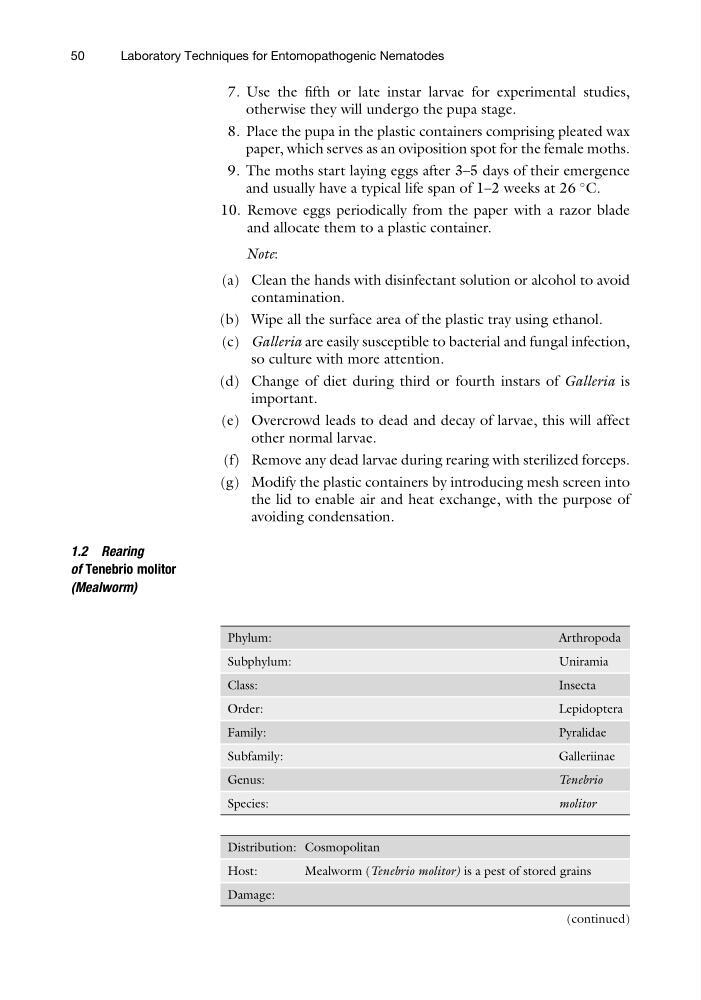
Phylum:
Arthropoda
Subphylum:
Uniramia
Class:
Insecta
Order:
Lepidoptera
Family:
Pyralidae
Subfamily:
Galleriinae
Genus:
Tenebrio
Species:
molitor
Distribution: Cosmopolitan
Host:
Mealworm (Tenebrio molitor) is a pest of stored grains
Damage:
(continued)
50
Laboratory Techniques for Entomopathogenic Nematodes
otherwise they will undergo the pupa stage.
8. Place the pupa in the plastic containers comprising pleated wax
paper, which serves as an oviposition spot for the female moths.
9. The moths start laying eggs after 3–5 days of their emergence
and usually have a typical life span of 1–2 weeks at 26
C.
10. Remove eggs periodically from the paper with a razor blade
and allocate them to a plastic container.
Note:
(a) Clean the hands with disinfectant solution or alcohol to avoid
contamination.
(b) Wipe all the surface area of the plastic tray using ethanol.
(c) Galleria are easily susceptible to bacterial and fungal infection,
so culture with more attention.
(d) Change of diet during third or fourth instars of Galleria is
important.
(e) Overcrowd leads to dead and decay of larvae, this will affect
other normal larvae.
(f) Remove any dead larvae during rearing with sterilized forceps.
(g) Modify the plastic containers by introducing mesh screen into
the lid to enable air and heat exchange, with the purpose of
avoiding condensation.
1.2 Rearing
of Tenebrio molitor
(Mealworm)
Phylum:
Arthropoda
Subphylum:
Uniramia
Class:
Insecta
Order:
Lepidoptera
Family:
Pyralidae
Subfamily:
Galleriinae
Genus:
Tenebrio
Species:
molitor
Distribution: Cosmopolitan
Host:
Mealworm (Tenebrio molitor) is a pest of stored grains
Damage:
(continued)
50
Laboratory Techniques for Entomopathogenic Nematodes