

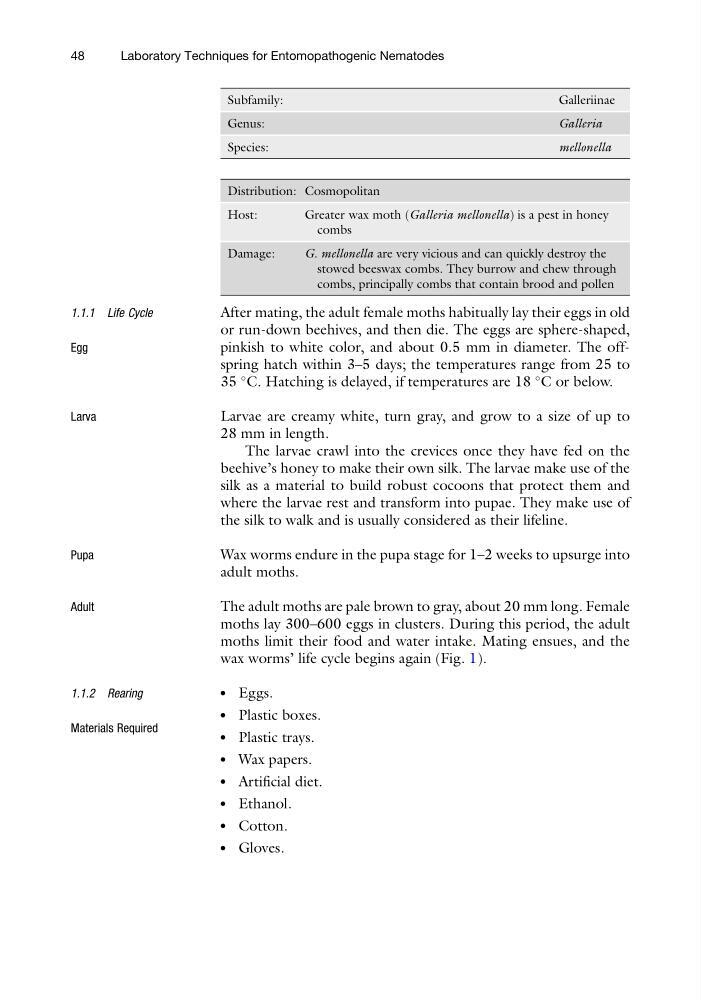
Subfamily:
Galleriinae
Genus:
Galleria
Species:
mellonella
Distribution: Cosmopolitan
Host:
Greater wax moth (Galleria mellonella) is a pest in honey
combs
Damage:
G. mellonella are very vicious and can quickly destroy the
stowed beeswax combs. They burrow and chew through
combs, principally combs that contain brood and pollen
1.1.1 Life Cycle
Egg
After mating, the adult female moths habitually lay their eggs in old
or run-down beehives, and then die. The eggs are sphere-shaped,
pinkish to white color, and about 0.5 mm in diameter. The offspring hatch within 3–5 days; the temperatures range from 25 to
35
C. Hatching is delayed, if temperatures are 18
C or below.
Larva
Larvae are creamy white, turn gray, and grow to a size of up to
28 mm in length.
The larvae crawl into the crevices once they have fed on the
beehive’s honey to make their own silk. The larvae make use of the
silk as a material to build robust cocoons that protect them and
where the larvae rest and transform into pupae. They make use of
the silk to walk and is usually considered as their lifeline.
Pupa
Wax worms endure in the pupa stage for 1–2 weeks to upsurge into
adult moths.
Adult
The adult moths are pale brown to gray, about 20 mm long. Female
moths lay 300–600 eggs in clusters. During this period, the adult
moths limit their food and water intake. Mating ensues, and the
wax worms’ life cycle begins again (Fig. 1).
1.1.2 Rearing
Materials Required
l
Eggs.
l
Plastic boxes.
l
Plastic trays.
l
Wax papers.
l
Artificial diet.
l
Ethanol.
l
Cotton.
l
Gloves.
48
Laboratory Techniques for Entomopathogenic Nematodes
Galleriinae
Genus:
Galleria
Species:
mellonella
Distribution: Cosmopolitan
Host:
Greater wax moth (Galleria mellonella) is a pest in honey
combs
Damage:
G. mellonella are very vicious and can quickly destroy the
stowed beeswax combs. They burrow and chew through
combs, principally combs that contain brood and pollen
1.1.1 Life Cycle
Egg
After mating, the adult female moths habitually lay their eggs in old
or run-down beehives, and then die. The eggs are sphere-shaped,
pinkish to white color, and about 0.5 mm in diameter. The offspring hatch within 3–5 days; the temperatures range from 25 to
35
C. Hatching is delayed, if temperatures are 18
C or below.
Larva
Larvae are creamy white, turn gray, and grow to a size of up to
28 mm in length.
The larvae crawl into the crevices once they have fed on the
beehive’s honey to make their own silk. The larvae make use of the
silk as a material to build robust cocoons that protect them and
where the larvae rest and transform into pupae. They make use of
the silk to walk and is usually considered as their lifeline.
Pupa
Wax worms endure in the pupa stage for 1–2 weeks to upsurge into
adult moths.
Adult
The adult moths are pale brown to gray, about 20 mm long. Female
moths lay 300–600 eggs in clusters. During this period, the adult
moths limit their food and water intake. Mating ensues, and the
wax worms’ life cycle begins again (Fig. 1).
1.1.2 Rearing
Materials Required
l
Eggs.
l
Plastic boxes.
l
Plastic trays.
l
Wax papers.
l
Artificial diet.
l
Ethanol.
l
Cotton.
l
Gloves.
48
Laboratory Techniques for Entomopathogenic Nematodes