

unconstrained from disrupted cells is precipitated by cold absolute
ethanol or isopropanol.
4.1.1 Materials Required
l
Culture: Xenorhabdus/Photorhabdus symbiotic bacteria culture
(1 ml).
l
Chemicals: For culture, nutrient broth/Luria broth.
l
Chemicals: For DNA isolation, Tris–HCl, EDTA, NaOH, SDS,
sodium acetate, phenol–chloroform mixture, proteinase K, isopropanol, ethanol.
l
Instruments: Autoclave, centrifuge, laminar air flow (LAF)
chamber, refrigerator, gel documentation electrophoresis unit.
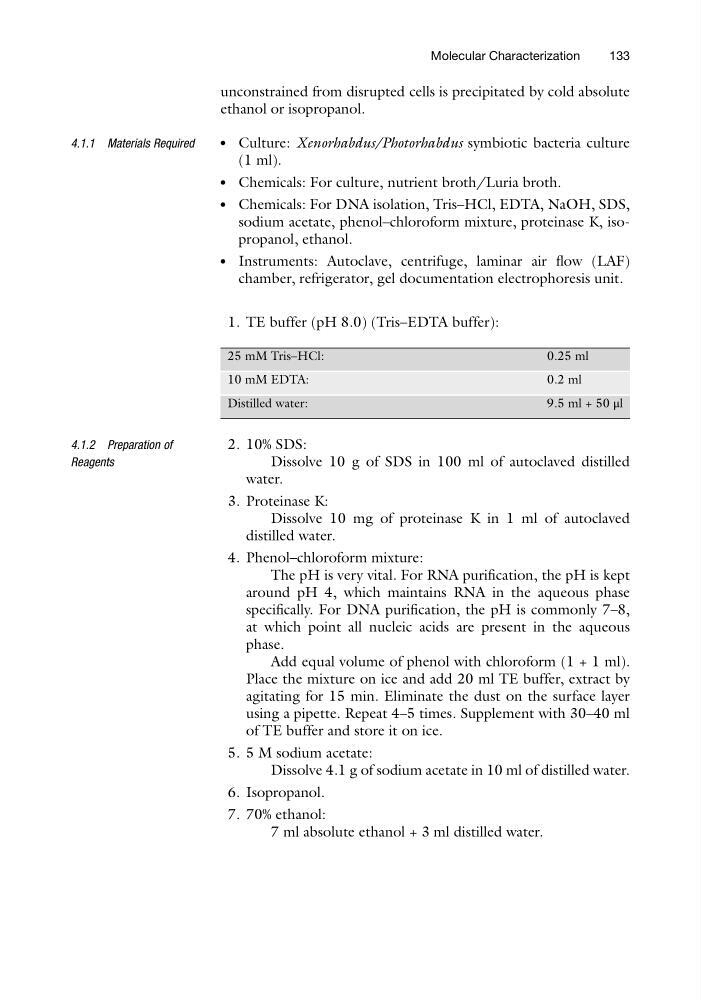
1. TE buffer (pH 8.0) (Tris–EDTA buffer):
4.1.2 Preparation of
Reagents
2. 10% SDS:
Dissolve 10 g of SDS in 100 ml of autoclaved distilled
water.
3. Proteinase K:
Dissolve 10 mg of proteinase K in 1 ml of autoclaved
distilled water.
4. Phenol–chloroform mixture:
The pH is very vital. For RNA purification, the pH is kept
around pH 4, which maintains RNA in the aqueous phase
specifically. For DNA purification, the pH is commonly 7–8,
at which point all nucleic acids are present in the aqueous
phase.
Add equal volume of phenol with chloroform (1 + 1 ml).
Place the mixture on ice and add 20 ml TE buffer, extract by
agitating for 15 min. Eliminate the dust on the surface layer
using a pipette. Repeat 4–5 times. Supplement with 30–40 ml
of TE buffer and store it on ice.
5. 5 M sodium acetate:
Dissolve 4.1 g of sodium acetate in 10 ml of distilled water.
6. Isopropanol.
7. 70% ethanol:
7 ml absolute ethanol + 3 ml distilled water.
25 mM Tris–HCl:
0.25 ml
10 mM EDTA:
0.2 ml
Distilled water:
9.5 ml + 50 μl
Molecular Characterization
133
ethanol or isopropanol.
4.1.1 Materials Required
l
Culture: Xenorhabdus/Photorhabdus symbiotic bacteria culture
(1 ml).
l
Chemicals: For culture, nutrient broth/Luria broth.
l
Chemicals: For DNA isolation, Tris–HCl, EDTA, NaOH, SDS,
sodium acetate, phenol–chloroform mixture, proteinase K, isopropanol, ethanol.
l
Instruments: Autoclave, centrifuge, laminar air flow (LAF)
chamber, refrigerator, gel documentation electrophoresis unit.
1. TE buffer (pH 8.0) (Tris–EDTA buffer):
4.1.2 Preparation of
Reagents
2. 10% SDS:
Dissolve 10 g of SDS in 100 ml of autoclaved distilled
water.
3. Proteinase K:
Dissolve 10 mg of proteinase K in 1 ml of autoclaved
distilled water.
4. Phenol–chloroform mixture:
The pH is very vital. For RNA purification, the pH is kept
around pH 4, which maintains RNA in the aqueous phase
specifically. For DNA purification, the pH is commonly 7–8,
at which point all nucleic acids are present in the aqueous
phase.
Add equal volume of phenol with chloroform (1 + 1 ml).
Place the mixture on ice and add 20 ml TE buffer, extract by
agitating for 15 min. Eliminate the dust on the surface layer
using a pipette. Repeat 4–5 times. Supplement with 30–40 ml
of TE buffer and store it on ice.
5. 5 M sodium acetate:
Dissolve 4.1 g of sodium acetate in 10 ml of distilled water.
6. Isopropanol.
7. 70% ethanol:
7 ml absolute ethanol + 3 ml distilled water.
25 mM Tris–HCl:
0.25 ml
10 mM EDTA:
0.2 ml
Distilled water:
9.5 ml + 50 μl
Molecular Characterization
133