

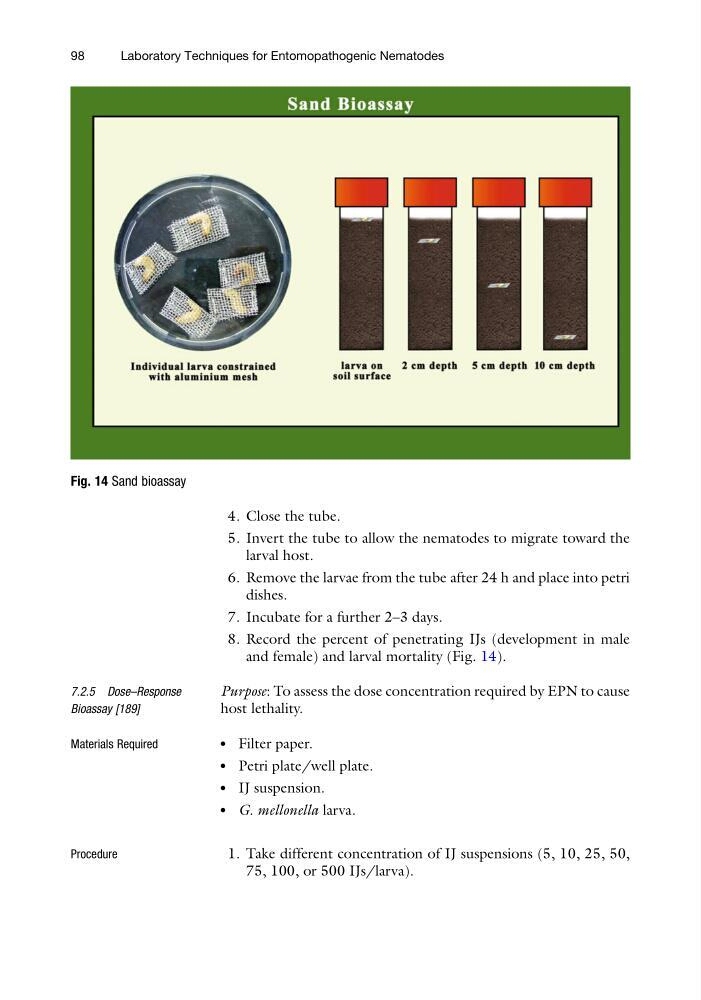
4. Close the tube.
5. Invert the tube to allow the nematodes to migrate toward the
larval host.
6. Remove the larvae from the tube after 24 h and place into petri
dishes.
7. Incubate for a further 2–3 days.
8. Record the percent of penetrating IJs (development in male
and female) and larval mortality (Fig. 14).
7.2.5 Dose–Response
Bioassay [189]
Purpose: To assess the dose concentration required by EPN to cause
host lethality.
Materials Required
l
Filter paper.
l
Petri plate/well plate.
l
IJ suspension.
l
G. mellonella larva.
Procedure
1. Take different concentration of IJ suspensions (5, 10, 25, 50,
75, 100, or 500 IJs/larva).
Fig. 14 Sand bioassay
98
Laboratory Techniques for Entomopathogenic Nematodes
5. Invert the tube to allow the nematodes to migrate toward the
larval host.
6. Remove the larvae from the tube after 24 h and place into petri
dishes.
7. Incubate for a further 2–3 days.
8. Record the percent of penetrating IJs (development in male
and female) and larval mortality (Fig. 14).
7.2.5 Dose–Response
Bioassay [189]
Purpose: To assess the dose concentration required by EPN to cause
host lethality.
Materials Required
l
Filter paper.
l
Petri plate/well plate.
l
IJ suspension.
l
G. mellonella larva.
Procedure
1. Take different concentration of IJ suspensions (5, 10, 25, 50,
75, 100, or 500 IJs/larva).
Fig. 14 Sand bioassay
98
Laboratory Techniques for Entomopathogenic Nematodes