

digestate. So the digester completely digests the raw material and the digested slurry
is collected for further uses. The time required when the biomass stayed inside the
digester is known as retention time.
The retention time depends on raw material and the temperature. This type of
digester can be stopped in case of sludge removal (undigested biomass residue);
otherwise it is operated continuously. The continuous flow digesters are also divided
into two basic models (Khan 2009).
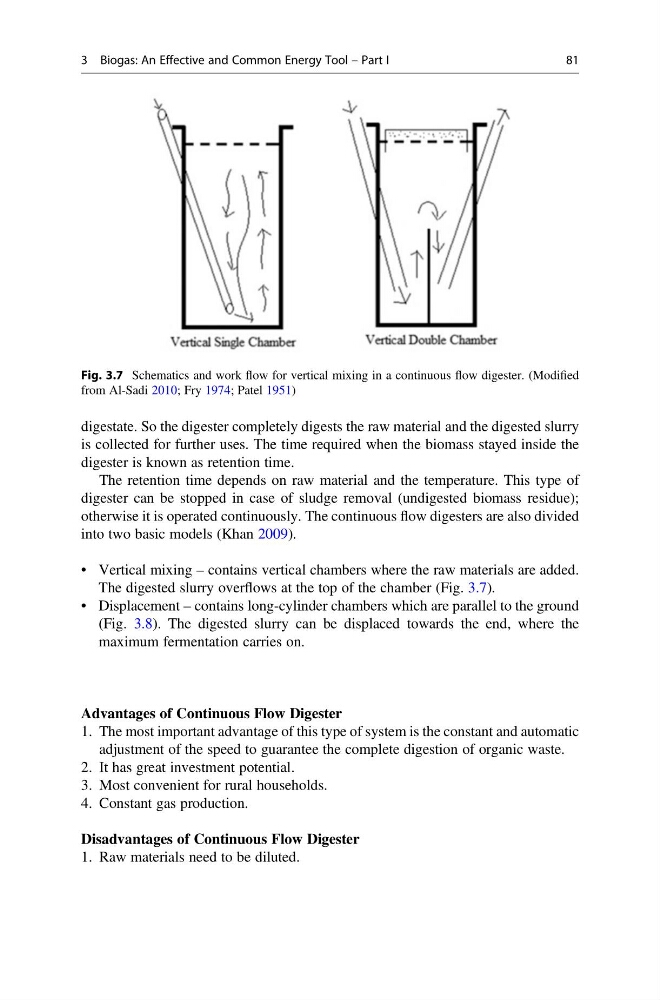
• Vertical mixing – contains vertical chambers where the raw materials are added.
The digested slurry overflows at the top of the chamber (Fig. 3.7).
• Displacement – contains long-cylinder chambers which are parallel to the ground
(Fig. 3.8). The digested slurry can be displaced towards the end, where the
maximum fermentation carries on.
Advantages of Continuous Flow Digester
1. The most important advantage of this type of system is the constant and automatic
adjustment of the speed to guarantee the complete digestion of organic waste.
2. It has great investment potential.
3. Most convenient for rural households.
4. Constant gas production.
Disadvantages of Continuous Flow Digester
1. Raw materials need to be diluted.
Fig. 3.7 Schematics and work flow for vertical mixing in a continuous flow digester. (Modified
from Al-Sadi 2010; Fry 1974; Patel 1951)
3 Biogas: An Effective and Common Energy Tool – Part I
81
is collected for further uses. The time required when the biomass stayed inside the
digester is known as retention time.
The retention time depends on raw material and the temperature. This type of
digester can be stopped in case of sludge removal (undigested biomass residue);
otherwise it is operated continuously. The continuous flow digesters are also divided
into two basic models (Khan 2009).
• Vertical mixing – contains vertical chambers where the raw materials are added.
The digested slurry overflows at the top of the chamber (Fig. 3.7).
• Displacement – contains long-cylinder chambers which are parallel to the ground
(Fig. 3.8). The digested slurry can be displaced towards the end, where the
maximum fermentation carries on.
Advantages of Continuous Flow Digester
1. The most important advantage of this type of system is the constant and automatic
adjustment of the speed to guarantee the complete digestion of organic waste.
2. It has great investment potential.
3. Most convenient for rural households.
4. Constant gas production.
Disadvantages of Continuous Flow Digester
1. Raw materials need to be diluted.
Fig. 3.7 Schematics and work flow for vertical mixing in a continuous flow digester. (Modified
from Al-Sadi 2010; Fry 1974; Patel 1951)
3 Biogas: An Effective and Common Energy Tool – Part I
81