

2.5
Cellulose
Cellulose is the renewable polysaccharide that is most abundant in the world. It is
composed of chains of homopolysaccharides, which are formed by units of anhydrous glucose and connected by β-1,4-D-glucose bonds, making up a crystalline
structure. This happens because of its long intra- and intermolecular hydrogen links,
facilitating its aggregation in fibrils (Pu et al. 2008). The microfibrils from cellulose
have highly organized regions (crystalline regions) and less organized ones (amorphous). Native cellulose is a polymorphic structure, defined as cellulose I, that can
suffer some chemical/thermal treatments converting it into polymorphous II, III, and
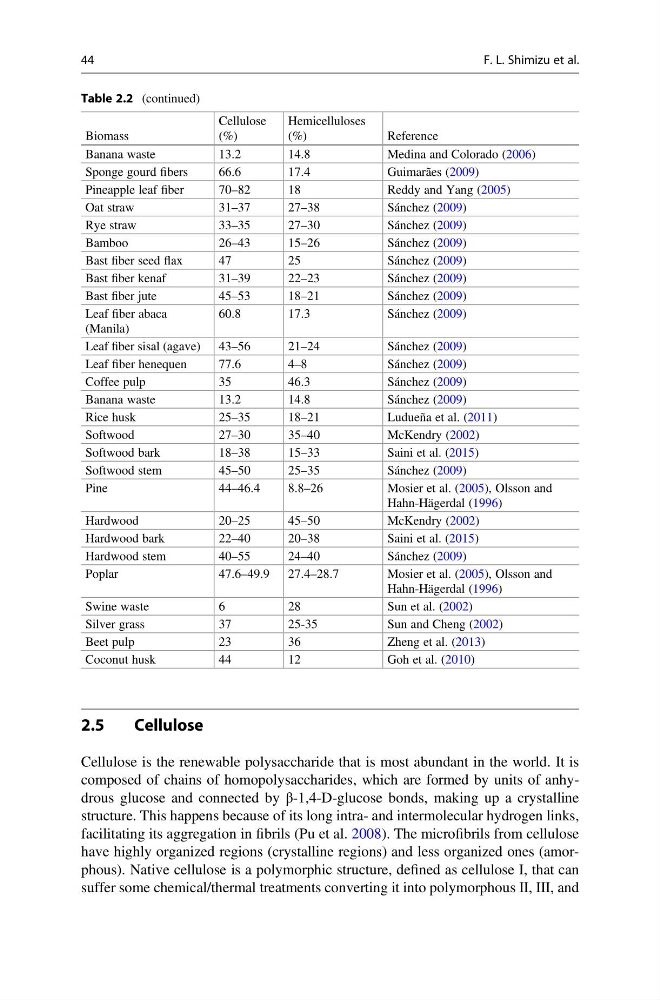
Table 2.2 (continued)
Biomass
Cellulose
(%)
Hemicelluloses
(%)
Reference
Banana waste
13.2
14.8
Medina and Colorado (2006)
Sponge gourd fibers
66.6
17.4
Guimarães (2009)
Pineapple leaf fiber
70–82
18
Reddy and Yang (2005)
Oat straw
31–37
27–38
Sánchez (2009)
Rye straw
33–35
27–30
Sánchez (2009)
Bamboo
26–43
15–26
Sánchez (2009)
Bast fiber seed flax
47
25
Sánchez (2009)
Bast fiber kenaf
31–39
22–23
Sánchez (2009)
Bast fiber jute
45–53
18–21
Sánchez (2009)
Leaf fiber abaca
(Manila)
60.8
17.3
Sánchez (2009)
Leaf fiber sisal (agave) 43–56
21–24
Sánchez (2009)
Leaf fiber henequen
77.6
4–8
Sánchez (2009)
Coffee pulp
35
46.3
Sánchez (2009)
Banana waste
13.2
14.8
Sánchez (2009)
Rice husk
25–35
18–21
Ludueña et al. (2011)
Softwood
27–30
35–40
McKendry (2002)
Softwood bark
18–38
15–33
Saini et al. (2015)
Softwood stem
45–50
25–35
Sánchez (2009)
Pine
44–46.4
8.8–26
Mosier et al. (2005), Olsson and
Hahn-Hägerdal (1996)
Hardwood
20–25
45–50
McKendry (2002)
Hardwood bark
22–40
20–38
Saini et al. (2015)
Hardwood stem
40–55
24–40
Sánchez (2009)
Poplar
47.6–49.9 27.4–28.7
Mosier et al. (2005), Olsson and
Hahn-Hägerdal (1996)
Swine waste
6
28
Sun et al. (2002)
Silver grass
37
25-35
Sun and Cheng (2002)
Beet pulp
23
36
Zheng et al. (2013)
Coconut husk
44
12
Goh et al. (2010)
44
F. L. Shimizu et al.
Cellulose
Cellulose is the renewable polysaccharide that is most abundant in the world. It is
composed of chains of homopolysaccharides, which are formed by units of anhydrous glucose and connected by β-1,4-D-glucose bonds, making up a crystalline
structure. This happens because of its long intra- and intermolecular hydrogen links,
facilitating its aggregation in fibrils (Pu et al. 2008). The microfibrils from cellulose
have highly organized regions (crystalline regions) and less organized ones (amorphous). Native cellulose is a polymorphic structure, defined as cellulose I, that can
suffer some chemical/thermal treatments converting it into polymorphous II, III, and
Table 2.2 (continued)
Biomass
Cellulose
(%)
Hemicelluloses
(%)
Reference
Banana waste
13.2
14.8
Medina and Colorado (2006)
Sponge gourd fibers
66.6
17.4
Guimarães (2009)
Pineapple leaf fiber
70–82
18
Reddy and Yang (2005)
Oat straw
31–37
27–38
Sánchez (2009)
Rye straw
33–35
27–30
Sánchez (2009)
Bamboo
26–43
15–26
Sánchez (2009)
Bast fiber seed flax
47
25
Sánchez (2009)
Bast fiber kenaf
31–39
22–23
Sánchez (2009)
Bast fiber jute
45–53
18–21
Sánchez (2009)
Leaf fiber abaca
(Manila)
60.8
17.3
Sánchez (2009)
Leaf fiber sisal (agave) 43–56
21–24
Sánchez (2009)
Leaf fiber henequen
77.6
4–8
Sánchez (2009)
Coffee pulp
35
46.3
Sánchez (2009)
Banana waste
13.2
14.8
Sánchez (2009)
Rice husk
25–35
18–21
Ludueña et al. (2011)
Softwood
27–30
35–40
McKendry (2002)
Softwood bark
18–38
15–33
Saini et al. (2015)
Softwood stem
45–50
25–35
Sánchez (2009)
Pine
44–46.4
8.8–26
Mosier et al. (2005), Olsson and
Hahn-Hägerdal (1996)
Hardwood
20–25
45–50
McKendry (2002)
Hardwood bark
22–40
20–38
Saini et al. (2015)
Hardwood stem
40–55
24–40
Sánchez (2009)
Poplar
47.6–49.9 27.4–28.7
Mosier et al. (2005), Olsson and
Hahn-Hägerdal (1996)
Swine waste
6
28
Sun et al. (2002)
Silver grass
37
25-35
Sun and Cheng (2002)
Beet pulp
23
36
Zheng et al. (2013)
Coconut husk
44
12
Goh et al. (2010)
44
F. L. Shimizu et al.