

pollutant emissions in SI engines. After ignition by the spark, a turbulent premixed
flame propagates through the premixed fuel–air charge in the engine, rapidly
converting the fuel into combustion products and producing the thermal energy
and pressure that drive the engine. A recent study observing flames in optically
accessible engines has shown that ethanol flames propagate faster than butanol,
gasoline, and iso-octane (Aleiferis et al. 2013). Recent papers still do not produce
consistent trends in relative NO x potential of gasoline–alcohol blends (Karavalakis
et al. 2014; Canakci et al. 2013; Gravalos et al. 2013; Balki et al. 2014), while
agreement is growing on the risk of a potential increase in oxygenated emissions,
such as formaldehyde, acetaldehyde, and ketones (Agarwal 2007; Lynd et al. 1991;
Kohse-Höinghaus et al. 2010; Saxena and Williams 2007).
Dealing with biodiesel, when compared to diesel, it has a 9% lower volumetric
energy content, due to its oxygen content (Agarwal 2007; Lapuerta et al. 2008). At
high-temperatures, the reactivity of long-chain esters is nearly indistinguishable for
saturated and unsaturated esters (Wang et al. 2013), while the unsaturated esters
(with double bonds) have generally increased low-temperature ignition delay times
and reduced cetane numbers (Westbrook 2013; Westbrook et al. 2013). Biodiesels
have the positive aspect of reducing engine deposits and coking, compared to
petroleum-derived fuels (Graboski and McCormick 1998; Xue et al. 2011). NO x
emissions have been observed to increase for biodiesel compared to petro-diesel for
many engine tests (Lapuerta et al. 2008; Graboski and McCormick 1998; Xue et al.
2011; Coniglio et al. 2013; Lai et al. 2011; Sun et al. 2010; Giakoumis et al. 2012;
Palash et al. 2013; Varatharajan and Cheralathan 2012; Szybist et al. 2007; Hoekman
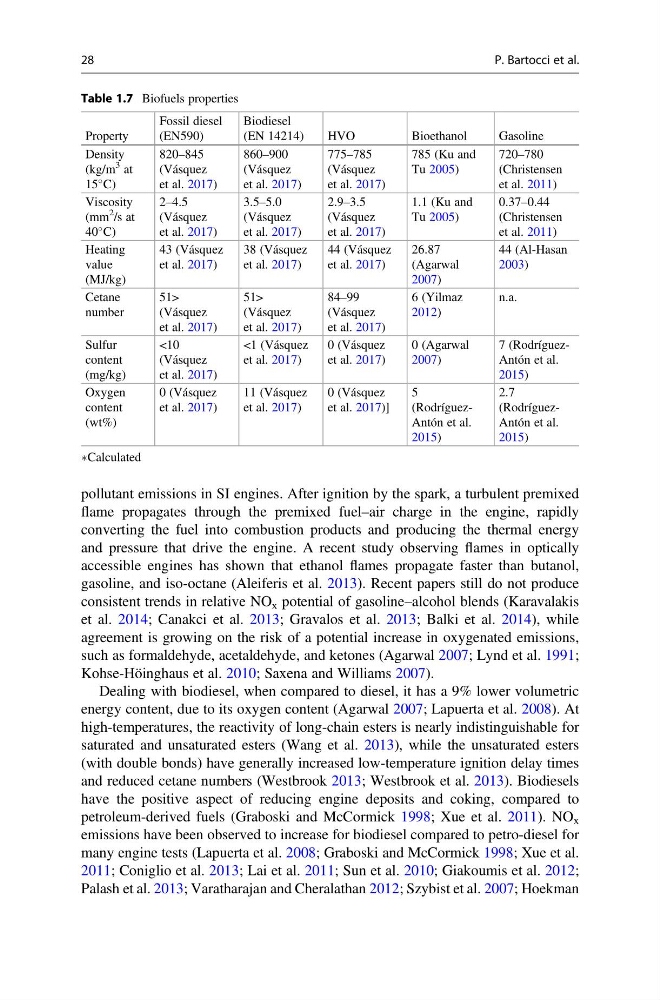
Table 1.7 Biofuels properties
Property
Fossil diesel
(EN590)
Biodiesel
(EN 14214)
HVO
Bioethanol
Gasoline
Density
(kg/m
3 at
15
C)
820–845
(Vásquez
et al. 2017)
860–900
(Vásquez
et al. 2017)
775–785
(Vásquez
et al. 2017)
785 (Ku and
Tu 2005)
720–780
(Christensen
et al. 2011)
Viscosity
(mm
2
/s at
40
C)
2–4.5
(Vásquez
et al. 2017)
3.5–5.0
(Vásquez
et al. 2017)
2.9–3.5
(Vásquez
et al. 2017)
1.1 (Ku and
Tu 2005)
0.37–0.44
(Christensen
et al. 2011)
Heating
value
(MJ/kg)
43 (Vásquez
et al. 2017)
38 (Vásquez
et al. 2017)
44 (Vásquez
et al. 2017)
26.87
(Agarwal
2007)
44 (Al-Hasan
2003)
Cetane
number
51>
(Vásquez
et al. 2017)
51>
(Vásquez
et al. 2017)
84–99
(Vásquez
et al. 2017)
6 (Yilmaz
2012)
n.a.
Sulfur
content
(mg/kg)
<10
(Vásquez
et al. 2017)
<1 (Vásquez
et al. 2017)
0 (Vásquez
et al. 2017)
0 (Agarwal
2007)
7 (RodríguezAntón et al.
2015)
Oxygen
content
(wt%)
0 (Vásquez
et al. 2017)
11 (Vásquez
et al. 2017)
0 (Vásquez
et al. 2017)]
5
(RodríguezAntón et al.
2015)
2.7
(RodríguezAntón et al.
2015)
ÃCalculated
28
P. Bartocci et al.
flame propagates through the premixed fuel–air charge in the engine, rapidly
converting the fuel into combustion products and producing the thermal energy
and pressure that drive the engine. A recent study observing flames in optically
accessible engines has shown that ethanol flames propagate faster than butanol,
gasoline, and iso-octane (Aleiferis et al. 2013). Recent papers still do not produce
consistent trends in relative NO x potential of gasoline–alcohol blends (Karavalakis
et al. 2014; Canakci et al. 2013; Gravalos et al. 2013; Balki et al. 2014), while
agreement is growing on the risk of a potential increase in oxygenated emissions,
such as formaldehyde, acetaldehyde, and ketones (Agarwal 2007; Lynd et al. 1991;
Kohse-Höinghaus et al. 2010; Saxena and Williams 2007).
Dealing with biodiesel, when compared to diesel, it has a 9% lower volumetric
energy content, due to its oxygen content (Agarwal 2007; Lapuerta et al. 2008). At
high-temperatures, the reactivity of long-chain esters is nearly indistinguishable for
saturated and unsaturated esters (Wang et al. 2013), while the unsaturated esters
(with double bonds) have generally increased low-temperature ignition delay times
and reduced cetane numbers (Westbrook 2013; Westbrook et al. 2013). Biodiesels
have the positive aspect of reducing engine deposits and coking, compared to
petroleum-derived fuels (Graboski and McCormick 1998; Xue et al. 2011). NO x
emissions have been observed to increase for biodiesel compared to petro-diesel for
many engine tests (Lapuerta et al. 2008; Graboski and McCormick 1998; Xue et al.
2011; Coniglio et al. 2013; Lai et al. 2011; Sun et al. 2010; Giakoumis et al. 2012;
Palash et al. 2013; Varatharajan and Cheralathan 2012; Szybist et al. 2007; Hoekman
Table 1.7 Biofuels properties
Property
Fossil diesel
(EN590)
Biodiesel
(EN 14214)
HVO
Bioethanol
Gasoline
Density
(kg/m
3 at
15
C)
820–845
(Vásquez
et al. 2017)
860–900
(Vásquez
et al. 2017)
775–785
(Vásquez
et al. 2017)
785 (Ku and
Tu 2005)
720–780
(Christensen
et al. 2011)
Viscosity
(mm
2
/s at
40
C)
2–4.5
(Vásquez
et al. 2017)
3.5–5.0
(Vásquez
et al. 2017)
2.9–3.5
(Vásquez
et al. 2017)
1.1 (Ku and
Tu 2005)
0.37–0.44
(Christensen
et al. 2011)
Heating
value
(MJ/kg)
43 (Vásquez
et al. 2017)
38 (Vásquez
et al. 2017)
44 (Vásquez
et al. 2017)
26.87
(Agarwal
2007)
44 (Al-Hasan
2003)
Cetane
number
51>
(Vásquez
et al. 2017)
51>
(Vásquez
et al. 2017)
84–99
(Vásquez
et al. 2017)
6 (Yilmaz
2012)
n.a.
Sulfur
content
(mg/kg)
<10
(Vásquez
et al. 2017)
<1 (Vásquez
et al. 2017)
0 (Vásquez
et al. 2017)
0 (Agarwal
2007)
7 (RodríguezAntón et al.
2015)
Oxygen
content
(wt%)
0 (Vásquez
et al. 2017)
11 (Vásquez
et al. 2017)
0 (Vásquez
et al. 2017)]
5
(RodríguezAntón et al.
2015)
2.7
(RodríguezAntón et al.
2015)
ÃCalculated
28
P. Bartocci et al.