

1.7
Biofuel Yields and Costs
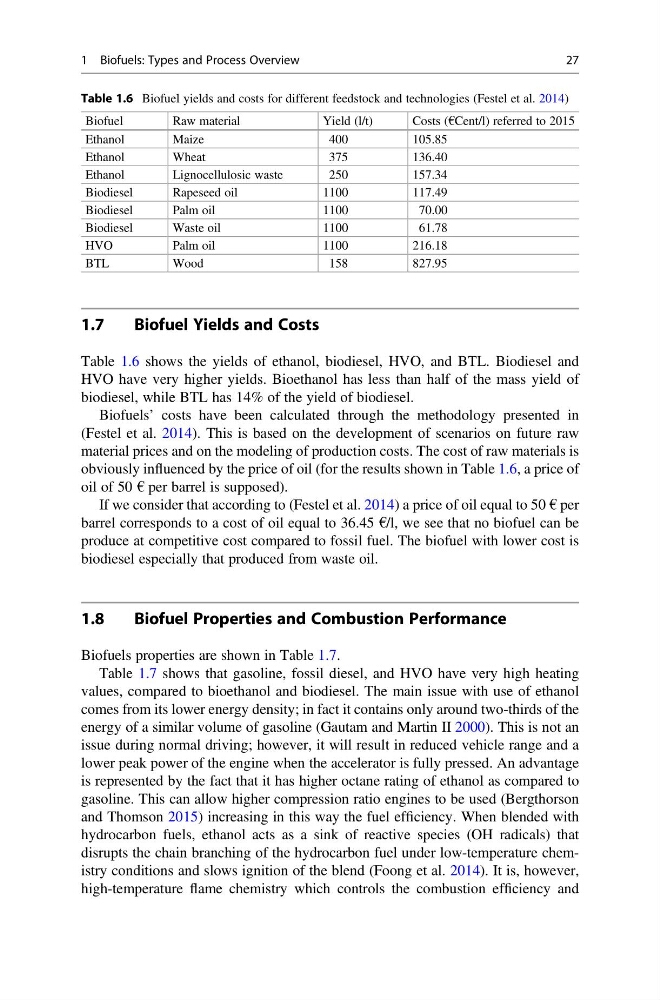
Table 1.6 shows the yields of ethanol, biodiesel, HVO, and BTL. Biodiesel and
HVO have very higher yields. Bioethanol has less than half of the mass yield of
biodiesel, while BTL has 14% of the yield of biodiesel.
Biofuels’ costs have been calculated through the methodology presented in
(Festel et al. 2014). This is based on the development of scenarios on future raw
material prices and on the modeling of production costs. The cost of raw materials is
obviously influenced by the price of oil (for the results shown in Table 1.6, a price of
oil of 50 € per barrel is supposed).
If we consider that according to (Festel et al. 2014) a price of oil equal to 50 € per
barrel corresponds to a cost of oil equal to 36.45 €/l, we see that no biofuel can be
produce at competitive cost compared to fossil fuel. The biofuel with lower cost is
biodiesel especially that produced from waste oil.
1.8
Biofuel Properties and Combustion Performance
Biofuels properties are shown in Table 1.7.
Table 1.7 shows that gasoline, fossil diesel, and HVO have very high heating
values, compared to bioethanol and biodiesel. The main issue with use of ethanol
comes from its lower energy density; in fact it contains only around two-thirds of the
energy of a similar volume of gasoline (Gautam and Martin II 2000). This is not an
issue during normal driving; however, it will result in reduced vehicle range and a
lower peak power of the engine when the accelerator is fully pressed. An advantage
is represented by the fact that it has higher octane rating of ethanol as compared to
gasoline. This can allow higher compression ratio engines to be used (Bergthorson
and Thomson 2015) increasing in this way the fuel efficiency. When blended with
hydrocarbon fuels, ethanol acts as a sink of reactive species (OH radicals) that
disrupts the chain branching of the hydrocarbon fuel under low-temperature chemistry conditions and slows ignition of the blend (Foong et al. 2014). It is, however,
high-temperature flame chemistry which controls the combustion efficiency and
Table 1.6 Biofuel yields and costs for different feedstock and technologies (Festel et al. 2014)
Biofuel
Raw material
Yield (l/t)
Costs (€Cent/l) referred to 2015
Ethanol
Maize
400
105.85
Ethanol
Wheat
375
136.40
Ethanol
Lignocellulosic waste
250
157.34
Biodiesel
Rapeseed oil
1100
117.49
Biodiesel
Palm oil
1100
70.00
Biodiesel
Waste oil
1100
61.78
HVO
Palm oil
1100
216.18
BTL
Wood
158
827.95
1 Biofuels: Types and Process Overview
27
Biofuel Yields and Costs
Table 1.6 shows the yields of ethanol, biodiesel, HVO, and BTL. Biodiesel and
HVO have very higher yields. Bioethanol has less than half of the mass yield of
biodiesel, while BTL has 14% of the yield of biodiesel.
Biofuels’ costs have been calculated through the methodology presented in
(Festel et al. 2014). This is based on the development of scenarios on future raw
material prices and on the modeling of production costs. The cost of raw materials is
obviously influenced by the price of oil (for the results shown in Table 1.6, a price of
oil of 50 € per barrel is supposed).
If we consider that according to (Festel et al. 2014) a price of oil equal to 50 € per
barrel corresponds to a cost of oil equal to 36.45 €/l, we see that no biofuel can be
produce at competitive cost compared to fossil fuel. The biofuel with lower cost is
biodiesel especially that produced from waste oil.
1.8
Biofuel Properties and Combustion Performance
Biofuels properties are shown in Table 1.7.
Table 1.7 shows that gasoline, fossil diesel, and HVO have very high heating
values, compared to bioethanol and biodiesel. The main issue with use of ethanol
comes from its lower energy density; in fact it contains only around two-thirds of the
energy of a similar volume of gasoline (Gautam and Martin II 2000). This is not an
issue during normal driving; however, it will result in reduced vehicle range and a
lower peak power of the engine when the accelerator is fully pressed. An advantage
is represented by the fact that it has higher octane rating of ethanol as compared to
gasoline. This can allow higher compression ratio engines to be used (Bergthorson
and Thomson 2015) increasing in this way the fuel efficiency. When blended with
hydrocarbon fuels, ethanol acts as a sink of reactive species (OH radicals) that
disrupts the chain branching of the hydrocarbon fuel under low-temperature chemistry conditions and slows ignition of the blend (Foong et al. 2014). It is, however,
high-temperature flame chemistry which controls the combustion efficiency and
Table 1.6 Biofuel yields and costs for different feedstock and technologies (Festel et al. 2014)
Biofuel
Raw material
Yield (l/t)
Costs (€Cent/l) referred to 2015
Ethanol
Maize
400
105.85
Ethanol
Wheat
375
136.40
Ethanol
Lignocellulosic waste
250
157.34
Biodiesel
Rapeseed oil
1100
117.49
Biodiesel
Palm oil
1100
70.00
Biodiesel
Waste oil
1100
61.78
HVO
Palm oil
1100
216.18
BTL
Wood
158
827.95
1 Biofuels: Types and Process Overview
27