

reasons; Tween-80 has the potential for cutting the price of the biocatalyst-based
utilisation of cellulosic depositions. On the contrary, Micales (Micales 1991) proved
that the inclusion of Tween-80 had no impact on the secretion of CMCase by Postia
placenta.
11.18 Applications of Cellulases
Cellulase occupies the third position in the world enzyme market and is grabbing
rejuvenated interests because of their boundless and diverse range of applications,
thereby dominating the rest of the plant cell wall degrading enzymes (Chandel et al.
2012; Singhania et al. 2010). Cellulases of microbial origin have been exploited for a
broad range of industrial applications. Moreover, these enzymes have been economically feasible for more than 30 years now and emerged as a goal for academic and
industrial exploration (Singh et al. 1999, 2007). Currently, cellulases from
Trichoderma and Aspergillus account for roughly 20% of the world enzyme market
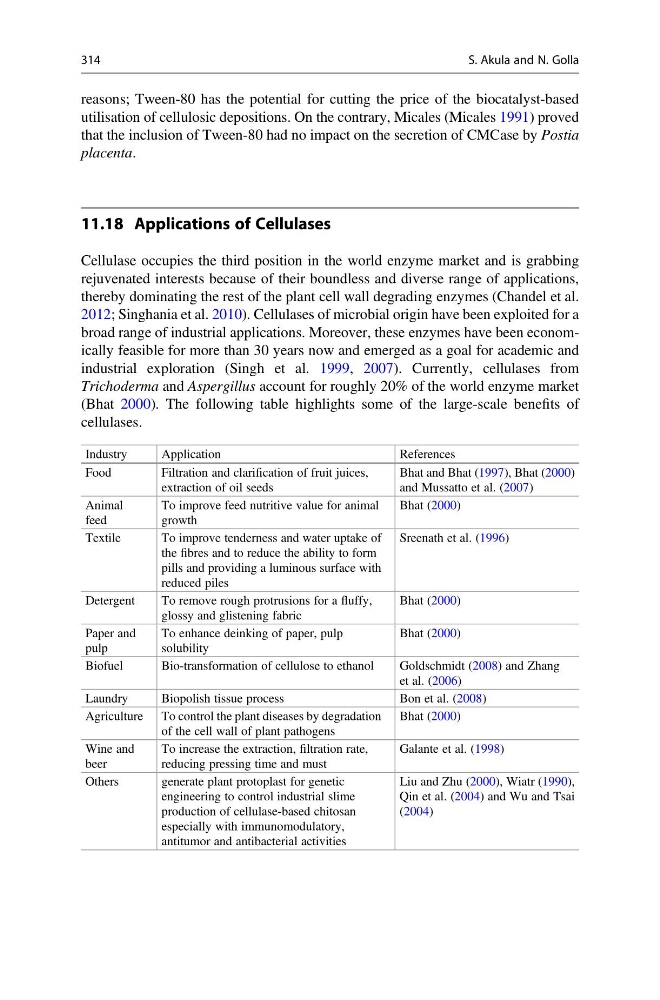
(Bhat 2000). The following table highlights some of the large-scale benefits of
cellulases.
Industry
Application
References
Food
Filtration and clarification of fruit juices,
extraction of oil seeds
Bhat and Bhat (1997), Bhat (2000)
and Mussatto et al. (2007)
Animal
feed
To improve feed nutritive value for animal
growth
Bhat (2000)
Textile
To improve tenderness and water uptake of
the fibres and to reduce the ability to form
pills and providing a luminous surface with
reduced piles
Sreenath et al. (1996)
Detergent
To remove rough protrusions for a fluffy,
glossy and glistening fabric
Bhat (2000)
Paper and
pulp
To enhance deinking of paper, pulp
solubility
Bhat (2000)
Biofuel
Bio-transformation of cellulose to ethanol
Goldschmidt (2008) and Zhang
et al. (2006)
Laundry
Biopolish tissue process
Bon et al. (2008)
Agriculture To control the plant diseases by degradation
of the cell wall of plant pathogens
Bhat (2000)
Wine and
beer
To increase the extraction, filtration rate,
reducing pressing time and must
Galante et al. (1998)
Others
generate plant protoplast for genetic
engineering to control industrial slime
production of cellulase-based chitosan
especially with immunomodulatory,
antitumor and antibacterial activities
Liu and Zhu (2000), Wiatr (1990),
Qin et al. (2004) and Wu and Tsai
(2004)
314
S. Akula and N. Golla
utilisation of cellulosic depositions. On the contrary, Micales (Micales 1991) proved
that the inclusion of Tween-80 had no impact on the secretion of CMCase by Postia
placenta.
11.18 Applications of Cellulases
Cellulase occupies the third position in the world enzyme market and is grabbing
rejuvenated interests because of their boundless and diverse range of applications,
thereby dominating the rest of the plant cell wall degrading enzymes (Chandel et al.
2012; Singhania et al. 2010). Cellulases of microbial origin have been exploited for a
broad range of industrial applications. Moreover, these enzymes have been economically feasible for more than 30 years now and emerged as a goal for academic and
industrial exploration (Singh et al. 1999, 2007). Currently, cellulases from
Trichoderma and Aspergillus account for roughly 20% of the world enzyme market
(Bhat 2000). The following table highlights some of the large-scale benefits of
cellulases.
Industry
Application
References
Food
Filtration and clarification of fruit juices,
extraction of oil seeds
Bhat and Bhat (1997), Bhat (2000)
and Mussatto et al. (2007)
Animal
feed
To improve feed nutritive value for animal
growth
Bhat (2000)
Textile
To improve tenderness and water uptake of
the fibres and to reduce the ability to form
pills and providing a luminous surface with
reduced piles
Sreenath et al. (1996)
Detergent
To remove rough protrusions for a fluffy,
glossy and glistening fabric
Bhat (2000)
Paper and
pulp
To enhance deinking of paper, pulp
solubility
Bhat (2000)
Biofuel
Bio-transformation of cellulose to ethanol
Goldschmidt (2008) and Zhang
et al. (2006)
Laundry
Biopolish tissue process
Bon et al. (2008)
Agriculture To control the plant diseases by degradation
of the cell wall of plant pathogens
Bhat (2000)
Wine and
beer
To increase the extraction, filtration rate,
reducing pressing time and must
Galante et al. (1998)
Others
generate plant protoplast for genetic
engineering to control industrial slime
production of cellulase-based chitosan
especially with immunomodulatory,
antitumor and antibacterial activities
Liu and Zhu (2000), Wiatr (1990),
Qin et al. (2004) and Wu and Tsai
(2004)
314
S. Akula and N. Golla