

consisting of an elemental structure of a twisted sheet of three short antiparallel
strands. One side of the wedge is placoid and contains three preserved aromatic
amino acids set apart by a distance reminiscent of the length of the continuation unit
in cellulose, cellobiose (Tomme et al. 1995). This interaction is recurrently
supplemented by polar residues resulting in hydrogen bonds (Tormo et al. 1996).
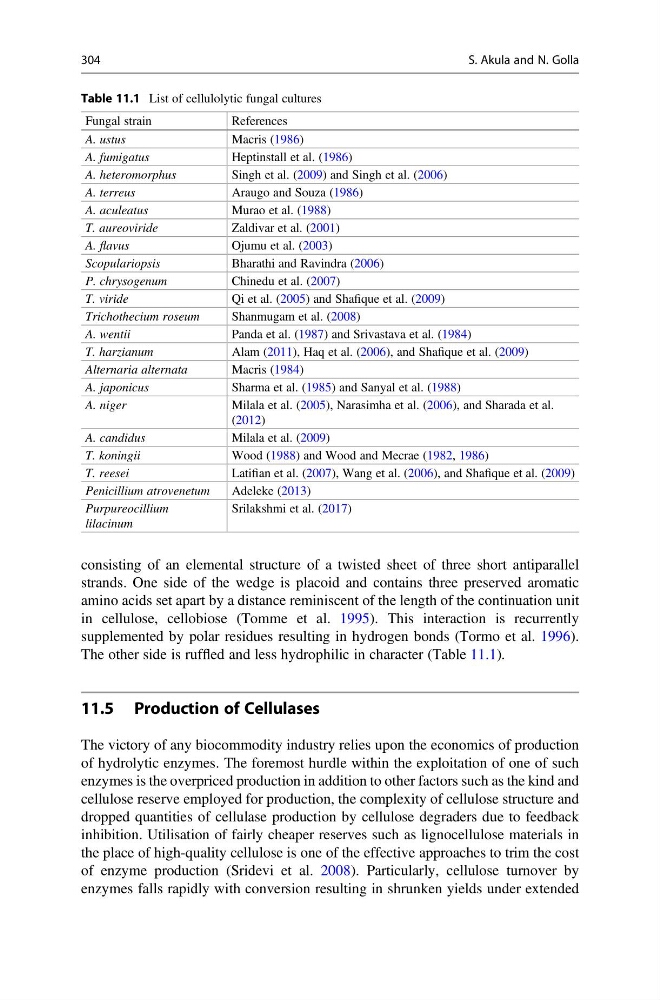
The other side is ruffled and less hydrophilic in character (Table 11.1).
11.5 Production of Cellulases
The victory of any biocommodity industry relies upon the economics of production
of hydrolytic enzymes. The foremost hurdle within the exploitation of one of such
enzymes is the overpriced production in addition to other factors such as the kind and
cellulose reserve employed for production, the complexity of cellulose structure and
dropped quantities of cellulase production by cellulose degraders due to feedback
inhibition. Utilisation of fairly cheaper reserves such as lignocellulose materials in
the place of high-quality cellulose is one of the effective approaches to trim the cost
of enzyme production (Sridevi et al. 2008). Particularly, cellulose turnover by
enzymes falls rapidly with conversion resulting in shrunken yields under extended
Table 11.1 List of cellulolytic fungal cultures
Fungal strain
References
A. ustus
Macris (1986)
A. fumigatus
Heptinstall et al. (1986)
A. heteromorphus
Singh et al. (2009) and Singh et al. (2006)
A. terreus
Araugo and Souza (1986)
A. aculeatus
Murao et al. (1988)
T. aureoviride
Zaldivar et al. (2001)
A. flavus
Ojumu et al. (2003)
Scopulariopsis
Bharathi and Ravindra (2006)
P. chrysogenum
Chinedu et al. (2007)
T. viride
Qi et al. (2005) and Shafique et al. (2009)
Trichothecium roseum
Shanmugam et al. (2008)
A. wentii
Panda et al. (1987) and Srivastava et al. (1984)
T. harzianum
Alam (2011), Haq et al. (2006), and Shafique et al. (2009)
Alternaria alternata
Macris (1984)
A. japonicus
Sharma et al. (1985) and Sanyal et al. (1988)
A. niger
Milala et al. (2005), Narasimha et al. (2006), and Sharada et al.
(2012)
A. candidus
Milala et al. (2009)
T. koningii
Wood (1988) and Wood and Mecrae (1982, 1986)
T. reesei
Latifian et al. (2007), Wang et al. (2006), and Shafique et al. (2009)
Penicillium atrovenetum
Adeleke (2013)
Purpureocillium
lilacinum
Srilakshmi et al. (2017)
304
S. Akula and N. Golla
strands. One side of the wedge is placoid and contains three preserved aromatic
amino acids set apart by a distance reminiscent of the length of the continuation unit
in cellulose, cellobiose (Tomme et al. 1995). This interaction is recurrently
supplemented by polar residues resulting in hydrogen bonds (Tormo et al. 1996).
The other side is ruffled and less hydrophilic in character (Table 11.1).
11.5 Production of Cellulases
The victory of any biocommodity industry relies upon the economics of production
of hydrolytic enzymes. The foremost hurdle within the exploitation of one of such
enzymes is the overpriced production in addition to other factors such as the kind and
cellulose reserve employed for production, the complexity of cellulose structure and
dropped quantities of cellulase production by cellulose degraders due to feedback
inhibition. Utilisation of fairly cheaper reserves such as lignocellulose materials in
the place of high-quality cellulose is one of the effective approaches to trim the cost
of enzyme production (Sridevi et al. 2008). Particularly, cellulose turnover by
enzymes falls rapidly with conversion resulting in shrunken yields under extended
Table 11.1 List of cellulolytic fungal cultures
Fungal strain
References
A. ustus
Macris (1986)
A. fumigatus
Heptinstall et al. (1986)
A. heteromorphus
Singh et al. (2009) and Singh et al. (2006)
A. terreus
Araugo and Souza (1986)
A. aculeatus
Murao et al. (1988)
T. aureoviride
Zaldivar et al. (2001)
A. flavus
Ojumu et al. (2003)
Scopulariopsis
Bharathi and Ravindra (2006)
P. chrysogenum
Chinedu et al. (2007)
T. viride
Qi et al. (2005) and Shafique et al. (2009)
Trichothecium roseum
Shanmugam et al. (2008)
A. wentii
Panda et al. (1987) and Srivastava et al. (1984)
T. harzianum
Alam (2011), Haq et al. (2006), and Shafique et al. (2009)
Alternaria alternata
Macris (1984)
A. japonicus
Sharma et al. (1985) and Sanyal et al. (1988)
A. niger
Milala et al. (2005), Narasimha et al. (2006), and Sharada et al.
(2012)
A. candidus
Milala et al. (2009)
T. koningii
Wood (1988) and Wood and Mecrae (1982, 1986)
T. reesei
Latifian et al. (2007), Wang et al. (2006), and Shafique et al. (2009)
Penicillium atrovenetum
Adeleke (2013)
Purpureocillium
lilacinum
Srilakshmi et al. (2017)
304
S. Akula and N. Golla