

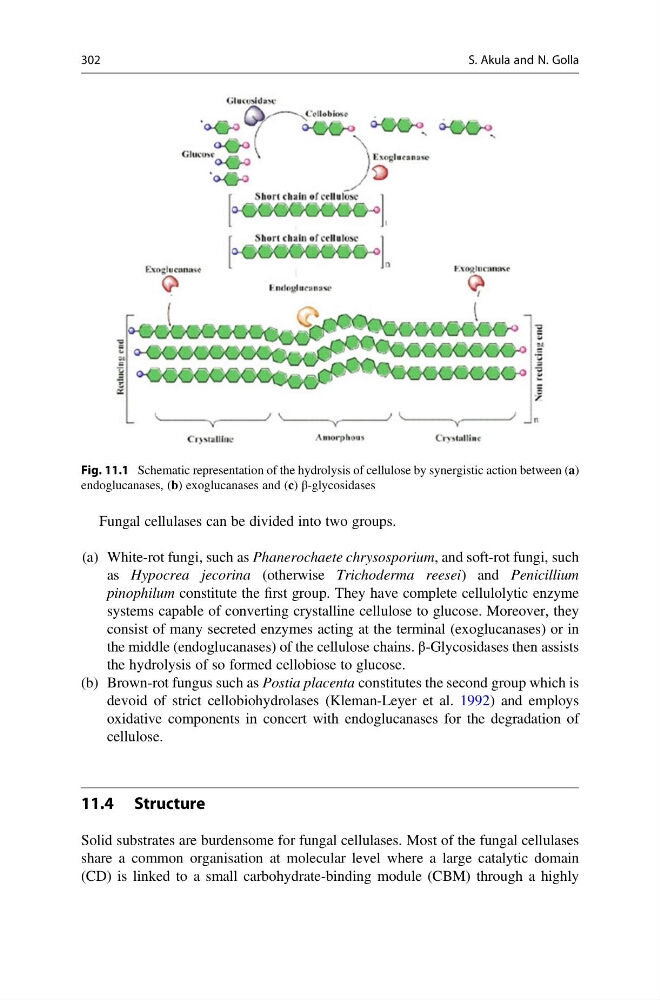
Fungal cellulases can be divided into two groups.
(a) White-rot fungi, such as Phanerochaete chrysosporium, and soft-rot fungi, such
as Hypocrea jecorina (otherwise Trichoderma reesei) and Penicillium
pinophilum constitute the first group. They have complete cellulolytic enzyme
systems capable of converting crystalline cellulose to glucose. Moreover, they
consist of many secreted enzymes acting at the terminal (exoglucanases) or in
the middle (endoglucanases) of the cellulose chains. β-Glycosidases then assists
the hydrolysis of so formed cellobiose to glucose.
(b) Brown-rot fungus such as Postia placenta constitutes the second group which is
devoid of strict cellobiohydrolases (Kleman-Leyer et al. 1992) and employs
oxidative components in concert with endoglucanases for the degradation of
cellulose.
11.4 Structure
Solid substrates are burdensome for fungal cellulases. Most of the fungal cellulases
share a common organisation at molecular level where a large catalytic domain
(CD) is linked to a small carbohydrate-binding module (CBM) through a highly
Fig. 11.1 Schematic representation of the hydrolysis of cellulose by synergistic action between (a)
endoglucanases, (b) exoglucanases and (c) β-glycosidases
302
S. Akula and N. Golla
(a) White-rot fungi, such as Phanerochaete chrysosporium, and soft-rot fungi, such
as Hypocrea jecorina (otherwise Trichoderma reesei) and Penicillium
pinophilum constitute the first group. They have complete cellulolytic enzyme
systems capable of converting crystalline cellulose to glucose. Moreover, they
consist of many secreted enzymes acting at the terminal (exoglucanases) or in
the middle (endoglucanases) of the cellulose chains. β-Glycosidases then assists
the hydrolysis of so formed cellobiose to glucose.
(b) Brown-rot fungus such as Postia placenta constitutes the second group which is
devoid of strict cellobiohydrolases (Kleman-Leyer et al. 1992) and employs
oxidative components in concert with endoglucanases for the degradation of
cellulose.
11.4 Structure
Solid substrates are burdensome for fungal cellulases. Most of the fungal cellulases
share a common organisation at molecular level where a large catalytic domain
(CD) is linked to a small carbohydrate-binding module (CBM) through a highly
Fig. 11.1 Schematic representation of the hydrolysis of cellulose by synergistic action between (a)
endoglucanases, (b) exoglucanases and (c) β-glycosidases
302
S. Akula and N. Golla