

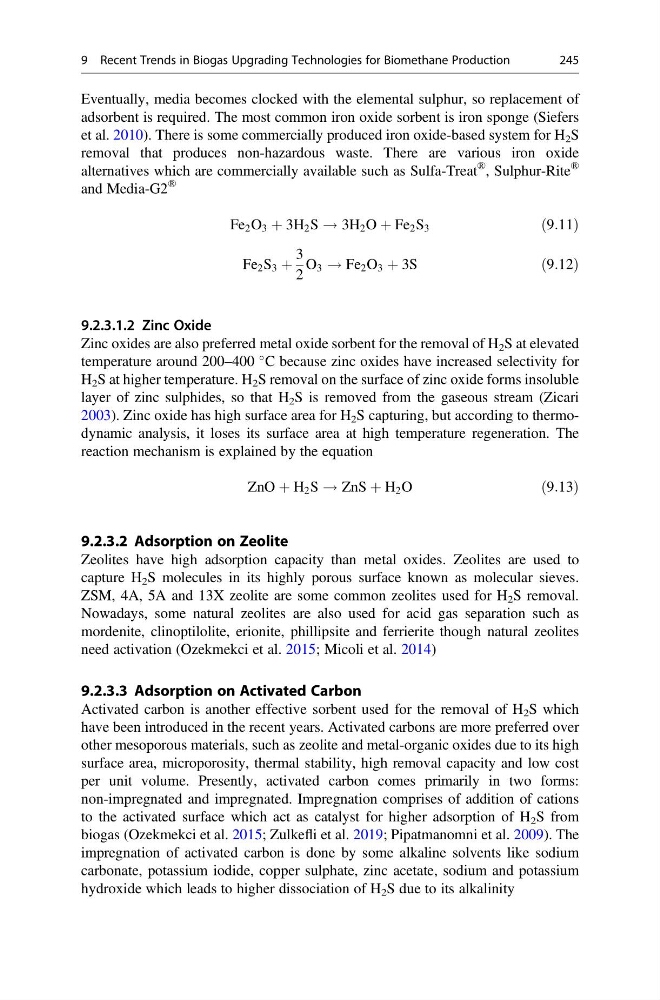
Eventually, media becomes clocked with the elemental sulphur, so replacement of
adsorbent is required. The most common iron oxide sorbent is iron sponge (Siefers
et al. 2010). There is some commercially produced iron oxide-based system for H 2 S
removal that produces non-hazardous waste. There are various iron oxide
alternatives which are commercially available such as Sulfa-Treat
® , Sulphur-Rite
®
and Media-G2
®
Fe 2 O 3 þ 3H 2 S ! 3H 2 O þ Fe 2 S 3
ð9:11Þ
Fe 2 S 3 þ
3
2
O 3 ! Fe 2 O 3 þ 3S
ð9:12Þ
9.2.3.1.2 Zinc Oxide
Zinc oxides are also preferred metal oxide sorbent for the removal of H 2 S at elevated
temperature around 200–400
C because zinc oxides have increased selectivity for
H 2 S at higher temperature. H 2 S removal on the surface of zinc oxide forms insoluble
layer of zinc sulphides, so that H 2 S is removed from the gaseous stream (Zicari
2003). Zinc oxide has high surface area for H 2 S capturing, but according to thermodynamic analysis, it loses its surface area at high temperature regeneration. The
reaction mechanism is explained by the equation
ZnO þ H 2 S ! ZnS þ H 2 O
ð9:13Þ
9.2.3.2 Adsorption on Zeolite
Zeolites have high adsorption capacity than metal oxides. Zeolites are used to
capture H 2 S molecules in its highly porous surface known as molecular sieves.
ZSM, 4A, 5A and 13X zeolite are some common zeolites used for H 2 S removal.
Nowadays, some natural zeolites are also used for acid gas separation such as
mordenite, clinoptilolite, erionite, phillipsite and ferrierite though natural zeolites
need activation (Ozekmekci et al. 2015; Micoli et al. 2014)
9.2.3.3 Adsorption on Activated Carbon
Activated carbon is another effective sorbent used for the removal of H 2 S which
have been introduced in the recent years. Activated carbons are more preferred over
other mesoporous materials, such as zeolite and metal-organic oxides due to its high
surface area, microporosity, thermal stability, high removal capacity and low cost
per unit volume. Presently, activated carbon comes primarily in two forms:
non-impregnated and impregnated. Impregnation comprises of addition of cations
to the activated surface which act as catalyst for higher adsorption of H 2 S from
biogas (Ozekmekci et al. 2015; Zulkefli et al. 2019; Pipatmanomni et al. 2009). The
impregnation of activated carbon is done by some alkaline solvents like sodium
carbonate, potassium iodide, copper sulphate, zinc acetate, sodium and potassium
hydroxide which leads to higher dissociation of H 2 S due to its alkalinity
9 Recent Trends in Biogas Upgrading Technologies for Biomethane Production
245
adsorbent is required. The most common iron oxide sorbent is iron sponge (Siefers
et al. 2010). There is some commercially produced iron oxide-based system for H 2 S
removal that produces non-hazardous waste. There are various iron oxide
alternatives which are commercially available such as Sulfa-Treat
® , Sulphur-Rite
®
and Media-G2
®
Fe 2 O 3 þ 3H 2 S ! 3H 2 O þ Fe 2 S 3
ð9:11Þ
Fe 2 S 3 þ
3
2
O 3 ! Fe 2 O 3 þ 3S
ð9:12Þ
9.2.3.1.2 Zinc Oxide
Zinc oxides are also preferred metal oxide sorbent for the removal of H 2 S at elevated
temperature around 200–400
C because zinc oxides have increased selectivity for
H 2 S at higher temperature. H 2 S removal on the surface of zinc oxide forms insoluble
layer of zinc sulphides, so that H 2 S is removed from the gaseous stream (Zicari
2003). Zinc oxide has high surface area for H 2 S capturing, but according to thermodynamic analysis, it loses its surface area at high temperature regeneration. The
reaction mechanism is explained by the equation
ZnO þ H 2 S ! ZnS þ H 2 O
ð9:13Þ
9.2.3.2 Adsorption on Zeolite
Zeolites have high adsorption capacity than metal oxides. Zeolites are used to
capture H 2 S molecules in its highly porous surface known as molecular sieves.
ZSM, 4A, 5A and 13X zeolite are some common zeolites used for H 2 S removal.
Nowadays, some natural zeolites are also used for acid gas separation such as
mordenite, clinoptilolite, erionite, phillipsite and ferrierite though natural zeolites
need activation (Ozekmekci et al. 2015; Micoli et al. 2014)
9.2.3.3 Adsorption on Activated Carbon
Activated carbon is another effective sorbent used for the removal of H 2 S which
have been introduced in the recent years. Activated carbons are more preferred over
other mesoporous materials, such as zeolite and metal-organic oxides due to its high
surface area, microporosity, thermal stability, high removal capacity and low cost
per unit volume. Presently, activated carbon comes primarily in two forms:
non-impregnated and impregnated. Impregnation comprises of addition of cations
to the activated surface which act as catalyst for higher adsorption of H 2 S from
biogas (Ozekmekci et al. 2015; Zulkefli et al. 2019; Pipatmanomni et al. 2009). The
impregnation of activated carbon is done by some alkaline solvents like sodium
carbonate, potassium iodide, copper sulphate, zinc acetate, sodium and potassium
hydroxide which leads to higher dissociation of H 2 S due to its alkalinity
9 Recent Trends in Biogas Upgrading Technologies for Biomethane Production
245