

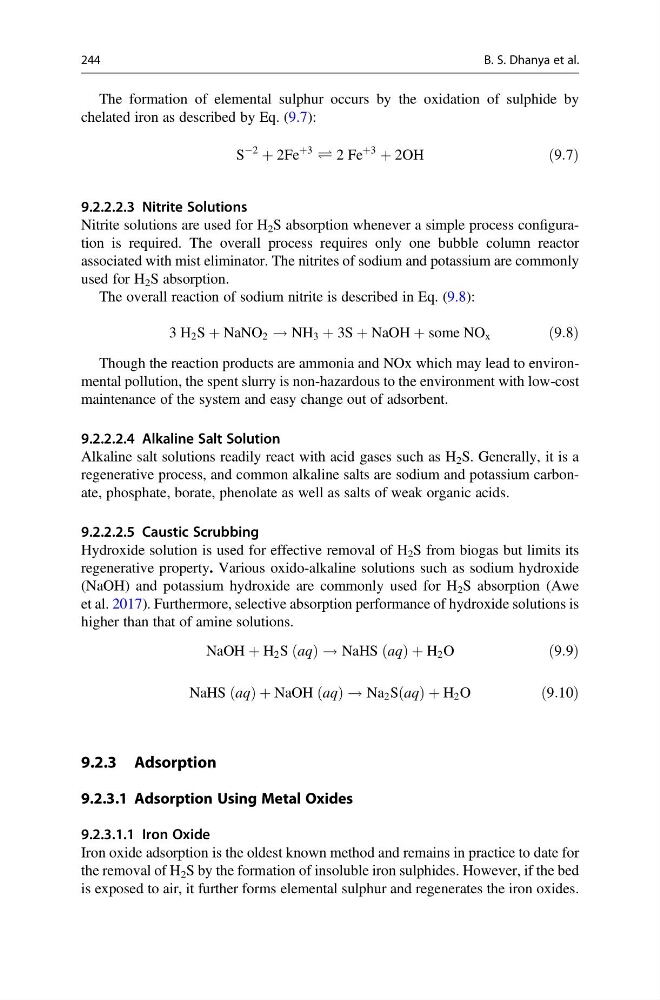
The formation of elemental sulphur occurs by the oxidation of sulphide by
chelated iron as described by Eq. (9.7):
S
À2
þ 2Fe
þ3
Ð 2 Fe
þ3
þ 2OH
ð9:7Þ
9.2.2.2.3 Nitrite Solutions
Nitrite solutions are used for H 2 S absorption whenever a simple process configuration is required. The overall process requires only one bubble column reactor
associated with mist eliminator. The nitrites of sodium and potassium are commonly
used for H 2 S absorption.
The overall reaction of sodium nitrite is described in Eq. (9.8):
3 H 2 S þ NaNO 2 ! NH 3 þ 3S þ NaOH þ some NO x
ð9:8Þ
Though the reaction products are ammonia and NOx which may lead to environmental pollution, the spent slurry is non-hazardous to the environment with low-cost
maintenance of the system and easy change out of adsorbent.
9.2.2.2.4 Alkaline Salt Solution
Alkaline salt solutions readily react with acid gases such as H 2 S. Generally, it is a
regenerative process, and common alkaline salts are sodium and potassium carbonate, phosphate, borate, phenolate as well as salts of weak organic acids.
9.2.2.2.5 Caustic Scrubbing
Hydroxide solution is used for effective removal of H 2 S from biogas but limits its
regenerative property. Various oxido-alkaline solutions such as sodium hydroxide
(NaOH) and potassium hydroxide are commonly used for H 2 S absorption (Awe
et al. 2017). Furthermore, selective absorption performance of hydroxide solutions is
higher than that of amine solutions.
NaOH þ H 2 S aq
ð Þ ! NaHS aq
ð Þ þ H 2 O
ð9:9Þ
NaHS aq
ð Þ þ NaOH aq
ð Þ ! Na 2 S aq
ð Þ þ H 2 O
ð9:10Þ
9.2.3 Adsorption
9.2.3.1 Adsorption Using Metal Oxides
9.2.3.1.1 Iron Oxide
Iron oxide adsorption is the oldest known method and remains in practice to date for
the removal of H 2 S by the formation of insoluble iron sulphides. However, if the bed
is exposed to air, it further forms elemental sulphur and regenerates the iron oxides.
244
B. S. Dhanya et al.
chelated iron as described by Eq. (9.7):
S
À2
þ 2Fe
þ3
Ð 2 Fe
þ3
þ 2OH
ð9:7Þ
9.2.2.2.3 Nitrite Solutions
Nitrite solutions are used for H 2 S absorption whenever a simple process configuration is required. The overall process requires only one bubble column reactor
associated with mist eliminator. The nitrites of sodium and potassium are commonly
used for H 2 S absorption.
The overall reaction of sodium nitrite is described in Eq. (9.8):
3 H 2 S þ NaNO 2 ! NH 3 þ 3S þ NaOH þ some NO x
ð9:8Þ
Though the reaction products are ammonia and NOx which may lead to environmental pollution, the spent slurry is non-hazardous to the environment with low-cost
maintenance of the system and easy change out of adsorbent.
9.2.2.2.4 Alkaline Salt Solution
Alkaline salt solutions readily react with acid gases such as H 2 S. Generally, it is a
regenerative process, and common alkaline salts are sodium and potassium carbonate, phosphate, borate, phenolate as well as salts of weak organic acids.
9.2.2.2.5 Caustic Scrubbing
Hydroxide solution is used for effective removal of H 2 S from biogas but limits its
regenerative property. Various oxido-alkaline solutions such as sodium hydroxide
(NaOH) and potassium hydroxide are commonly used for H 2 S absorption (Awe
et al. 2017). Furthermore, selective absorption performance of hydroxide solutions is
higher than that of amine solutions.
NaOH þ H 2 S aq
ð Þ ! NaHS aq
ð Þ þ H 2 O
ð9:9Þ
NaHS aq
ð Þ þ NaOH aq
ð Þ ! Na 2 S aq
ð Þ þ H 2 O
ð9:10Þ
9.2.3 Adsorption
9.2.3.1 Adsorption Using Metal Oxides
9.2.3.1.1 Iron Oxide
Iron oxide adsorption is the oldest known method and remains in practice to date for
the removal of H 2 S by the formation of insoluble iron sulphides. However, if the bed
is exposed to air, it further forms elemental sulphur and regenerates the iron oxides.
244
B. S. Dhanya et al.