

tolerable owing to the large quantity of methanol employed in the system. As
compared to the conventional method, relatively higher biomass yields are obtained
through this direct form of transesterification (Al-lwayzy et al. 2014; Park et al.
2015; Adeniyi et al. 2018).
8.6.2 Conventional Transesterification
This method is comprised of two stages and involves the mechanical extraction of
lipids prior to the transesterification process. Degumming and extraction methods
employing nonpolar, cheap, and unreactive solvents are significantly involved in this
kind of transesterification process (Hossain et al. 2018). The product obtained from
this method is highly refined and utilized in high-speed diesel engines (Salam et al.
2016; Martinez-Guerra and Gude 2016; Adeniyi et al. 2018).
8.6.3 Supercritical Methanol Transesterification
In this method, methanol is introduced to 100 mL algae culture containing cylinder
under supercritical conditions which are defined as 350–400
C, 10–25 MPa
(Demirbas 2008). Higher biomass yields are obtained through this economically
feasible method (Bahadar and Khan 2013); however, this method is not applied on a
commercial scale and is still being explored by the researchers.
8.7
Applications of Algal Biomass in Various Biotechnological
Sectors
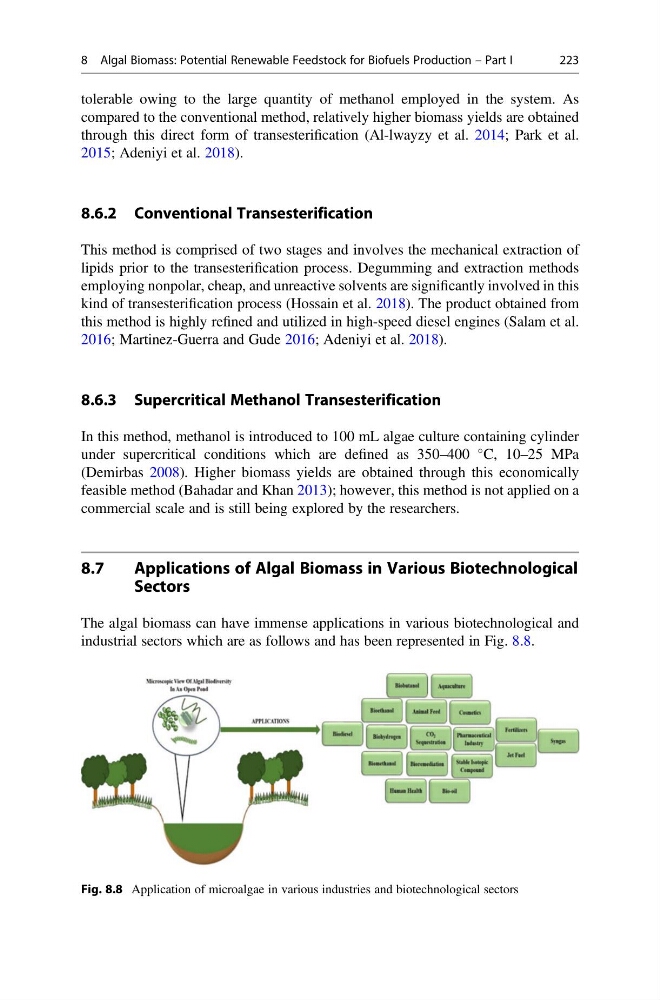
The algal biomass can have immense applications in various biotechnological and
industrial sectors which are as follows and has been represented in Fig. 8.8.
Fig. 8.8 Application of microalgae in various industries and biotechnological sectors
8 Algal Biomass: Potential Renewable Feedstock for Biofuels Production – Part I
223
compared to the conventional method, relatively higher biomass yields are obtained
through this direct form of transesterification (Al-lwayzy et al. 2014; Park et al.
2015; Adeniyi et al. 2018).
8.6.2 Conventional Transesterification
This method is comprised of two stages and involves the mechanical extraction of
lipids prior to the transesterification process. Degumming and extraction methods
employing nonpolar, cheap, and unreactive solvents are significantly involved in this
kind of transesterification process (Hossain et al. 2018). The product obtained from
this method is highly refined and utilized in high-speed diesel engines (Salam et al.
2016; Martinez-Guerra and Gude 2016; Adeniyi et al. 2018).
8.6.3 Supercritical Methanol Transesterification
In this method, methanol is introduced to 100 mL algae culture containing cylinder
under supercritical conditions which are defined as 350–400
C, 10–25 MPa
(Demirbas 2008). Higher biomass yields are obtained through this economically
feasible method (Bahadar and Khan 2013); however, this method is not applied on a
commercial scale and is still being explored by the researchers.
8.7
Applications of Algal Biomass in Various Biotechnological
Sectors
The algal biomass can have immense applications in various biotechnological and
industrial sectors which are as follows and has been represented in Fig. 8.8.
Fig. 8.8 Application of microalgae in various industries and biotechnological sectors
8 Algal Biomass: Potential Renewable Feedstock for Biofuels Production – Part I
223