

serves as a vital part of the microalgal biofuel production owing to its potential
features such as lower biomass loss during the respiratory phase (dark phase) and
reduced utilization of organic substrates during growth phase of the microalgal cells
(Brennan and Owende 2010).
8.3
Harvesting of Algal Biomass for Efficient Production
of Biofuel
Harvesting accounts for >30% of the total production cost in the open pond systems
(Zittelli et al. 2006; Shuba and Kifle 2018; Mathimani and Mallick 2018). The
harvesting of microalgae involves a two-stage process (i.e., bulk harvesting and
thickening). Biomass is separated from the bulk of the suspension in the process of
bulk harvesting, while thickening is characterized as the process of concentrating the
slurry (Brennan and Owende 2010; Shuba and Kifle 2018). As the microalgal cells
are small in size and have low density, this step incurs additional costs in the
production process. Thus, cost-effective processes for dewatering and harvesting
need to be chosen to make the entire process economically viable (Shuba and Kifle
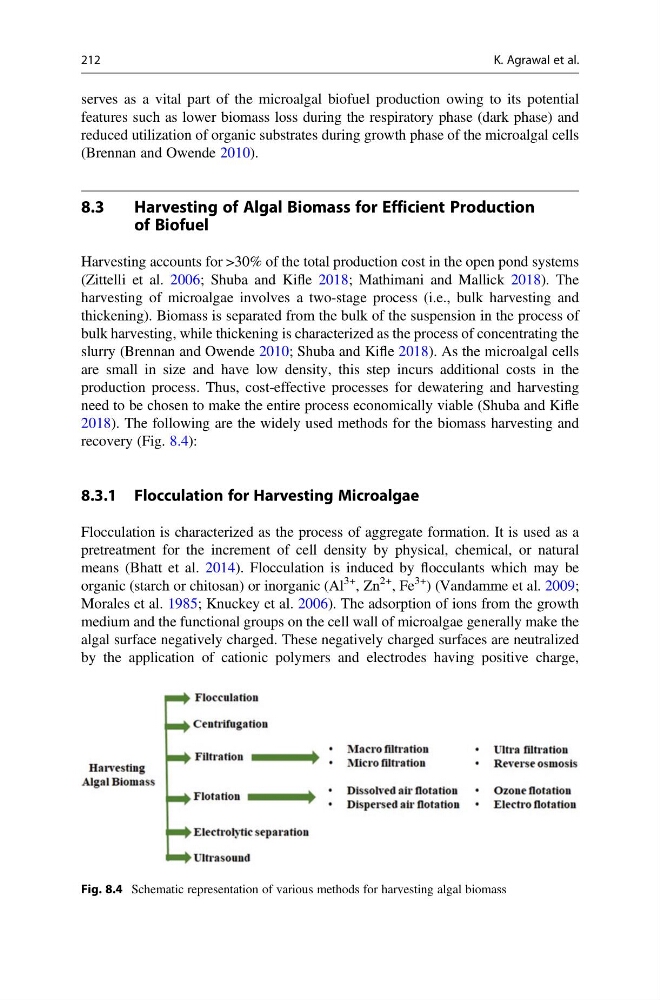
2018). The following are the widely used methods for the biomass harvesting and
recovery (Fig. 8.4):
8.3.1 Flocculation for Harvesting Microalgae
Flocculation is characterized as the process of aggregate formation. It is used as a
pretreatment for the increment of cell density by physical, chemical, or natural
means (Bhatt et al. 2014). Flocculation is induced by flocculants which may be
organic (starch or chitosan) or inorganic (Al
3+ , Zn
2+ , Fe
3+ ) (Vandamme et al. 2009;
Morales et al. 1985; Knuckey et al. 2006). The adsorption of ions from the growth
medium and the functional groups on the cell wall of microalgae generally make the
algal surface negatively charged. These negatively charged surfaces are neutralized
by the application of cationic polymers and electrodes having positive charge,
Fig. 8.4 Schematic representation of various methods for harvesting algal biomass
212
K. Agrawal et al.
features such as lower biomass loss during the respiratory phase (dark phase) and
reduced utilization of organic substrates during growth phase of the microalgal cells
(Brennan and Owende 2010).
8.3
Harvesting of Algal Biomass for Efficient Production
of Biofuel
Harvesting accounts for >30% of the total production cost in the open pond systems
(Zittelli et al. 2006; Shuba and Kifle 2018; Mathimani and Mallick 2018). The
harvesting of microalgae involves a two-stage process (i.e., bulk harvesting and
thickening). Biomass is separated from the bulk of the suspension in the process of
bulk harvesting, while thickening is characterized as the process of concentrating the
slurry (Brennan and Owende 2010; Shuba and Kifle 2018). As the microalgal cells
are small in size and have low density, this step incurs additional costs in the
production process. Thus, cost-effective processes for dewatering and harvesting
need to be chosen to make the entire process economically viable (Shuba and Kifle
2018). The following are the widely used methods for the biomass harvesting and
recovery (Fig. 8.4):
8.3.1 Flocculation for Harvesting Microalgae
Flocculation is characterized as the process of aggregate formation. It is used as a
pretreatment for the increment of cell density by physical, chemical, or natural
means (Bhatt et al. 2014). Flocculation is induced by flocculants which may be
organic (starch or chitosan) or inorganic (Al
3+ , Zn
2+ , Fe
3+ ) (Vandamme et al. 2009;
Morales et al. 1985; Knuckey et al. 2006). The adsorption of ions from the growth
medium and the functional groups on the cell wall of microalgae generally make the
algal surface negatively charged. These negatively charged surfaces are neutralized
by the application of cationic polymers and electrodes having positive charge,
Fig. 8.4 Schematic representation of various methods for harvesting algal biomass
212
K. Agrawal et al.