

system that precludes its use is the cost of the carbon source. However, the production cost can be reduced by using industrial waste or coproduct of refinery plants as
carbon source for the heterotrophic cultures. For instance, the microalgal productivity increases upon utilization of glycerol (crude) as the carbon source which is
obtained as a coproduct in biodiesel refinery plant (Suali and Sarbatly 2012).
Relative to the photosynthetic production, heterotrophic cultivation system
consumes more energy owing to the photosynthetic production of the initial organic
carbon source (Chisti 2007; Brennan and Owende 2010).
8.2.3 Mixotrophic Cultivation System of Microalgae
Many algal species can employ either phototrophic or autotrophic method of growth.
This implies that any metabolism process can be utilized as they possess photosynthetic ability and can also consume prey or exploit organic resources for growth
(Graham et al. 2009). Either light or organic carbon source can assist in microalgal
growth, and it is not stringently determined by photosynthesis, thereby exempting
light from being a growth limiting factor (Andrade and Costa 2007). The green algae
Spirulina platensis and Chlamydomonas reinhardtii are the representative
organisms displaying mixotrophic metabolism (Chen et al. 1996). In the mixotrophic
type of production, lesser amount of biomass is lost during the dark phase because
the microalgal growth is affected by media supplements along with glucose in both
the light and dark phases (Andrade and Costa 2007). As compared with the CPBRs
and OPCS of photoautotrophic microorganisms, the mixotrophic microalgal growth
rates are comparable with respect to the CPBR and higher than OPCS, but these rates
are significantly lower contrary to the heterotrophic production. Mixotrophic method
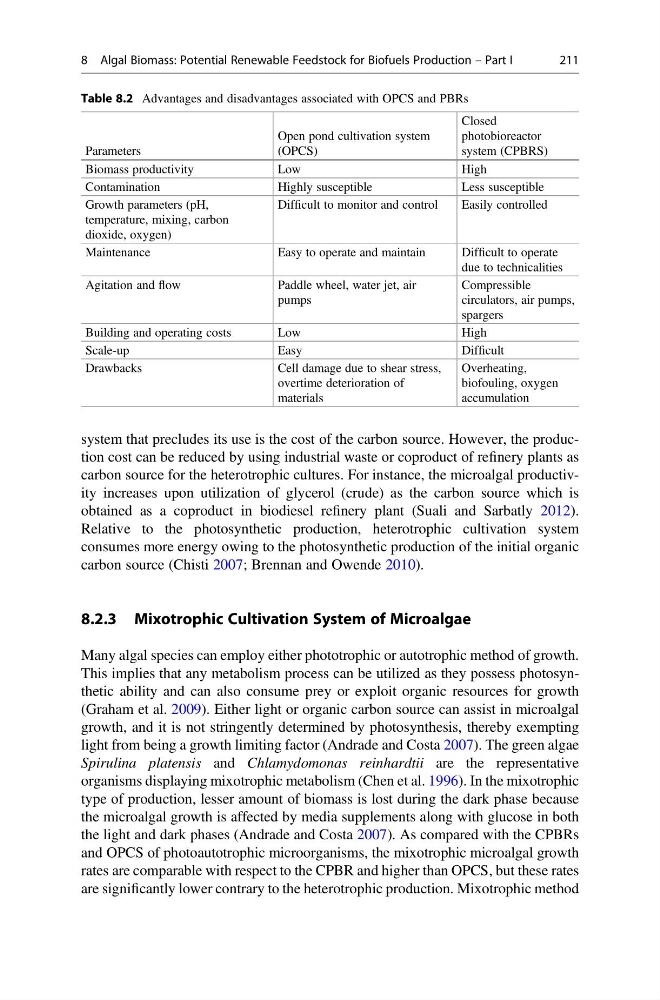
Table 8.2 Advantages and disadvantages associated with OPCS and PBRs
Parameters
Open pond cultivation system
(OPCS)
Closed
photobioreactor
system (CPBRS)
Biomass productivity
Low
High
Contamination
Highly susceptible
Less susceptible
Growth parameters (pH,
temperature, mixing, carbon
dioxide, oxygen)
Difficult to monitor and control
Easily controlled
Maintenance
Easy to operate and maintain
Difficult to operate
due to technicalities
Agitation and flow
Paddle wheel, water jet, air
pumps
Compressible
circulators, air pumps,
spargers
Building and operating costs
Low
High
Scale-up
Easy
Difficult
Drawbacks
Cell damage due to shear stress,
overtime deterioration of
materials
Overheating,
biofouling, oxygen
accumulation
8 Algal Biomass: Potential Renewable Feedstock for Biofuels Production – Part I
211
carbon source for the heterotrophic cultures. For instance, the microalgal productivity increases upon utilization of glycerol (crude) as the carbon source which is
obtained as a coproduct in biodiesel refinery plant (Suali and Sarbatly 2012).
Relative to the photosynthetic production, heterotrophic cultivation system
consumes more energy owing to the photosynthetic production of the initial organic
carbon source (Chisti 2007; Brennan and Owende 2010).
8.2.3 Mixotrophic Cultivation System of Microalgae
Many algal species can employ either phototrophic or autotrophic method of growth.
This implies that any metabolism process can be utilized as they possess photosynthetic ability and can also consume prey or exploit organic resources for growth
(Graham et al. 2009). Either light or organic carbon source can assist in microalgal
growth, and it is not stringently determined by photosynthesis, thereby exempting
light from being a growth limiting factor (Andrade and Costa 2007). The green algae
Spirulina platensis and Chlamydomonas reinhardtii are the representative
organisms displaying mixotrophic metabolism (Chen et al. 1996). In the mixotrophic
type of production, lesser amount of biomass is lost during the dark phase because
the microalgal growth is affected by media supplements along with glucose in both
the light and dark phases (Andrade and Costa 2007). As compared with the CPBRs
and OPCS of photoautotrophic microorganisms, the mixotrophic microalgal growth
rates are comparable with respect to the CPBR and higher than OPCS, but these rates
are significantly lower contrary to the heterotrophic production. Mixotrophic method
Table 8.2 Advantages and disadvantages associated with OPCS and PBRs
Parameters
Open pond cultivation system
(OPCS)
Closed
photobioreactor
system (CPBRS)
Biomass productivity
Low
High
Contamination
Highly susceptible
Less susceptible
Growth parameters (pH,
temperature, mixing, carbon
dioxide, oxygen)
Difficult to monitor and control
Easily controlled
Maintenance
Easy to operate and maintain
Difficult to operate
due to technicalities
Agitation and flow
Paddle wheel, water jet, air
pumps
Compressible
circulators, air pumps,
spargers
Building and operating costs
Low
High
Scale-up
Easy
Difficult
Drawbacks
Cell damage due to shear stress,
overtime deterioration of
materials
Overheating,
biofouling, oxygen
accumulation
8 Algal Biomass: Potential Renewable Feedstock for Biofuels Production – Part I
211