

enzymes for carbohydrate hydrolysis and enhancing the rate of fermentation. Therefore, selection of an optimal pretreatment strategy may have the following
characteristics: (i) high sugar and carbohydrate content after pretreatment,
(ii) improved enzymatic accessibility, (iii) minimum inhibitory generation and its
neutralization, (iv) assessing pretreated samples for value-added product generation,
and (v) selecting the source of bioethanol (liquid hydrolysate or water-insoluble
solids) (Agbor et al. 2011; Lee et al. 2013). Several pretreatment methods are
investigated for pretreatment of feedstocks that can be broadly categorized into
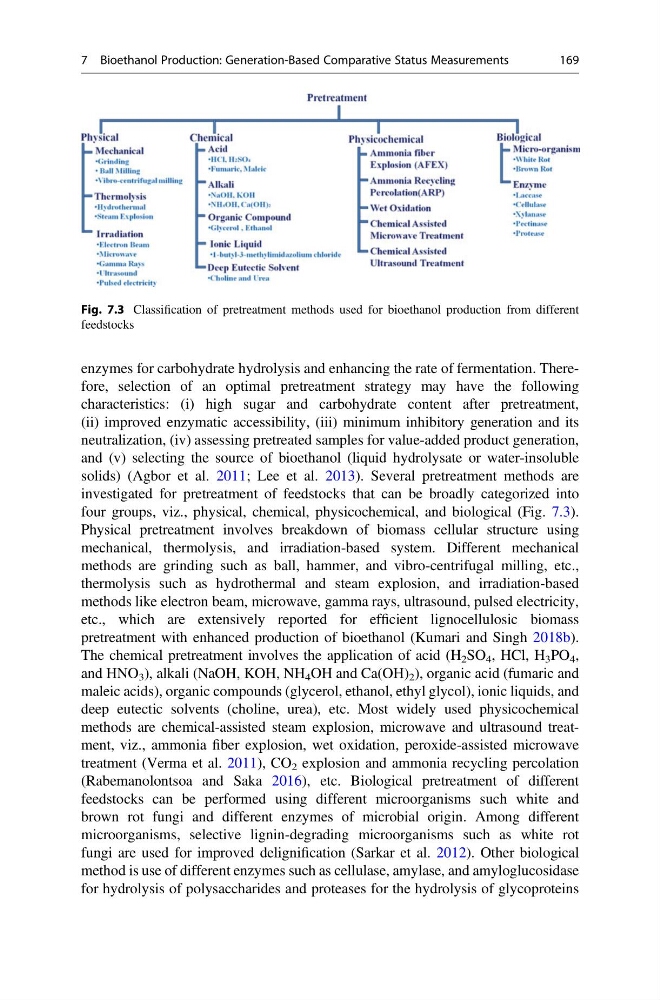
four groups, viz., physical, chemical, physicochemical, and biological (Fig. 7.3).
Physical pretreatment involves breakdown of biomass cellular structure using
mechanical, thermolysis, and irradiation-based system. Different mechanical
methods are grinding such as ball, hammer, and vibro-centrifugal milling, etc.,
thermolysis such as hydrothermal and steam explosion, and irradiation-based
methods like electron beam, microwave, gamma rays, ultrasound, pulsed electricity,
etc., which are extensively reported for efficient lignocellulosic biomass
pretreatment with enhanced production of bioethanol (Kumari and Singh 2018b).
The chemical pretreatment involves the application of acid (H 2 SO 4 , HCl, H 3 PO 4 ,
and HNO 3 ), alkali (NaOH, KOH, NH 4 OH and Ca(OH) 2 ), organic acid (fumaric and
maleic acids), organic compounds (glycerol, ethanol, ethyl glycol), ionic liquids, and
deep eutectic solvents (choline, urea), etc. Most widely used physicochemical
methods are chemical-assisted steam explosion, microwave and ultrasound treatment, viz., ammonia fiber explosion, wet oxidation, peroxide-assisted microwave
treatment (Verma et al. 2011), CO 2 explosion and ammonia recycling percolation
(Rabemanolontsoa and Saka 2016), etc. Biological pretreatment of different
feedstocks can be performed using different microorganisms such white and
brown rot fungi and different enzymes of microbial origin. Among different
microorganisms, selective lignin-degrading microorganisms such as white rot
fungi are used for improved delignification (Sarkar et al. 2012). Other biological
method is use of different enzymes such as cellulase, amylase, and amyloglucosidase
for hydrolysis of polysaccharides and proteases for the hydrolysis of glycoproteins
Fig. 7.3 Classification of pretreatment methods used for bioethanol production from different
feedstocks
7 Bioethanol Production: Generation-Based Comparative Status Measurements
169
characteristics: (i) high sugar and carbohydrate content after pretreatment,
(ii) improved enzymatic accessibility, (iii) minimum inhibitory generation and its
neutralization, (iv) assessing pretreated samples for value-added product generation,
and (v) selecting the source of bioethanol (liquid hydrolysate or water-insoluble
solids) (Agbor et al. 2011; Lee et al. 2013). Several pretreatment methods are
investigated for pretreatment of feedstocks that can be broadly categorized into
four groups, viz., physical, chemical, physicochemical, and biological (Fig. 7.3).
Physical pretreatment involves breakdown of biomass cellular structure using
mechanical, thermolysis, and irradiation-based system. Different mechanical
methods are grinding such as ball, hammer, and vibro-centrifugal milling, etc.,
thermolysis such as hydrothermal and steam explosion, and irradiation-based
methods like electron beam, microwave, gamma rays, ultrasound, pulsed electricity,
etc., which are extensively reported for efficient lignocellulosic biomass
pretreatment with enhanced production of bioethanol (Kumari and Singh 2018b).
The chemical pretreatment involves the application of acid (H 2 SO 4 , HCl, H 3 PO 4 ,
and HNO 3 ), alkali (NaOH, KOH, NH 4 OH and Ca(OH) 2 ), organic acid (fumaric and
maleic acids), organic compounds (glycerol, ethanol, ethyl glycol), ionic liquids, and
deep eutectic solvents (choline, urea), etc. Most widely used physicochemical
methods are chemical-assisted steam explosion, microwave and ultrasound treatment, viz., ammonia fiber explosion, wet oxidation, peroxide-assisted microwave
treatment (Verma et al. 2011), CO 2 explosion and ammonia recycling percolation
(Rabemanolontsoa and Saka 2016), etc. Biological pretreatment of different
feedstocks can be performed using different microorganisms such white and
brown rot fungi and different enzymes of microbial origin. Among different
microorganisms, selective lignin-degrading microorganisms such as white rot
fungi are used for improved delignification (Sarkar et al. 2012). Other biological
method is use of different enzymes such as cellulase, amylase, and amyloglucosidase
for hydrolysis of polysaccharides and proteases for the hydrolysis of glycoproteins
Fig. 7.3 Classification of pretreatment methods used for bioethanol production from different
feedstocks
7 Bioethanol Production: Generation-Based Comparative Status Measurements
169