

the basis of the type of biomass used (Fig. 7.1). Bioethanol is a major class of biofuel
which can be obtained from all four generations of feedstocks. Thus, the bioethanol
obtained from food crops (grains and sugarcane) is called as first-generation
(1G) bioethanol. The lignocellulosic biomass (forest and agricultural residues)based ethanol is called second-generation (2G) bioethanol, and algal-based ethanol
is considered as third-generation (3G) bioethanol (Thatoi et al. 2016). One of the
recently developed approaches is the fourth generation (4G) which is basically based
on the capture of free CO 2 from the environment and its storage in biomass materials
using a process such as oxy-fuel combustion. Different feedstocks vary in their
compositional analysis which greatly influences the type of process adapted for
ethanol generation from the feedstocks. Composition of different renewable
feedstocks for different generations of bioethanol is explained through Fig. 7.1.
Researchers are making every possible attempt for economical production of
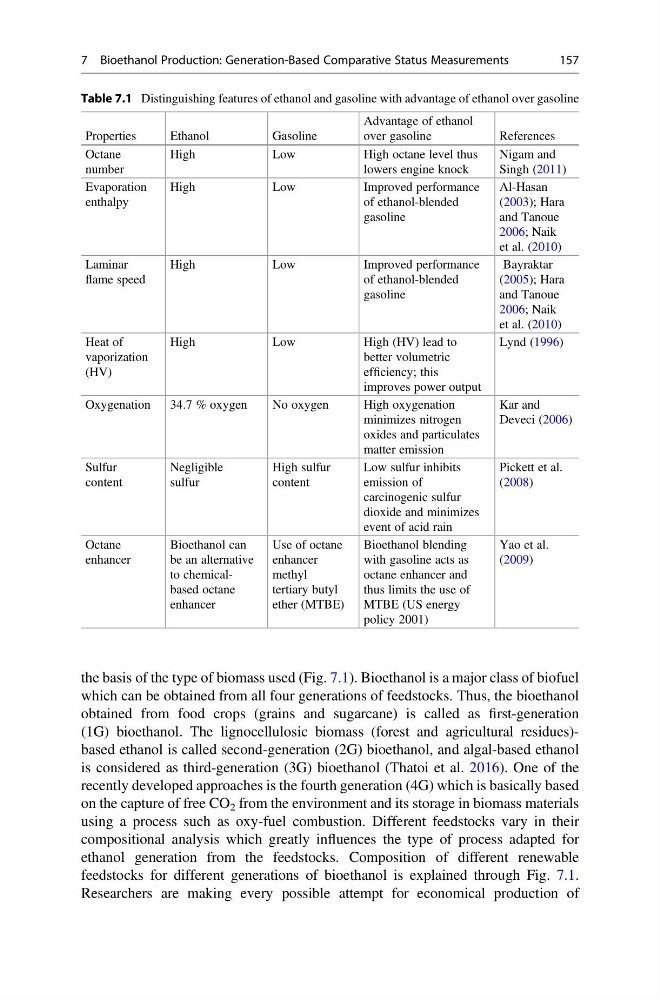
Table 7.1 Distinguishing features of ethanol and gasoline with advantage of ethanol over gasoline
Properties
Ethanol
Gasoline
Advantage of ethanol
over gasoline
References
Octane
number
High
Low
High octane level thus
lowers engine knock
Nigam and
Singh (2011)
Evaporation
enthalpy
High
Low
Improved performance
of ethanol-blended
gasoline
Al-Hasan
(2003); Hara
and Tanoue
2006; Naik
et al. (2010)
Laminar
flame speed
High
Low
Improved performance
of ethanol-blended
gasoline
Bayraktar
(2005); Hara
and Tanoue
2006; Naik
et al. (2010)
Heat of
vaporization
(HV)
High
Low
High (HV) lead to
better volumetric
efficiency; this
improves power output
Lynd (1996)
Oxygenation
34.7 % oxygen
No oxygen
High oxygenation
minimizes nitrogen
oxides and particulates
matter emission
Kar and
Deveci (2006)
Sulfur
content
Negligible
sulfur
High sulfur
content
Low sulfur inhibits
emission of
carcinogenic sulfur
dioxide and minimizes
event of acid rain
Pickett et al.
(2008)
Octane
enhancer
Bioethanol can
be an alternative
to chemicalbased octane
enhancer
Use of octane
enhancer
methyl
tertiary butyl
ether (MTBE)
Bioethanol blending
with gasoline acts as
octane enhancer and
thus limits the use of
MTBE (US energy
policy 2001)
Yao et al.
(2009)
7 Bioethanol Production: Generation-Based Comparative Status Measurements
157
which can be obtained from all four generations of feedstocks. Thus, the bioethanol
obtained from food crops (grains and sugarcane) is called as first-generation
(1G) bioethanol. The lignocellulosic biomass (forest and agricultural residues)based ethanol is called second-generation (2G) bioethanol, and algal-based ethanol
is considered as third-generation (3G) bioethanol (Thatoi et al. 2016). One of the
recently developed approaches is the fourth generation (4G) which is basically based
on the capture of free CO 2 from the environment and its storage in biomass materials
using a process such as oxy-fuel combustion. Different feedstocks vary in their
compositional analysis which greatly influences the type of process adapted for
ethanol generation from the feedstocks. Composition of different renewable
feedstocks for different generations of bioethanol is explained through Fig. 7.1.
Researchers are making every possible attempt for economical production of
Table 7.1 Distinguishing features of ethanol and gasoline with advantage of ethanol over gasoline
Properties
Ethanol
Gasoline
Advantage of ethanol
over gasoline
References
Octane
number
High
Low
High octane level thus
lowers engine knock
Nigam and
Singh (2011)
Evaporation
enthalpy
High
Low
Improved performance
of ethanol-blended
gasoline
Al-Hasan
(2003); Hara
and Tanoue
2006; Naik
et al. (2010)
Laminar
flame speed
High
Low
Improved performance
of ethanol-blended
gasoline
Bayraktar
(2005); Hara
and Tanoue
2006; Naik
et al. (2010)
Heat of
vaporization
(HV)
High
Low
High (HV) lead to
better volumetric
efficiency; this
improves power output
Lynd (1996)
Oxygenation
34.7 % oxygen
No oxygen
High oxygenation
minimizes nitrogen
oxides and particulates
matter emission
Kar and
Deveci (2006)
Sulfur
content
Negligible
sulfur
High sulfur
content
Low sulfur inhibits
emission of
carcinogenic sulfur
dioxide and minimizes
event of acid rain
Pickett et al.
(2008)
Octane
enhancer
Bioethanol can
be an alternative
to chemicalbased octane
enhancer
Use of octane
enhancer
methyl
tertiary butyl
ether (MTBE)
Bioethanol blending
with gasoline acts as
octane enhancer and
thus limits the use of
MTBE (US energy
policy 2001)
Yao et al.
(2009)
7 Bioethanol Production: Generation-Based Comparative Status Measurements
157