

Keywords
Biofuels · Biodiesel · Bioethanol · Vegetable oils · BTL · Fischer-Tropsch
1.1
Introduction to Biofuels
Compared to gasoline, diesel, and natural gas, alternative liquid biofuels derived
from biomasses have one main selling point: they are renewable. While there are
significant differences among liquid biofuels with regard to production, all are
argued to have a lower environmental impact at both the extraction and consumption
stages (Renewable Fuels Association 2015; Skutsch et al. 2011; Slade and Bauen
2013). Thus, while biofuels are economically marginal in the marketplace, they are
socially and politically useful (Solomon et al. 2007).
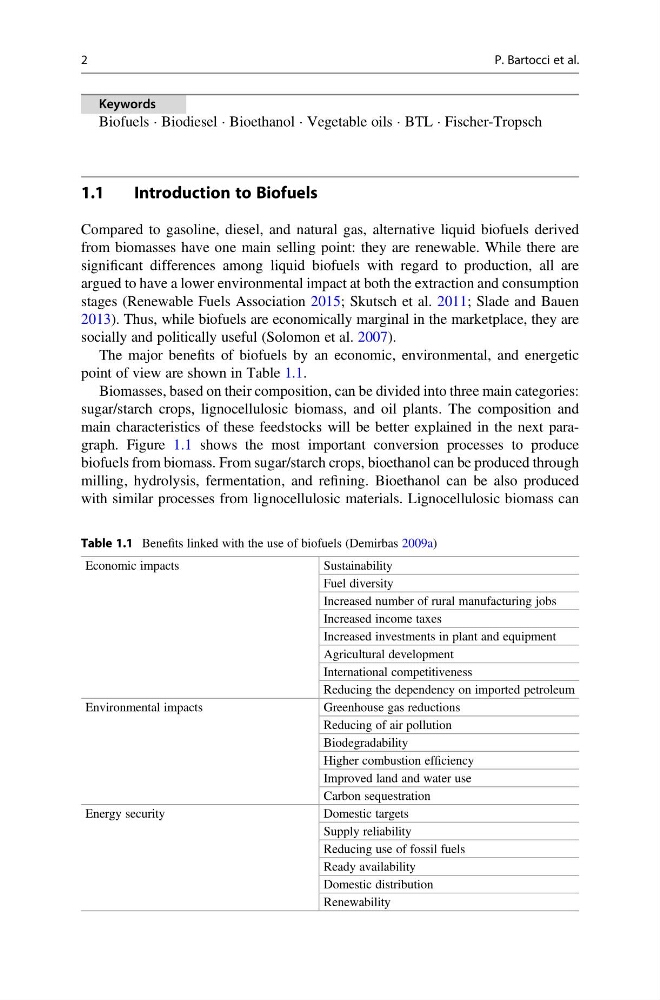
The major benefits of biofuels by an economic, environmental, and energetic
point of view are shown in Table 1.1.
Biomasses, based on their composition, can be divided into three main categories:
sugar/starch crops, lignocellulosic biomass, and oil plants. The composition and
main characteristics of these feedstocks will be better explained in the next paragraph. Figure 1.1 shows the most important conversion processes to produce
biofuels from biomass. From sugar/starch crops, bioethanol can be produced through
milling, hydrolysis, fermentation, and refining. Bioethanol can be also produced
with similar processes from lignocellulosic materials. Lignocellulosic biomass can
Table 1.1 Benefits linked with the use of biofuels (Demirbas 2009a)
Economic impacts
Sustainability
Fuel diversity
Increased number of rural manufacturing jobs
Increased income taxes
Increased investments in plant and equipment
Agricultural development
International competitiveness
Reducing the dependency on imported petroleum
Environmental impacts
Greenhouse gas reductions
Reducing of air pollution
Biodegradability
Higher combustion efficiency
Improved land and water use
Carbon sequestration
Energy security
Domestic targets
Supply reliability
Reducing use of fossil fuels
Ready availability
Domestic distribution
Renewability
2
P. Bartocci et al.
Biofuels · Biodiesel · Bioethanol · Vegetable oils · BTL · Fischer-Tropsch
1.1
Introduction to Biofuels
Compared to gasoline, diesel, and natural gas, alternative liquid biofuels derived
from biomasses have one main selling point: they are renewable. While there are
significant differences among liquid biofuels with regard to production, all are
argued to have a lower environmental impact at both the extraction and consumption
stages (Renewable Fuels Association 2015; Skutsch et al. 2011; Slade and Bauen
2013). Thus, while biofuels are economically marginal in the marketplace, they are
socially and politically useful (Solomon et al. 2007).
The major benefits of biofuels by an economic, environmental, and energetic
point of view are shown in Table 1.1.
Biomasses, based on their composition, can be divided into three main categories:
sugar/starch crops, lignocellulosic biomass, and oil plants. The composition and
main characteristics of these feedstocks will be better explained in the next paragraph. Figure 1.1 shows the most important conversion processes to produce
biofuels from biomass. From sugar/starch crops, bioethanol can be produced through
milling, hydrolysis, fermentation, and refining. Bioethanol can be also produced
with similar processes from lignocellulosic materials. Lignocellulosic biomass can
Table 1.1 Benefits linked with the use of biofuels (Demirbas 2009a)
Economic impacts
Sustainability
Fuel diversity
Increased number of rural manufacturing jobs
Increased income taxes
Increased investments in plant and equipment
Agricultural development
International competitiveness
Reducing the dependency on imported petroleum
Environmental impacts
Greenhouse gas reductions
Reducing of air pollution
Biodegradability
Higher combustion efficiency
Improved land and water use
Carbon sequestration
Energy security
Domestic targets
Supply reliability
Reducing use of fossil fuels
Ready availability
Domestic distribution
Renewability
2
P. Bartocci et al.