

European countries are using biogas for two purposes either for heat production
or for electricity. Basic technology is totally different from the industrial production
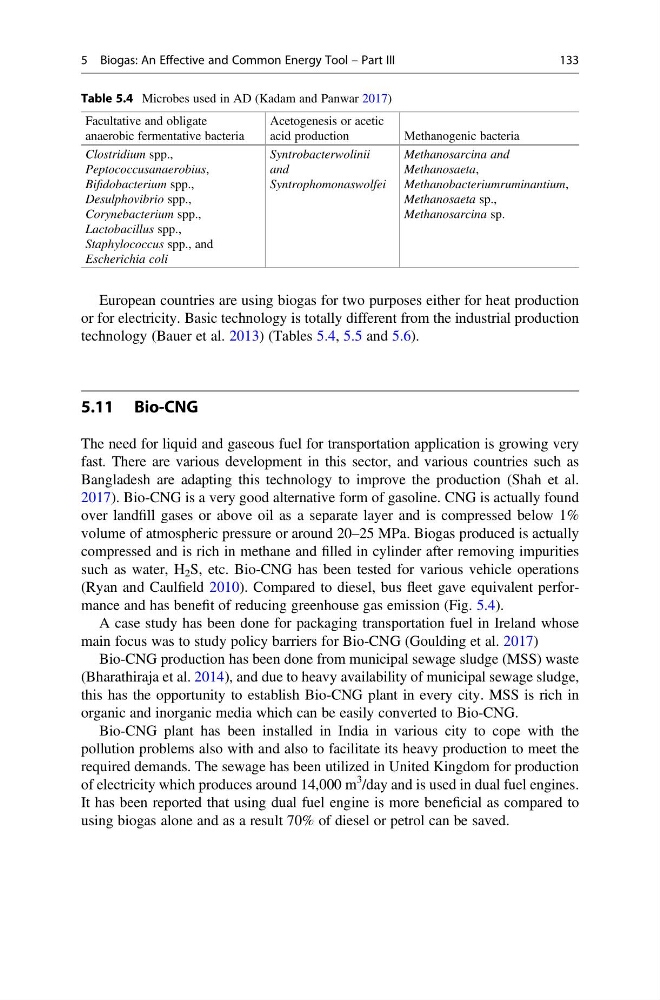
technology (Bauer et al. 2013) (Tables 5.4, 5.5 and 5.6).
5.11 Bio-CNG
The need for liquid and gaseous fuel for transportation application is growing very
fast. There are various development in this sector, and various countries such as
Bangladesh are adapting this technology to improve the production (Shah et al.
2017). Bio-CNG is a very good alternative form of gasoline. CNG is actually found
over landfill gases or above oil as a separate layer and is compressed below 1%
volume of atmospheric pressure or around 20–25 MPa. Biogas produced is actually
compressed and is rich in methane and filled in cylinder after removing impurities
such as water, H 2 S, etc. Bio-CNG has been tested for various vehicle operations
(Ryan and Caulfield 2010). Compared to diesel, bus fleet gave equivalent performance and has benefit of reducing greenhouse gas emission (Fig. 5.4).
A case study has been done for packaging transportation fuel in Ireland whose
main focus was to study policy barriers for Bio-CNG (Goulding et al. 2017)
Bio-CNG production has been done from municipal sewage sludge (MSS) waste
(Bharathiraja et al. 2014), and due to heavy availability of municipal sewage sludge,
this has the opportunity to establish Bio-CNG plant in every city. MSS is rich in
organic and inorganic media which can be easily converted to Bio-CNG.
Bio-CNG plant has been installed in India in various city to cope with the
pollution problems also with and also to facilitate its heavy production to meet the
required demands. The sewage has been utilized in United Kingdom for production
of electricity which produces around 14,000 m
3 /day and is used in dual fuel engines.
It has been reported that using dual fuel engine is more beneficial as compared to
using biogas alone and as a result 70% of diesel or petrol can be saved.
Table 5.4 Microbes used in AD (Kadam and Panwar 2017)
Facultative and obligate
anaerobic fermentative bacteria
Acetogenesis or acetic
acid production
Methanogenic bacteria
Clostridium spp.,
Peptococcusanaerobius,
Bifidobacterium spp.,
Desulphovibrio spp.,
Corynebacterium spp.,
Lactobacillus spp.,
Staphylococcus spp., and
Escherichia coli
Syntrobacterwolinii
and
Syntrophomonaswolfei
Methanosarcina and
Methanosaeta,
Methanobacteriumruminantium,
Methanosaeta sp.,
Methanosarcina sp.
5 Biogas: An Effective and Common Energy Tool – Part III
133
or for electricity. Basic technology is totally different from the industrial production
technology (Bauer et al. 2013) (Tables 5.4, 5.5 and 5.6).
5.11 Bio-CNG
The need for liquid and gaseous fuel for transportation application is growing very
fast. There are various development in this sector, and various countries such as
Bangladesh are adapting this technology to improve the production (Shah et al.
2017). Bio-CNG is a very good alternative form of gasoline. CNG is actually found
over landfill gases or above oil as a separate layer and is compressed below 1%
volume of atmospheric pressure or around 20–25 MPa. Biogas produced is actually
compressed and is rich in methane and filled in cylinder after removing impurities
such as water, H 2 S, etc. Bio-CNG has been tested for various vehicle operations
(Ryan and Caulfield 2010). Compared to diesel, bus fleet gave equivalent performance and has benefit of reducing greenhouse gas emission (Fig. 5.4).
A case study has been done for packaging transportation fuel in Ireland whose
main focus was to study policy barriers for Bio-CNG (Goulding et al. 2017)
Bio-CNG production has been done from municipal sewage sludge (MSS) waste
(Bharathiraja et al. 2014), and due to heavy availability of municipal sewage sludge,
this has the opportunity to establish Bio-CNG plant in every city. MSS is rich in
organic and inorganic media which can be easily converted to Bio-CNG.
Bio-CNG plant has been installed in India in various city to cope with the
pollution problems also with and also to facilitate its heavy production to meet the
required demands. The sewage has been utilized in United Kingdom for production
of electricity which produces around 14,000 m
3 /day and is used in dual fuel engines.
It has been reported that using dual fuel engine is more beneficial as compared to
using biogas alone and as a result 70% of diesel or petrol can be saved.
Table 5.4 Microbes used in AD (Kadam and Panwar 2017)
Facultative and obligate
anaerobic fermentative bacteria
Acetogenesis or acetic
acid production
Methanogenic bacteria
Clostridium spp.,
Peptococcusanaerobius,
Bifidobacterium spp.,
Desulphovibrio spp.,
Corynebacterium spp.,
Lactobacillus spp.,
Staphylococcus spp., and
Escherichia coli
Syntrobacterwolinii
and
Syntrophomonaswolfei
Methanosarcina and
Methanosaeta,
Methanobacteriumruminantium,
Methanosaeta sp.,
Methanosarcina sp.
5 Biogas: An Effective and Common Energy Tool – Part III
133