

(Zhu et al. 2004; Attwood et al. 2007; Ver Eecke et al. 2012; Brune, 2010).
Morphologically they have several shapes such as cocci, bacilli, spirilla, and sarcina.
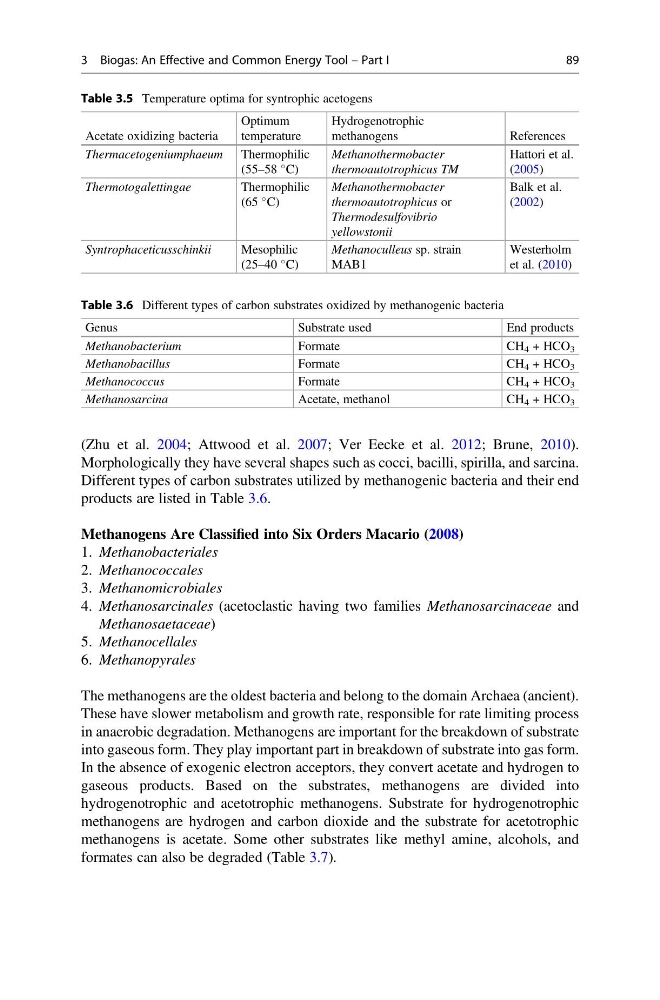
Different types of carbon substrates utilized by methanogenic bacteria and their end
products are listed in Table 3.6.
Methanogens Are Classified into Six Orders Macario (2008)
1. Methanobacteriales
2. Methanococcales
3. Methanomicrobiales
4. Methanosarcinales (acetoclastic having two families Methanosarcinaceae and
Methanosaetaceae)
5. Methanocellales
6. Methanopyrales
The methanogens are the oldest bacteria and belong to the domain Archaea (ancient).
These have slower metabolism and growth rate, responsible for rate limiting process
in anaerobic degradation. Methanogens are important for the breakdown of substrate
into gaseous form. They play important part in breakdown of substrate into gas form.
In the absence of exogenic electron acceptors, they convert acetate and hydrogen to
gaseous products. Based on the substrates, methanogens are divided into
hydrogenotrophic and acetotrophic methanogens. Substrate for hydrogenotrophic
methanogens are hydrogen and carbon dioxide and the substrate for acetotrophic
methanogens is acetate. Some other substrates like methyl amine, alcohols, and
formates can also be degraded (Table 3.7).
Table 3.5 Temperature optima for syntrophic acetogens
Acetate oxidizing bacteria
Optimum
temperature
Hydrogenotrophic
methanogens
References
Thermacetogeniumphaeum Thermophilic
(55–58
C)
Methanothermobacter
thermoautotrophicus TM
Hattori et al.
(2005)
Thermotogalettingae
Thermophilic
(65
C)
Methanothermobacter
thermoautotrophicus or
Thermodesulfovibrio
yellowstonii
Balk et al.
(2002)
Syntrophaceticusschinkii
Mesophilic
(25–40
C)
Methanoculleus sp. strain
MAB1
Westerholm
et al. (2010)
Table 3.6 Different types of carbon substrates oxidized by methanogenic bacteria
Genus
Substrate used
End products
Methanobacterium
Formate
CH 4 + HCO 3
Methanobacillus
Formate
CH 4 + HCO 3
Methanococcus
Formate
CH 4 + HCO 3
Methanosarcina
Acetate, methanol
CH 4 + HCO 3
3 Biogas: An Effective and Common Energy Tool – Part I
89
Morphologically they have several shapes such as cocci, bacilli, spirilla, and sarcina.
Different types of carbon substrates utilized by methanogenic bacteria and their end
products are listed in Table 3.6.
Methanogens Are Classified into Six Orders Macario (2008)
1. Methanobacteriales
2. Methanococcales
3. Methanomicrobiales
4. Methanosarcinales (acetoclastic having two families Methanosarcinaceae and
Methanosaetaceae)
5. Methanocellales
6. Methanopyrales
The methanogens are the oldest bacteria and belong to the domain Archaea (ancient).
These have slower metabolism and growth rate, responsible for rate limiting process
in anaerobic degradation. Methanogens are important for the breakdown of substrate
into gaseous form. They play important part in breakdown of substrate into gas form.
In the absence of exogenic electron acceptors, they convert acetate and hydrogen to
gaseous products. Based on the substrates, methanogens are divided into
hydrogenotrophic and acetotrophic methanogens. Substrate for hydrogenotrophic
methanogens are hydrogen and carbon dioxide and the substrate for acetotrophic
methanogens is acetate. Some other substrates like methyl amine, alcohols, and
formates can also be degraded (Table 3.7).
Table 3.5 Temperature optima for syntrophic acetogens
Acetate oxidizing bacteria
Optimum
temperature
Hydrogenotrophic
methanogens
References
Thermacetogeniumphaeum Thermophilic
(55–58
C)
Methanothermobacter
thermoautotrophicus TM
Hattori et al.
(2005)
Thermotogalettingae
Thermophilic
(65
C)
Methanothermobacter
thermoautotrophicus or
Thermodesulfovibrio
yellowstonii
Balk et al.
(2002)
Syntrophaceticusschinkii
Mesophilic
(25–40
C)
Methanoculleus sp. strain
MAB1
Westerholm
et al. (2010)
Table 3.6 Different types of carbon substrates oxidized by methanogenic bacteria
Genus
Substrate used
End products
Methanobacterium
Formate
CH 4 + HCO 3
Methanobacillus
Formate
CH 4 + HCO 3
Methanococcus
Formate
CH 4 + HCO 3
Methanosarcina
Acetate, methanol
CH 4 + HCO 3
3 Biogas: An Effective and Common Energy Tool – Part I
89