

processes, more than one digesters separate different stages (Lozano et al. 2009;
Klocke et al. 2008).
3.8
Microbiology of Anaerobic Digestion
Microbiology of anaerobic digestion is a process which involves decomposition of
several types of complex organic wastes, through consortia of metabolically active
microorganisms such as hydrolysing, acidifying, acetogenic, and methanogenic, into
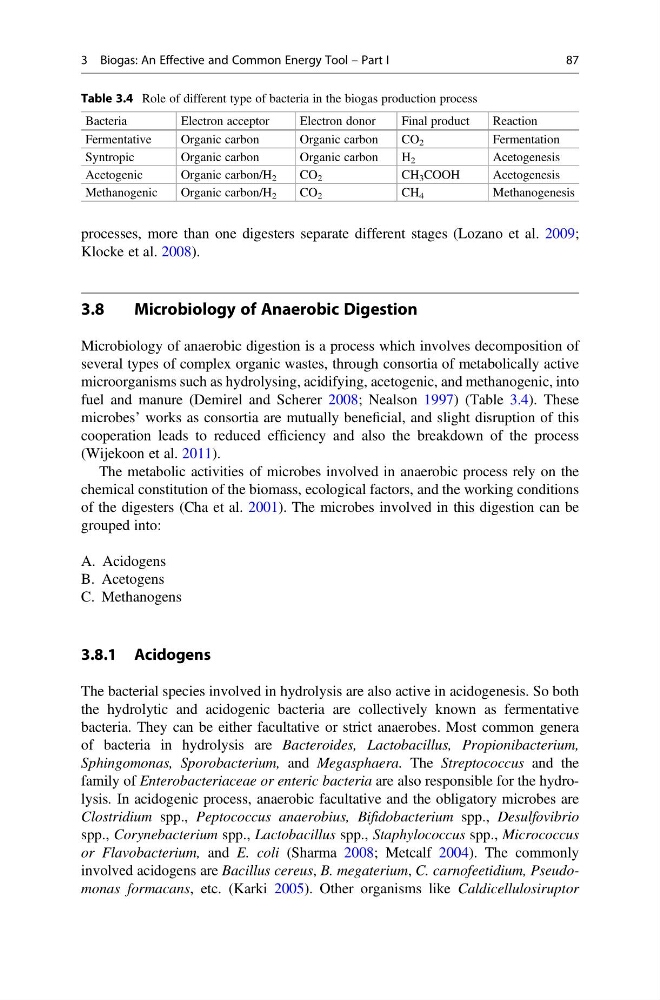
fuel and manure (Demirel and Scherer 2008; Nealson 1997) (Table 3.4). These
microbes’ works as consortia are mutually beneficial, and slight disruption of this
cooperation leads to reduced efficiency and also the breakdown of the process
(Wijekoon et al. 2011).
The metabolic activities of microbes involved in anaerobic process rely on the
chemical constitution of the biomass, ecological factors, and the working conditions
of the digesters (Cha et al. 2001). The microbes involved in this digestion can be
grouped into:
A. Acidogens
B. Acetogens
C. Methanogens
3.8.1 Acidogens
The bacterial species involved in hydrolysis are also active in acidogenesis. So both
the hydrolytic and acidogenic bacteria are collectively known as fermentative
bacteria. They can be either facultative or strict anaerobes. Most common genera
of bacteria in hydrolysis are Bacteroides, Lactobacillus, Propionibacterium,
Sphingomonas, Sporobacterium, and Megasphaera. The Streptococcus and the
family of Enterobacteriaceae or enteric bacteria are also responsible for the hydrolysis. In acidogenic process, anaerobic facultative and the obligatory microbes are
Clostridium spp., Peptococcus anaerobius, Bifidobacterium spp., Desulfovibrio
spp., Corynebacterium spp., Lactobacillus spp., Staphylococcus spp., Micrococcus
or Flavobacterium, and E. coli (Sharma 2008; Metcalf 2004). The commonly
involved acidogens are Bacillus cereus, B. megaterium, C. carnofeetidium, Pseudomonas formacans, etc. (Karki 2005). Other organisms like Caldicellulosiruptor
Table 3.4 Role of different type of bacteria in the biogas production process
Bacteria
Electron acceptor
Electron donor
Final product
Reaction
Fermentative
Organic carbon
Organic carbon
CO 2
Fermentation
Syntropic
Organic carbon
Organic carbon
H 2
Acetogenesis
Acetogenic
Organic carbon/H 2
CO 2
CH 3 COOH
Acetogenesis
Methanogenic
Organic carbon/H 2
CO 2
CH 4
Methanogenesis
3 Biogas: An Effective and Common Energy Tool – Part I
87
Klocke et al. 2008).
3.8
Microbiology of Anaerobic Digestion
Microbiology of anaerobic digestion is a process which involves decomposition of
several types of complex organic wastes, through consortia of metabolically active
microorganisms such as hydrolysing, acidifying, acetogenic, and methanogenic, into
fuel and manure (Demirel and Scherer 2008; Nealson 1997) (Table 3.4). These
microbes’ works as consortia are mutually beneficial, and slight disruption of this
cooperation leads to reduced efficiency and also the breakdown of the process
(Wijekoon et al. 2011).
The metabolic activities of microbes involved in anaerobic process rely on the
chemical constitution of the biomass, ecological factors, and the working conditions
of the digesters (Cha et al. 2001). The microbes involved in this digestion can be
grouped into:
A. Acidogens
B. Acetogens
C. Methanogens
3.8.1 Acidogens
The bacterial species involved in hydrolysis are also active in acidogenesis. So both
the hydrolytic and acidogenic bacteria are collectively known as fermentative
bacteria. They can be either facultative or strict anaerobes. Most common genera
of bacteria in hydrolysis are Bacteroides, Lactobacillus, Propionibacterium,
Sphingomonas, Sporobacterium, and Megasphaera. The Streptococcus and the
family of Enterobacteriaceae or enteric bacteria are also responsible for the hydrolysis. In acidogenic process, anaerobic facultative and the obligatory microbes are
Clostridium spp., Peptococcus anaerobius, Bifidobacterium spp., Desulfovibrio
spp., Corynebacterium spp., Lactobacillus spp., Staphylococcus spp., Micrococcus
or Flavobacterium, and E. coli (Sharma 2008; Metcalf 2004). The commonly
involved acidogens are Bacillus cereus, B. megaterium, C. carnofeetidium, Pseudomonas formacans, etc. (Karki 2005). Other organisms like Caldicellulosiruptor
Table 3.4 Role of different type of bacteria in the biogas production process
Bacteria
Electron acceptor
Electron donor
Final product
Reaction
Fermentative
Organic carbon
Organic carbon
CO 2
Fermentation
Syntropic
Organic carbon
Organic carbon
H 2
Acetogenesis
Acetogenic
Organic carbon/H 2
CO 2
CH 3 COOH
Acetogenesis
Methanogenic
Organic carbon/H 2
CO 2
CH 4
Methanogenesis
3 Biogas: An Effective and Common Energy Tool – Part I
87