

808
W. S. de Amorim et al.
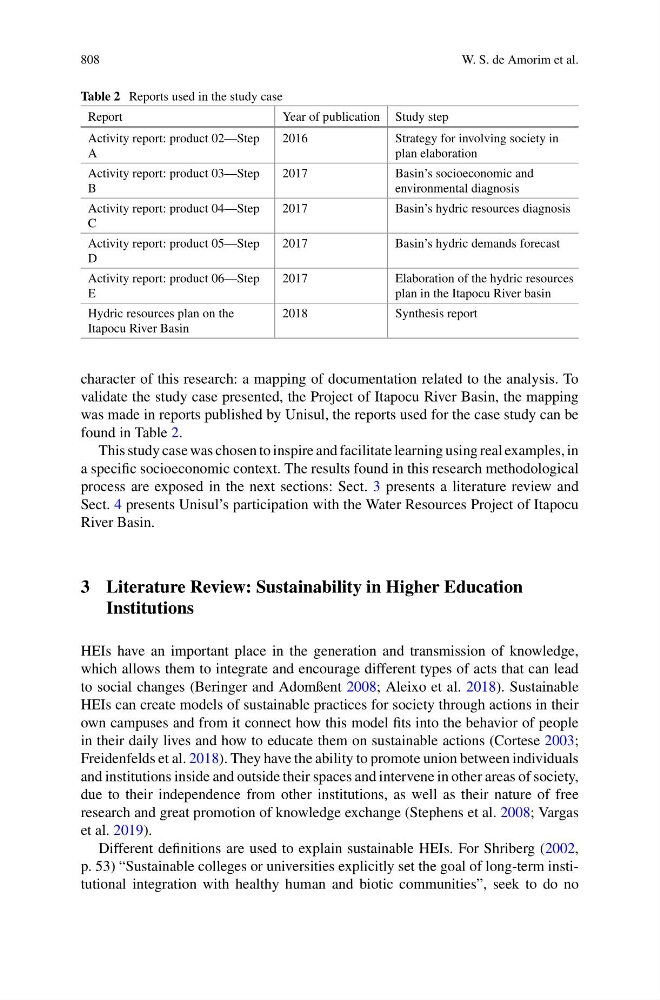
Table 2 Reports used in the study case
Report
Year of publication Study step
Activity report: product 02—Step
A
2016
Strategy for involving society in
plan elaboration
Activity report: product 03—Step
B
2017
Basin’s socioeconomic and
environmental diagnosis
Activity report: product 04—Step
C
2017
Basin’s hydric resources diagnosis
Activity report: product 05—Step
D
2017
Basin’s hydric demands forecast
Activity report: product 06—Step
E
2017
Elaboration of the hydric resources
plan in the Itapocu River basin
Hydric resources plan on the
Itapocu River Basin
2018
Synthesis report
character of this research: a mapping of documentation related to the analysis. To
validate the study case presented, the Project of Itapocu River Basin, the mapping
was made in reports published by Unisul, the reports used for the case study can be
found in Table 2.
This study case was chosen to inspire and facilitate learning using real examples, in
a specific socioeconomic context. The results found in this research methodological
process are exposed in the next sections: Sect. 3 presents a literature review and
Sect. 4 presents Unisul’s participation with the Water Resources Project of Itapocu
River Basin.
3 Literature Review: Sustainability in Higher Education
Institutions
HEIs have an important place in the generation and transmission of knowledge,
which allows them to integrate and encourage different types of acts that can lead
to social changes (Beringer and Adomßent 2008; Aleixo et al. 2018). Sustainable
HEIs can create models of sustainable practices for society through actions in their
own campuses and from it connect how this model fits into the behavior of people
in their daily lives and how to educate them on sustainable actions (Cortese 2003;
Freidenfelds et al. 2018). They have the ability to promote union between individuals
and institutions inside and outside their spaces and intervene in other areas of society,
due to their independence from other institutions, as well as their nature of free
research and great promotion of knowledge exchange (Stephens et al. 2008; Vargas
et al. 2019).
Different definitions are used to explain sustainable HEIs. For Shriberg (2002,
p. 53) “Sustainable colleges or universities explicitly set the goal of long-term institutional integration with healthy human and biotic communities”, seek to do no