

Higher Education Institutions as Drivers of Sustainable …
807
matic events which will be approached further. Accounting all these factors, Unisul,
alongside the government of the state of Santa Catarina, has elaborated a plan to aid
communities prosper and sustainably manage the critical resources provided by the
basin. Through the case study and literature review it is possible to acknowledge the
importance of HEIs in the strengthening communities to accomplish SDGs.
2 Methods
The methodological process used in this article consists of two parts: the fist one is a
bibliometric review as presented by Arksey and O’Malley (2005) and confirmed by
Levac et al. (2010). This spectrum was used to identify state-of-the-art literature on
Sustainable Higher Education Institutions, Living Labs, Green Campus and the role
of Universities, and how can these things help implementing Sustainable Development. The first step in the bibliometric research was to identify the research question:
how can HEIs promote Sustainable Development in communities?
The second step was to identify relevant studies to that goal. Firstly, the following databases were selected: Science Direct, Scopus and Web of Science. In these
databases, a search was conducted for the following keywords: Higher Education
Institutions; Sustainable Communities; Sustainable Development Goals; Sustainability and Living Labs. As in systematic literature reviews, inclusion and exclusion
criteria were adopted, favoring breadth rather than depth in the selection. The third
step was selecting material for the study; since there is a great number of publications
presented for each search, the 20 most relevant and the 20 most cited articles were
selected for a deeper analysis based on their relevance for the research question. To
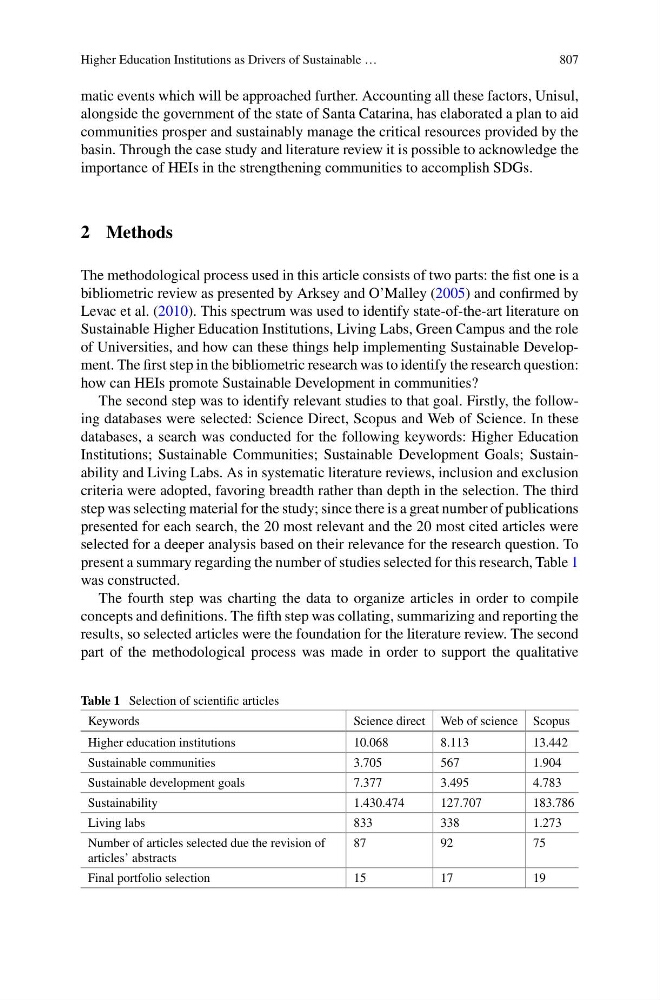
present a summary regarding the number of studies selected for this research, Table 1
was constructed.
The fourth step was charting the data to organize articles in order to compile
concepts and definitions. The fifth step was collating, summarizing and reporting the
results, so selected articles were the foundation for the literature review. The second
part of the methodological process was made in order to support the qualitative
Table 1 Selection of scientific articles
Keywords
Science direct Web of science Scopus
Higher education institutions
10.068
8.113
13.442
Sustainable communities
3.705
567
1.904
Sustainable development goals
7.377
3.495
4.783
Sustainability
1.430.474
127.707
183.786
Living labs
833
338
1.273
Number of articles selected due the revision of
articles’ abstracts
87
92
75
Final portfolio selection
15
17
19