

64
F. L. L. de Paulo and P. J. S. Camões
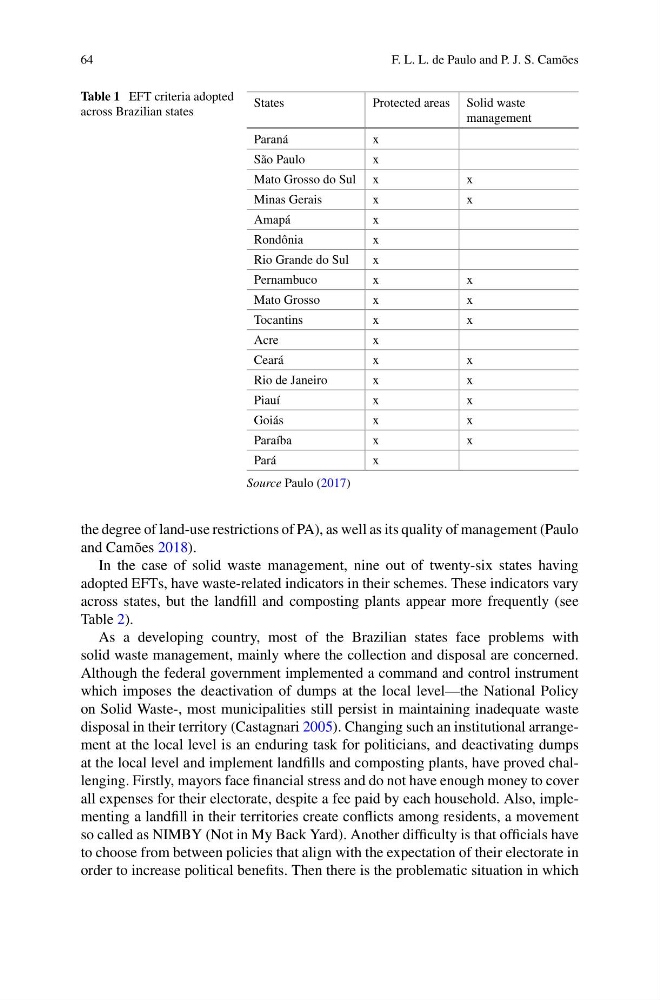
Table 1 EFT criteria adopted
across Brazilian states
States
Protected areas Solid waste
management
Paraná
x
São Paulo
x
Mato Grosso do Sul x
x
Minas Gerais
x
x
Amapá
x
Rondônia
x
Rio Grande do Sul
x
Pernambuco
x
x
Mato Grosso
x
x
Tocantins
x
x
Acre
x
Ceará
x
x
Rio de Janeiro
x
x
Piauí
x
x
Goiás
x
x
Paraíba
x
x
Pará
x
Source Paulo (2017)
the degree of land-use restrictions of PA), as well as its quality of management (Paulo
and Camões 2018).
In the case of solid waste management, nine out of twenty-six states having
adopted EFTs, have waste-related indicators in their schemes. These indicators vary
across states, but the landfill and composting plants appear more frequently (see
Table 2).
As a developing country, most of the Brazilian states face problems with
solid waste management, mainly where the collection and disposal are concerned.
Although the federal government implemented a command and control instrument
which imposes the deactivation of dumps at the local level—the National Policy
on Solid Waste-, most municipalities still persist in maintaining inadequate waste
disposal in their territory (Castagnari 2005). Changing such an institutional arrangement at the local level is an enduring task for politicians, and deactivating dumps
at the local level and implement landfills and composting plants, have proved challenging. Firstly, mayors face financial stress and do not have enough money to cover
all expenses for their electorate, despite a fee paid by each household. Also, implementing a landfill in their territories create conflicts among residents, a movement
so called as NIMBY (Not in My Back Yard). Another difficulty is that officials have
to choose from between policies that align with the expectation of their electorate in
order to increase political benefits. Then there is the problematic situation in which
F. L. L. de Paulo and P. J. S. Camões
Table 1 EFT criteria adopted
across Brazilian states
States
Protected areas Solid waste
management
Paraná
x
São Paulo
x
Mato Grosso do Sul x
x
Minas Gerais
x
x
Amapá
x
Rondônia
x
Rio Grande do Sul
x
Pernambuco
x
x
Mato Grosso
x
x
Tocantins
x
x
Acre
x
Ceará
x
x
Rio de Janeiro
x
x
Piauí
x
x
Goiás
x
x
Paraíba
x
x
Pará
x
Source Paulo (2017)
the degree of land-use restrictions of PA), as well as its quality of management (Paulo
and Camões 2018).
In the case of solid waste management, nine out of twenty-six states having
adopted EFTs, have waste-related indicators in their schemes. These indicators vary
across states, but the landfill and composting plants appear more frequently (see
Table 2).
As a developing country, most of the Brazilian states face problems with
solid waste management, mainly where the collection and disposal are concerned.
Although the federal government implemented a command and control instrument
which imposes the deactivation of dumps at the local level—the National Policy
on Solid Waste-, most municipalities still persist in maintaining inadequate waste
disposal in their territory (Castagnari 2005). Changing such an institutional arrangement at the local level is an enduring task for politicians, and deactivating dumps
at the local level and implement landfills and composting plants, have proved challenging. Firstly, mayors face financial stress and do not have enough money to cover
all expenses for their electorate, despite a fee paid by each household. Also, implementing a landfill in their territories create conflicts among residents, a movement
so called as NIMBY (Not in My Back Yard). Another difficulty is that officials have
to choose from between policies that align with the expectation of their electorate in
order to increase political benefits. Then there is the problematic situation in which