

660
M. Dantas
leaves a lot to be desired. One funding agent interviewed oversees project implementations in the region. He was involved with the CECAFES cooperative since
it began being built in 2007, though it was only inaugurated in March 2017. He
explained that in the initial draft for the project, the proposal was for the bulk investment in equipment and building to come from the MDA. The state government was
to directly fund expenses for water, electricity, telephone and security. Starting with
100% of these expenses, each year it would transfer 20% of the expenses back to the
coop, that is, in five years, the government would be completely absent. However, in
most of the ten years of construction, a concretization of these terms did not occur.
According to the bank representative, recently there was a renegotiation between
the state government and the cooperative. “The government is to finance only those
costs for one year, which has not yet happened. With all the political, debt and legal
issues, the government failed to transfer this promised resource, that is, so far the
[RN state] Government has not paid a dime” (my translation) (Anonymous. 2017.
Interview by author). The CECAFES was funded mainly by the now extinct MDA.
The cooperative administration declared that after ten years of waiting, they decided
to enter with the final finishing costs to be able to get the fire department’s approval
and open for business.
4.2 The Expected Role of Institutions and Networks
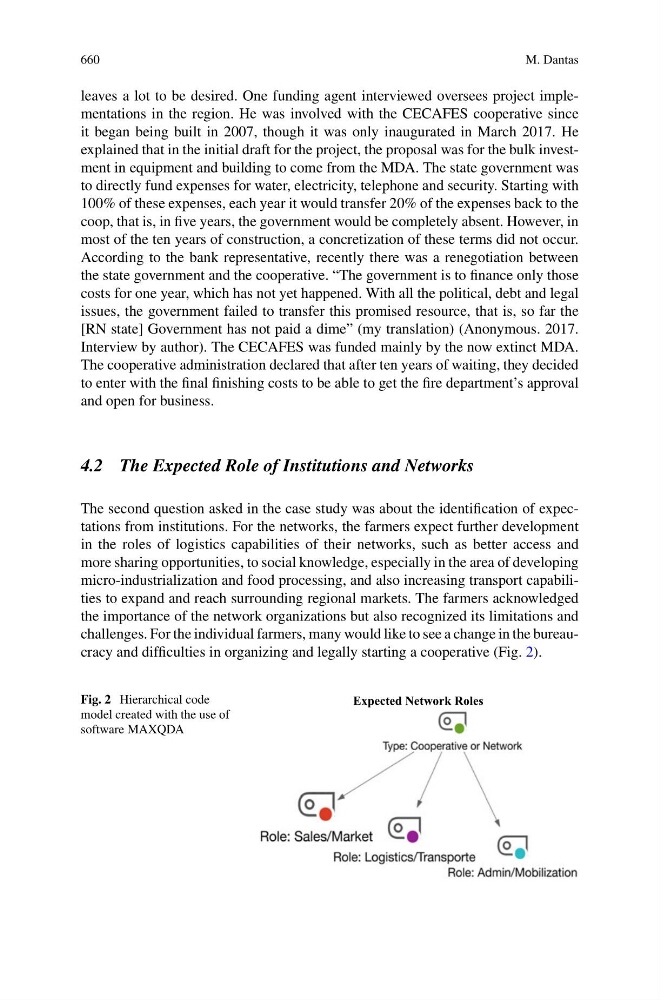
The second question asked in the case study was about the identification of expectations from institutions. For the networks, the farmers expect further development
in the roles of logistics capabilities of their networks, such as better access and
more sharing opportunities, to social knowledge, especially in the area of developing
micro-industrialization and food processing, and also increasing transport capabilities to expand and reach surrounding regional markets. The farmers acknowledged
the importance of the network organizations but also recognized its limitations and
challenges. For the individual farmers, many would like to see a change in the bureaucracy and difficulties in organizing and legally starting a cooperative (Fig. 2).
Fig. 2 Hierarchical code
model created with the use of
software MAXQDA
Expected Network Roles
M. Dantas
leaves a lot to be desired. One funding agent interviewed oversees project implementations in the region. He was involved with the CECAFES cooperative since
it began being built in 2007, though it was only inaugurated in March 2017. He
explained that in the initial draft for the project, the proposal was for the bulk investment in equipment and building to come from the MDA. The state government was
to directly fund expenses for water, electricity, telephone and security. Starting with
100% of these expenses, each year it would transfer 20% of the expenses back to the
coop, that is, in five years, the government would be completely absent. However, in
most of the ten years of construction, a concretization of these terms did not occur.
According to the bank representative, recently there was a renegotiation between
the state government and the cooperative. “The government is to finance only those
costs for one year, which has not yet happened. With all the political, debt and legal
issues, the government failed to transfer this promised resource, that is, so far the
[RN state] Government has not paid a dime” (my translation) (Anonymous. 2017.
Interview by author). The CECAFES was funded mainly by the now extinct MDA.
The cooperative administration declared that after ten years of waiting, they decided
to enter with the final finishing costs to be able to get the fire department’s approval
and open for business.
4.2 The Expected Role of Institutions and Networks
The second question asked in the case study was about the identification of expectations from institutions. For the networks, the farmers expect further development
in the roles of logistics capabilities of their networks, such as better access and
more sharing opportunities, to social knowledge, especially in the area of developing
micro-industrialization and food processing, and also increasing transport capabilities to expand and reach surrounding regional markets. The farmers acknowledged
the importance of the network organizations but also recognized its limitations and
challenges. For the individual farmers, many would like to see a change in the bureaucracy and difficulties in organizing and legally starting a cooperative (Fig. 2).
Fig. 2 Hierarchical code
model created with the use of
software MAXQDA
Expected Network Roles