

Teacher’s Approach on Climate Change …
637
Table 7 Climate change: experiences, causes, hopes and effects
Experiences with climate change
Causes of climate change
– Hail, on a large scale
– Winds
– Very intense floods in the city of Getúlio
Vargas when I was teaching there
– Storm and windstorm that resulted in the
sanding of most of the houses in my
neighborhood
– Tornado that caused the hurl of two trucks
in Rio Grande do Sul
– Landslide
– Floods in Paraná (São José dos Pinhais)
– Deforestation
– Changes in rainfall and air masses
– Disrespect for urban water resources, which
in most cases have their paths altered and/or
channeled through lack of planning
– The human beings
– Lack of education
“It wasn’t me” who threw the trash on the floor
– Lack of adequate waste separation
Hopes and expectations
Effects of climate change
– Sustainability
– Don’t change the paths of the rivers
– Use more efficient infrastructures
– Don’t experience lack of water
– Change in the consciousness of people and
also change their habits
– More respect and environmental education
– Consciousness of people in changing their
behavior
– Lack of water
– Financial losses
– Damage to the environment
– Loss of materials (in case of flood), many
people lost their homes and other goods
– Sudden temperature change over the same
day
– Mass movements
– Defrosting of the polar caps
– Storm
– Tornadoes
– Tsunamis
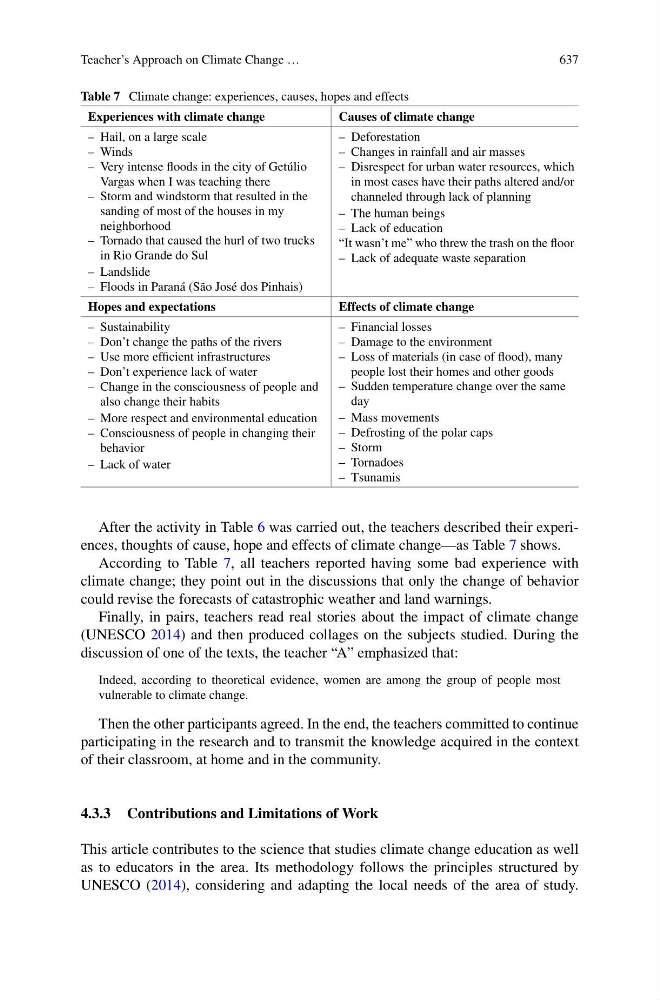
After the activity in Table 6 was carried out, the teachers described their experiences, thoughts of cause, hope and effects of climate change—as Table 7 shows.
According to Table 7, all teachers reported having some bad experience with
climate change; they point out in the discussions that only the change of behavior
could revise the forecasts of catastrophic weather and land warnings.
Finally, in pairs, teachers read real stories about the impact of climate change
(UNESCO 2014) and then produced collages on the subjects studied. During the
discussion of one of the texts, the teacher “A” emphasized that:
Indeed, according to theoretical evidence, women are among the group of people most
vulnerable to climate change.
Then the other participants agreed. In the end, the teachers committed to continue
participating in the research and to transmit the knowledge acquired in the context
of their classroom, at home and in the community.
4.3.3 Contributions and Limitations of Work
This article contributes to the science that studies climate change education as well
as to educators in the area. Its methodology follows the principles structured by
UNESCO (2014), considering and adapting the local needs of the area of study.
637
Table 7 Climate change: experiences, causes, hopes and effects
Experiences with climate change
Causes of climate change
– Hail, on a large scale
– Winds
– Very intense floods in the city of Getúlio
Vargas when I was teaching there
– Storm and windstorm that resulted in the
sanding of most of the houses in my
neighborhood
– Tornado that caused the hurl of two trucks
in Rio Grande do Sul
– Landslide
– Floods in Paraná (São José dos Pinhais)
– Deforestation
– Changes in rainfall and air masses
– Disrespect for urban water resources, which
in most cases have their paths altered and/or
channeled through lack of planning
– The human beings
– Lack of education
“It wasn’t me” who threw the trash on the floor
– Lack of adequate waste separation
Hopes and expectations
Effects of climate change
– Sustainability
– Don’t change the paths of the rivers
– Use more efficient infrastructures
– Don’t experience lack of water
– Change in the consciousness of people and
also change their habits
– More respect and environmental education
– Consciousness of people in changing their
behavior
– Lack of water
– Financial losses
– Damage to the environment
– Loss of materials (in case of flood), many
people lost their homes and other goods
– Sudden temperature change over the same
day
– Mass movements
– Defrosting of the polar caps
– Storm
– Tornadoes
– Tsunamis
After the activity in Table 6 was carried out, the teachers described their experiences, thoughts of cause, hope and effects of climate change—as Table 7 shows.
According to Table 7, all teachers reported having some bad experience with
climate change; they point out in the discussions that only the change of behavior
could revise the forecasts of catastrophic weather and land warnings.
Finally, in pairs, teachers read real stories about the impact of climate change
(UNESCO 2014) and then produced collages on the subjects studied. During the
discussion of one of the texts, the teacher “A” emphasized that:
Indeed, according to theoretical evidence, women are among the group of people most
vulnerable to climate change.
Then the other participants agreed. In the end, the teachers committed to continue
participating in the research and to transmit the knowledge acquired in the context
of their classroom, at home and in the community.
4.3.3 Contributions and Limitations of Work
This article contributes to the science that studies climate change education as well
as to educators in the area. Its methodology follows the principles structured by
UNESCO (2014), considering and adapting the local needs of the area of study.