

636
V. T. da Rocha et al.
Table 6 (continued)
Find/Rimind someone
who…
Source
Notes on the discussion
Report of one interviewee,
not identified and described
by teacher D
– “Yes. Recently, there was
a storm in Passo Fundo,
with high rainfall and
consequently, flood”
Note: teacher C did not
respond to this line
16 Can think about adaptations
being made to adapt to
climate change?
Report of one interviewee,
not identified and described
by teacher D
– “Yes. Specially related to
waste recycling”
Note: teachers A, B and C
did not answer this question
17 Feels very emotional about
climate change?
None of the teachers (A, B,
C and D) answered this
question
–
18 Heard or read terrible
predictions about climate
change?
Report of teachers A and B
– “Yes”
Note: teachers C and D did
not respond
19 Learn about species
extinction because of
climate change?
Report of teachers A and B
– “Yes. The polar bear is
an example”
Note: teachers C and D did
not respond
20 Believes that your children
will not be able to live as he
lives?
Report of teachers A and B
– “Yes”
Note: teachers C and D did
not respond
21 Believe that your students
will be able to respond
positively to climate
change?
Report of teachers A and B
– “Yes, if they are well
trained in the importance
of the subject”
Note: teachers C and D did
not respond
represent 19% of the questions asked; (b) future: issues 2; 3; 5; 13; 2 and 21—
represent 29% of the questions asked; (c) theoretical knowledge: 4; 7; 11; 14; 17; 18
and 19—represent 33% of the questions asked; and, (d) practical knowledge: 6; 9;
12; 15—represent, also according to the future, 19% of the questions asked.
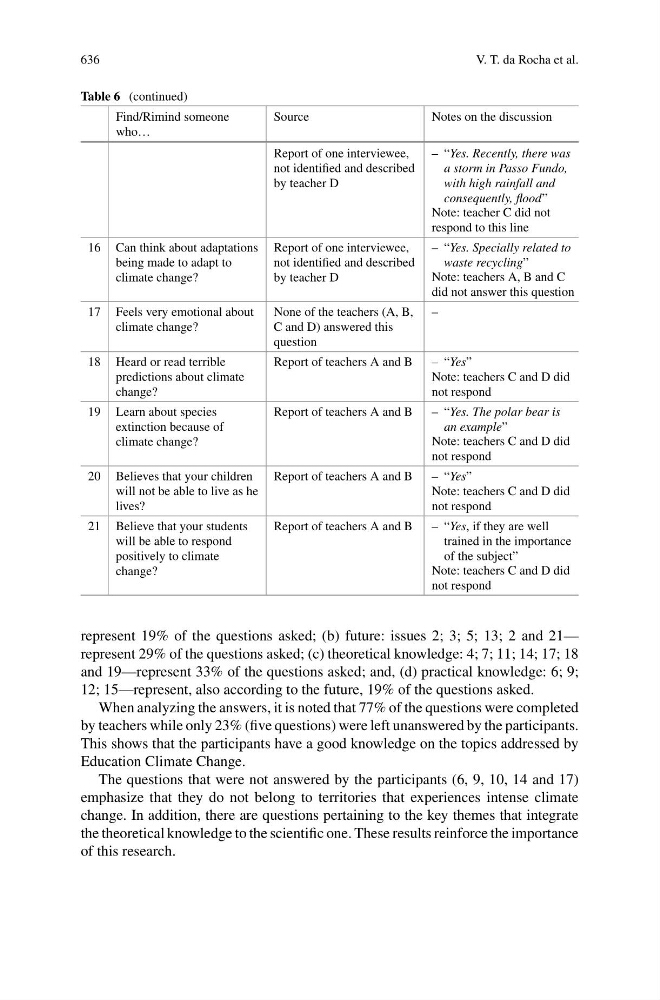
When analyzing the answers, it is noted that 77% of the questions were completed
by teachers while only 23% (five questions) were left unanswered by the participants.
This shows that the participants have a good knowledge on the topics addressed by
Education Climate Change.
The questions that were not answered by the participants (6, 9, 10, 14 and 17)
emphasize that they do not belong to territories that experiences intense climate
change. In addition, there are questions pertaining to the key themes that integrate
the theoretical knowledge to the scientific one. These results reinforce the importance
of this research.
V. T. da Rocha et al.
Table 6 (continued)
Find/Rimind someone
who…
Source
Notes on the discussion
Report of one interviewee,
not identified and described
by teacher D
– “Yes. Recently, there was
a storm in Passo Fundo,
with high rainfall and
consequently, flood”
Note: teacher C did not
respond to this line
16 Can think about adaptations
being made to adapt to
climate change?
Report of one interviewee,
not identified and described
by teacher D
– “Yes. Specially related to
waste recycling”
Note: teachers A, B and C
did not answer this question
17 Feels very emotional about
climate change?
None of the teachers (A, B,
C and D) answered this
question
–
18 Heard or read terrible
predictions about climate
change?
Report of teachers A and B
– “Yes”
Note: teachers C and D did
not respond
19 Learn about species
extinction because of
climate change?
Report of teachers A and B
– “Yes. The polar bear is
an example”
Note: teachers C and D did
not respond
20 Believes that your children
will not be able to live as he
lives?
Report of teachers A and B
– “Yes”
Note: teachers C and D did
not respond
21 Believe that your students
will be able to respond
positively to climate
change?
Report of teachers A and B
– “Yes, if they are well
trained in the importance
of the subject”
Note: teachers C and D did
not respond
represent 19% of the questions asked; (b) future: issues 2; 3; 5; 13; 2 and 21—
represent 29% of the questions asked; (c) theoretical knowledge: 4; 7; 11; 14; 17; 18
and 19—represent 33% of the questions asked; and, (d) practical knowledge: 6; 9;
12; 15—represent, also according to the future, 19% of the questions asked.
When analyzing the answers, it is noted that 77% of the questions were completed
by teachers while only 23% (five questions) were left unanswered by the participants.
This shows that the participants have a good knowledge on the topics addressed by
Education Climate Change.
The questions that were not answered by the participants (6, 9, 10, 14 and 17)
emphasize that they do not belong to territories that experiences intense climate
change. In addition, there are questions pertaining to the key themes that integrate
the theoretical knowledge to the scientific one. These results reinforce the importance
of this research.