

574
G. Nicolino and S. R. S. Barros
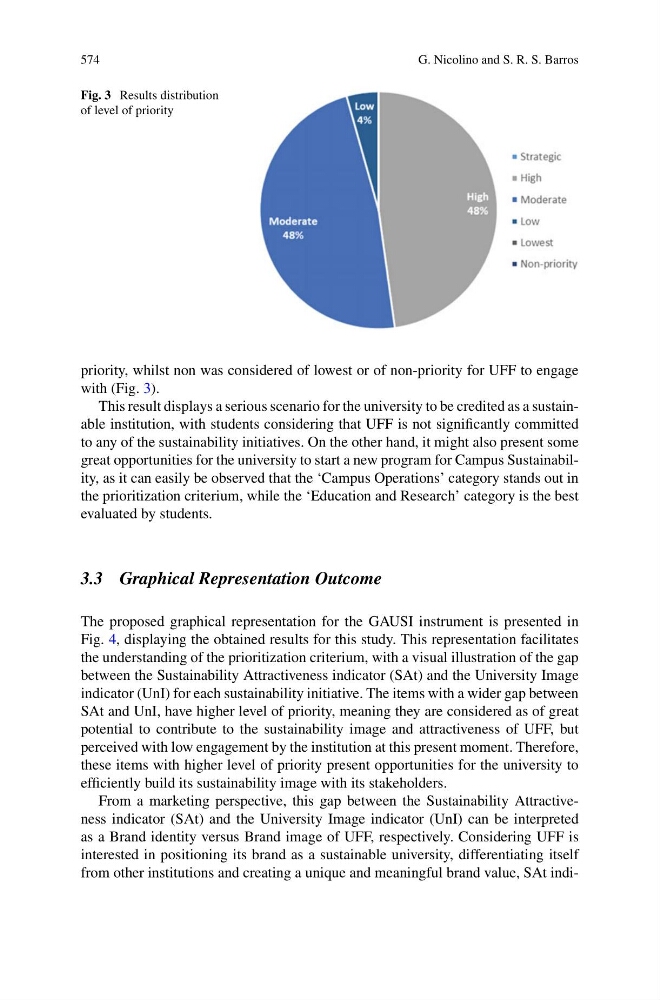
Fig. 3 Results distribution
of level of priority
priority, whilst non was considered of lowest or of non-priority for UFF to engage
with (Fig. 3).
This result displays a serious scenario for the university to be credited as a sustainable institution, with students considering that UFF is not significantly committed
to any of the sustainability initiatives. On the other hand, it might also present some
great opportunities for the university to start a new program for Campus Sustainability, as it can easily be observed that the ‘Campus Operations’ category stands out in
the prioritization criterium, while the ‘Education and Research’ category is the best
evaluated by students.
3.3 Graphical Representation Outcome
The proposed graphical representation for the GAUSI instrument is presented in
Fig. 4, displaying the obtained results for this study. This representation facilitates
the understanding of the prioritization criterium, with a visual illustration of the gap
between the Sustainability Attractiveness indicator (SAt) and the University Image
indicator (UnI) for each sustainability initiative. The items with a wider gap between
SAt and UnI, have higher level of priority, meaning they are considered as of great
potential to contribute to the sustainability image and attractiveness of UFF, but
perceived with low engagement by the institution at this present moment. Therefore,
these items with higher level of priority present opportunities for the university to
efficiently build its sustainability image with its stakeholders.
From a marketing perspective, this gap between the Sustainability Attractiveness indicator (SAt) and the University Image indicator (UnI) can be interpreted
as a Brand identity versus Brand image of UFF, respectively. Considering UFF is
interested in positioning its brand as a sustainable university, differentiating itself
from other institutions and creating a unique and meaningful brand value, SAt indi-
G. Nicolino and S. R. S. Barros
Fig. 3 Results distribution
of level of priority
priority, whilst non was considered of lowest or of non-priority for UFF to engage
with (Fig. 3).
This result displays a serious scenario for the university to be credited as a sustainable institution, with students considering that UFF is not significantly committed
to any of the sustainability initiatives. On the other hand, it might also present some
great opportunities for the university to start a new program for Campus Sustainability, as it can easily be observed that the ‘Campus Operations’ category stands out in
the prioritization criterium, while the ‘Education and Research’ category is the best
evaluated by students.
3.3 Graphical Representation Outcome
The proposed graphical representation for the GAUSI instrument is presented in
Fig. 4, displaying the obtained results for this study. This representation facilitates
the understanding of the prioritization criterium, with a visual illustration of the gap
between the Sustainability Attractiveness indicator (SAt) and the University Image
indicator (UnI) for each sustainability initiative. The items with a wider gap between
SAt and UnI, have higher level of priority, meaning they are considered as of great
potential to contribute to the sustainability image and attractiveness of UFF, but
perceived with low engagement by the institution at this present moment. Therefore,
these items with higher level of priority present opportunities for the university to
efficiently build its sustainability image with its stakeholders.
From a marketing perspective, this gap between the Sustainability Attractiveness indicator (SAt) and the University Image indicator (UnI) can be interpreted
as a Brand identity versus Brand image of UFF, respectively. Considering UFF is
interested in positioning its brand as a sustainable university, differentiating itself
from other institutions and creating a unique and meaningful brand value, SAt indi-