

An Enhanced Data-Analyses Method for the Graphical …
571
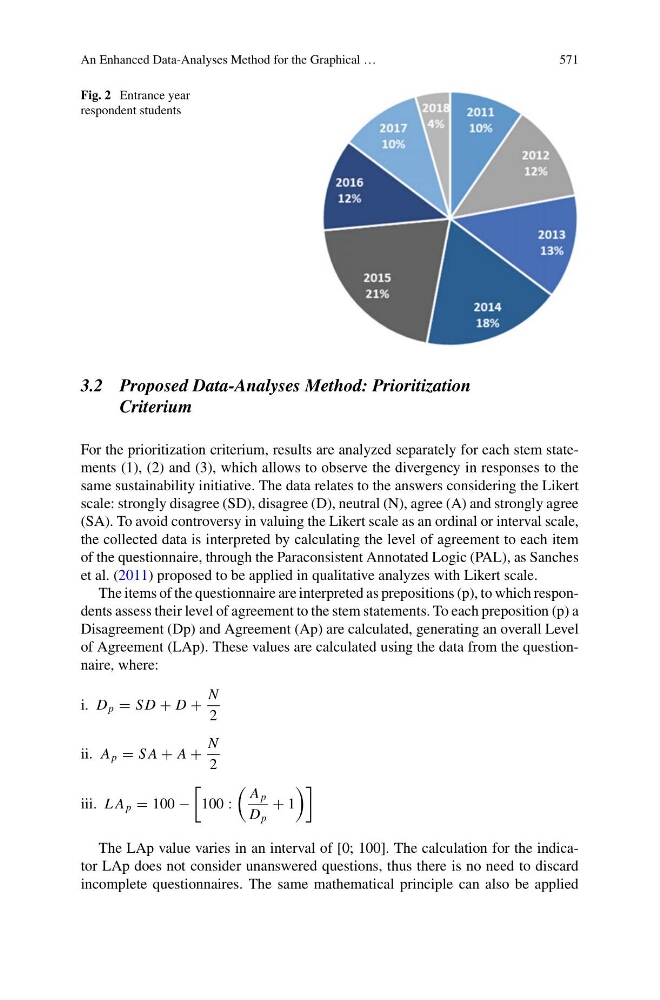
Fig. 2 Entrance year
respondent students
3.2 Proposed Data-Analyses Method: Prioritization
Criterium
For the prioritization criterium, results are analyzed separately for each stem statements (1), (2) and (3), which allows to observe the divergency in responses to the
same sustainability initiative. The data relates to the answers considering the Likert
scale: strongly disagree (SD), disagree (D), neutral (N), agree (A) and strongly agree
(SA). To avoid controversy in valuing the Likert scale as an ordinal or interval scale,
the collected data is interpreted by calculating the level of agreement to each item
of the questionnaire, through the Paraconsistent Annotated Logic (PAL), as Sanches
et al. (2011) proposed to be applied in qualitative analyzes with Likert scale.
The items of the questionnaire are interpreted as prepositions (p), to which respondents assess their level of agreement to the stem statements. To each preposition (p) a
Disagreement (Dp) and Agreement (Ap) are calculated, generating an overall Level
of Agreement (LAp). These values are calculated using the data from the questionnaire, where:
i. D p = S D + D +
N
2
ii. A p = S A + A +
N
2
iii. L A p = 100 −
100 :
A p
D p
+ 1
The LAp value varies in an interval of [0; 100]. The calculation for the indicator LAp does not consider unanswered questions, thus there is no need to discard
incomplete questionnaires. The same mathematical principle can also be applied
571
Fig. 2 Entrance year
respondent students
3.2 Proposed Data-Analyses Method: Prioritization
Criterium
For the prioritization criterium, results are analyzed separately for each stem statements (1), (2) and (3), which allows to observe the divergency in responses to the
same sustainability initiative. The data relates to the answers considering the Likert
scale: strongly disagree (SD), disagree (D), neutral (N), agree (A) and strongly agree
(SA). To avoid controversy in valuing the Likert scale as an ordinal or interval scale,
the collected data is interpreted by calculating the level of agreement to each item
of the questionnaire, through the Paraconsistent Annotated Logic (PAL), as Sanches
et al. (2011) proposed to be applied in qualitative analyzes with Likert scale.
The items of the questionnaire are interpreted as prepositions (p), to which respondents assess their level of agreement to the stem statements. To each preposition (p) a
Disagreement (Dp) and Agreement (Ap) are calculated, generating an overall Level
of Agreement (LAp). These values are calculated using the data from the questionnaire, where:
i. D p = S D + D +
N
2
ii. A p = S A + A +
N
2
iii. L A p = 100 −
100 :
A p
D p
+ 1
The LAp value varies in an interval of [0; 100]. The calculation for the indicator LAp does not consider unanswered questions, thus there is no need to discard
incomplete questionnaires. The same mathematical principle can also be applied