

570
G. Nicolino and S. R. S. Barros
brief explanation of the questionnaire’s dynamic was required before initiating the
interviews. Following, there was no interviewer-respondent interaction and students
completed the questionnaires individually. Each application session demanded from
fifteen to twenty minutes. In total, three sessions were conducted, with 80 students
interviewed.
Additionally, a weblink was provided to absent students interested in the research.
The digital questionnaire was hosted at the SurveyMonkey platform, where 56 extra
students participated. The responses were analyzed regarding the individual sustainability initiatives, and concerning the A&R, E&R, COp and COr categories for a
clearer overall understanding of the strengths and weaknesses of the university’s
sustainability image.
A total of 136 students were interviewed. According to UFF’s Transparency System (https://app.uff.br/transparencia/inscricoes_por_curso), there are 117 active students in the Environmental Science bachelor course and another 381 in the Environmental Engineer bachelor. This provides this study with a total statistic population
of 498 students, which represents a 6% margin of error, with 90% confidence level.
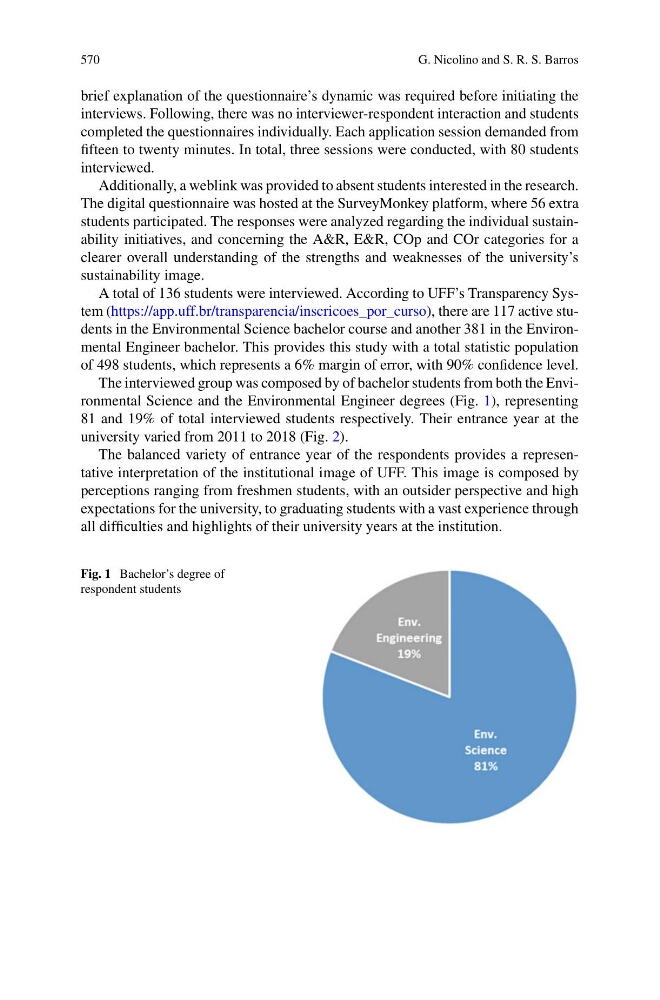
The interviewed group was composed by of bachelor students from both the Environmental Science and the Environmental Engineer degrees (Fig. 1), representing
81 and 19% of total interviewed students respectively. Their entrance year at the
university varied from 2011 to 2018 (Fig. 2).
The balanced variety of entrance year of the respondents provides a representative interpretation of the institutional image of UFF. This image is composed by
perceptions ranging from freshmen students, with an outsider perspective and high
expectations for the university, to graduating students with a vast experience through
all difficulties and highlights of their university years at the institution.
Fig. 1 Bachelor’s degree of
respondent students
G. Nicolino and S. R. S. Barros
brief explanation of the questionnaire’s dynamic was required before initiating the
interviews. Following, there was no interviewer-respondent interaction and students
completed the questionnaires individually. Each application session demanded from
fifteen to twenty minutes. In total, three sessions were conducted, with 80 students
interviewed.
Additionally, a weblink was provided to absent students interested in the research.
The digital questionnaire was hosted at the SurveyMonkey platform, where 56 extra
students participated. The responses were analyzed regarding the individual sustainability initiatives, and concerning the A&R, E&R, COp and COr categories for a
clearer overall understanding of the strengths and weaknesses of the university’s
sustainability image.
A total of 136 students were interviewed. According to UFF’s Transparency System (https://app.uff.br/transparencia/inscricoes_por_curso), there are 117 active students in the Environmental Science bachelor course and another 381 in the Environmental Engineer bachelor. This provides this study with a total statistic population
of 498 students, which represents a 6% margin of error, with 90% confidence level.
The interviewed group was composed by of bachelor students from both the Environmental Science and the Environmental Engineer degrees (Fig. 1), representing
81 and 19% of total interviewed students respectively. Their entrance year at the
university varied from 2011 to 2018 (Fig. 2).
The balanced variety of entrance year of the respondents provides a representative interpretation of the institutional image of UFF. This image is composed by
perceptions ranging from freshmen students, with an outsider perspective and high
expectations for the university, to graduating students with a vast experience through
all difficulties and highlights of their university years at the institution.
Fig. 1 Bachelor’s degree of
respondent students