

The Role of Neighborhood Origin in the Residential Satisfaction …
443
The Architectural and Town-Planning (PREQ_ArqPlan) variable accounts for
people’s perceptions of two aspects of the environment: building aesthetics and building density. In the PREQI, this variable is used to examine perceptions pertaining to
the “beauty” of buildings, how close together they are in the neighborhood, street
width, and the overall spatial quality of the residential environment. This variable
has the greatest effect on RS for informal origin neighborhoods, which means that
the residents place a high value on the look, feel, and density of their neighborhood.
A closer examination of building aesthetics and density in informal origin neighborhoods in Bogotá is warranted to more fully understand which architectural and
planning characteristics residents value most.
Finally, the MLR model includes Organization and Accessibility of Roads
(PREQ_OrgAccRoads) as a significant variable contributing to RS. As per the
PREQI, this variable is used to examine residents’ perceptions of how easy it is
to move around their neighborhood by walking or cycling and how adequately it
is connected to important parts of the city. For informal origin neighborhoods, this
offers an insight into the availability and accessibility of alternative transportation
modes given that most low-income people in Bogotá do not have a car such that
they rely on public transportation, bicycle and/or walking to work, to school, and to
access most of the other activities of daily life (Duarte and Rojas 2012).
3.3.4 Formal Origin Neighborhoods
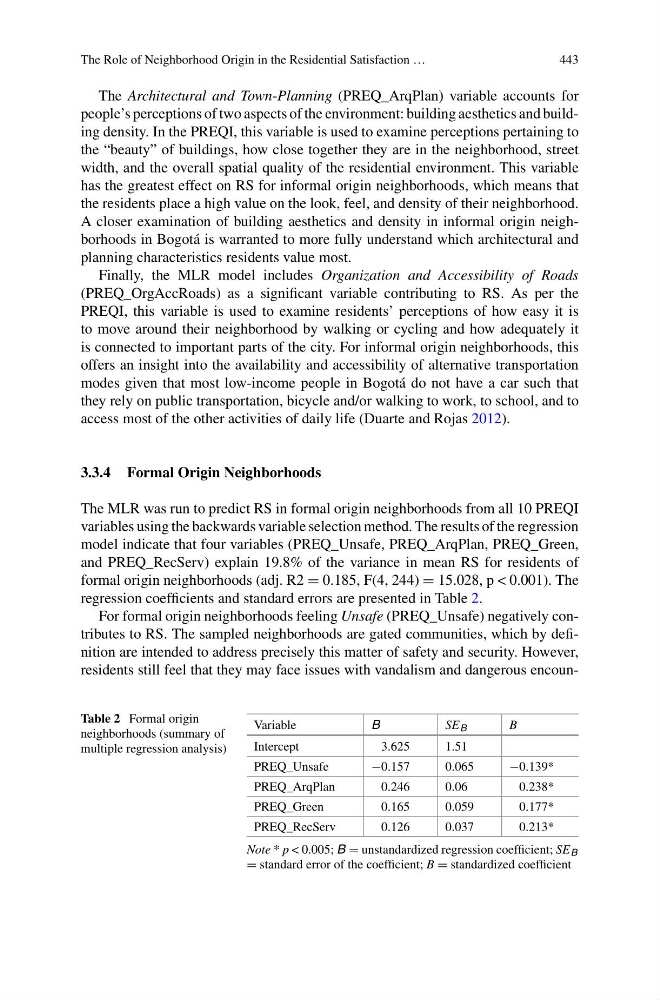
The MLR was run to predict RS in formal origin neighborhoods from all 10 PREQI
variables using the backwards variable selection method. The results of the regression
model indicate that four variables (PREQ_Unsafe, PREQ_ArqPlan, PREQ_Green,
and PREQ_RecServ) explain 19.8% of the variance in mean RS for residents of
formal origin neighborhoods (adj. R2 = 0.185, F(4, 244) = 15.028, p < 0.001). The
regression coefficients and standard errors are presented in Table 2.
For formal origin neighborhoods feeling Unsafe (PREQ_Unsafe) negatively contributes to RS. The sampled neighborhoods are gated communities, which by definition are intended to address precisely this matter of safety and security. However,
residents still feel that they may face issues with vandalism and dangerous encounTable 2 Formal origin
neighborhoods (summary of
multiple regression analysis)
Variable
B
SE B
B
Intercept
3.625
1.51
PREQ_Unsafe
−0.157
0.065
−0.139*
PREQ_ArqPlan
0.246
0.06
0.238*
PREQ_Green
0.165
0.059
0.177*
PREQ_RecServ
0.126
0.037
0.213*
Note * p < 0.005; B = unstandardized regression coefficient; SE B
= standard error of the coefficient; B = standardized coefficient
443
The Architectural and Town-Planning (PREQ_ArqPlan) variable accounts for
people’s perceptions of two aspects of the environment: building aesthetics and building density. In the PREQI, this variable is used to examine perceptions pertaining to
the “beauty” of buildings, how close together they are in the neighborhood, street
width, and the overall spatial quality of the residential environment. This variable
has the greatest effect on RS for informal origin neighborhoods, which means that
the residents place a high value on the look, feel, and density of their neighborhood.
A closer examination of building aesthetics and density in informal origin neighborhoods in Bogotá is warranted to more fully understand which architectural and
planning characteristics residents value most.
Finally, the MLR model includes Organization and Accessibility of Roads
(PREQ_OrgAccRoads) as a significant variable contributing to RS. As per the
PREQI, this variable is used to examine residents’ perceptions of how easy it is
to move around their neighborhood by walking or cycling and how adequately it
is connected to important parts of the city. For informal origin neighborhoods, this
offers an insight into the availability and accessibility of alternative transportation
modes given that most low-income people in Bogotá do not have a car such that
they rely on public transportation, bicycle and/or walking to work, to school, and to
access most of the other activities of daily life (Duarte and Rojas 2012).
3.3.4 Formal Origin Neighborhoods
The MLR was run to predict RS in formal origin neighborhoods from all 10 PREQI
variables using the backwards variable selection method. The results of the regression
model indicate that four variables (PREQ_Unsafe, PREQ_ArqPlan, PREQ_Green,
and PREQ_RecServ) explain 19.8% of the variance in mean RS for residents of
formal origin neighborhoods (adj. R2 = 0.185, F(4, 244) = 15.028, p < 0.001). The
regression coefficients and standard errors are presented in Table 2.
For formal origin neighborhoods feeling Unsafe (PREQ_Unsafe) negatively contributes to RS. The sampled neighborhoods are gated communities, which by definition are intended to address precisely this matter of safety and security. However,
residents still feel that they may face issues with vandalism and dangerous encounTable 2 Formal origin
neighborhoods (summary of
multiple regression analysis)
Variable
B
SE B
B
Intercept
3.625
1.51
PREQ_Unsafe
−0.157
0.065
−0.139*
PREQ_ArqPlan
0.246
0.06
0.238*
PREQ_Green
0.165
0.059
0.177*
PREQ_RecServ
0.126
0.037
0.213*
Note * p < 0.005; B = unstandardized regression coefficient; SE B
= standard error of the coefficient; B = standardized coefficient