

442
D. Vanegas and M. Bose
3.3.3 Informal Origin Neighborhoods
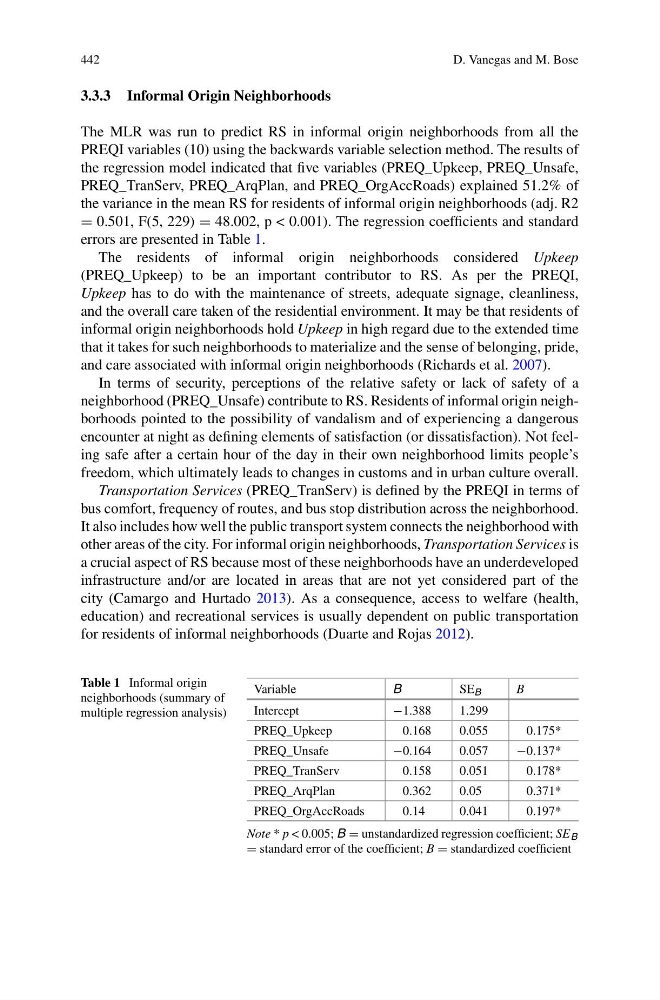
The MLR was run to predict RS in informal origin neighborhoods from all the
PREQI variables (10) using the backwards variable selection method. The results of
the regression model indicated that five variables (PREQ_Upkeep, PREQ_Unsafe,
PREQ_TranServ, PREQ_ArqPlan, and PREQ_OrgAccRoads) explained 51.2% of
the variance in the mean RS for residents of informal origin neighborhoods (adj. R2
= 0.501, F(5, 229) = 48.002, p < 0.001). The regression coefficients and standard
errors are presented in Table 1.
The residents of informal origin neighborhoods considered Upkeep
(PREQ_Upkeep) to be an important contributor to RS. As per the PREQI,
Upkeep has to do with the maintenance of streets, adequate signage, cleanliness,
and the overall care taken of the residential environment. It may be that residents of
informal origin neighborhoods hold Upkeep in high regard due to the extended time
that it takes for such neighborhoods to materialize and the sense of belonging, pride,
and care associated with informal origin neighborhoods (Richards et al. 2007).
In terms of security, perceptions of the relative safety or lack of safety of a
neighborhood (PREQ_Unsafe) contribute to RS. Residents of informal origin neighborhoods pointed to the possibility of vandalism and of experiencing a dangerous
encounter at night as defining elements of satisfaction (or dissatisfaction). Not feeling safe after a certain hour of the day in their own neighborhood limits people’s
freedom, which ultimately leads to changes in customs and in urban culture overall.
Transportation Services (PREQ_TranServ) is defined by the PREQI in terms of
bus comfort, frequency of routes, and bus stop distribution across the neighborhood.
It also includes how well the public transport system connects the neighborhood with
other areas of the city. For informal origin neighborhoods, Transportation Services is
a crucial aspect of RS because most of these neighborhoods have an underdeveloped
infrastructure and/or are located in areas that are not yet considered part of the
city (Camargo and Hurtado 2013). As a consequence, access to welfare (health,
education) and recreational services is usually dependent on public transportation
for residents of informal neighborhoods (Duarte and Rojas 2012).
Table 1 Informal origin
neighborhoods (summary of
multiple regression analysis)
Variable
B
SE B
B
Intercept
−1.388
1.299
PREQ_Upkeep
0.168
0.055
0.175*
PREQ_Unsafe
−0.164
0.057
−0.137*
PREQ_TranServ
0.158
0.051
0.178*
PREQ_ArqPlan
0.362
0.05
0.371*
PREQ_OrgAccRoads
0.14
0.041
0.197*
Note * p < 0.005; B = unstandardized regression coefficient; SE B
= standard error of the coefficient; B = standardized coefficient
D. Vanegas and M. Bose
3.3.3 Informal Origin Neighborhoods
The MLR was run to predict RS in informal origin neighborhoods from all the
PREQI variables (10) using the backwards variable selection method. The results of
the regression model indicated that five variables (PREQ_Upkeep, PREQ_Unsafe,
PREQ_TranServ, PREQ_ArqPlan, and PREQ_OrgAccRoads) explained 51.2% of
the variance in the mean RS for residents of informal origin neighborhoods (adj. R2
= 0.501, F(5, 229) = 48.002, p < 0.001). The regression coefficients and standard
errors are presented in Table 1.
The residents of informal origin neighborhoods considered Upkeep
(PREQ_Upkeep) to be an important contributor to RS. As per the PREQI,
Upkeep has to do with the maintenance of streets, adequate signage, cleanliness,
and the overall care taken of the residential environment. It may be that residents of
informal origin neighborhoods hold Upkeep in high regard due to the extended time
that it takes for such neighborhoods to materialize and the sense of belonging, pride,
and care associated with informal origin neighborhoods (Richards et al. 2007).
In terms of security, perceptions of the relative safety or lack of safety of a
neighborhood (PREQ_Unsafe) contribute to RS. Residents of informal origin neighborhoods pointed to the possibility of vandalism and of experiencing a dangerous
encounter at night as defining elements of satisfaction (or dissatisfaction). Not feeling safe after a certain hour of the day in their own neighborhood limits people’s
freedom, which ultimately leads to changes in customs and in urban culture overall.
Transportation Services (PREQ_TranServ) is defined by the PREQI in terms of
bus comfort, frequency of routes, and bus stop distribution across the neighborhood.
It also includes how well the public transport system connects the neighborhood with
other areas of the city. For informal origin neighborhoods, Transportation Services is
a crucial aspect of RS because most of these neighborhoods have an underdeveloped
infrastructure and/or are located in areas that are not yet considered part of the
city (Camargo and Hurtado 2013). As a consequence, access to welfare (health,
education) and recreational services is usually dependent on public transportation
for residents of informal neighborhoods (Duarte and Rojas 2012).
Table 1 Informal origin
neighborhoods (summary of
multiple regression analysis)
Variable
B
SE B
B
Intercept
−1.388
1.299
PREQ_Upkeep
0.168
0.055
0.175*
PREQ_Unsafe
−0.164
0.057
−0.137*
PREQ_TranServ
0.158
0.051
0.178*
PREQ_ArqPlan
0.362
0.05
0.371*
PREQ_OrgAccRoads
0.14
0.041
0.197*
Note * p < 0.005; B = unstandardized regression coefficient; SE B
= standard error of the coefficient; B = standardized coefficient