

The Role of Neighborhood Origin in the Residential Satisfaction …
437
3.1 Study Site and Context
In order to study low-income communities in Bogotá, it was necessary to use selection
criteria that would guarantee variability and comparability. To fulfill this goal, the
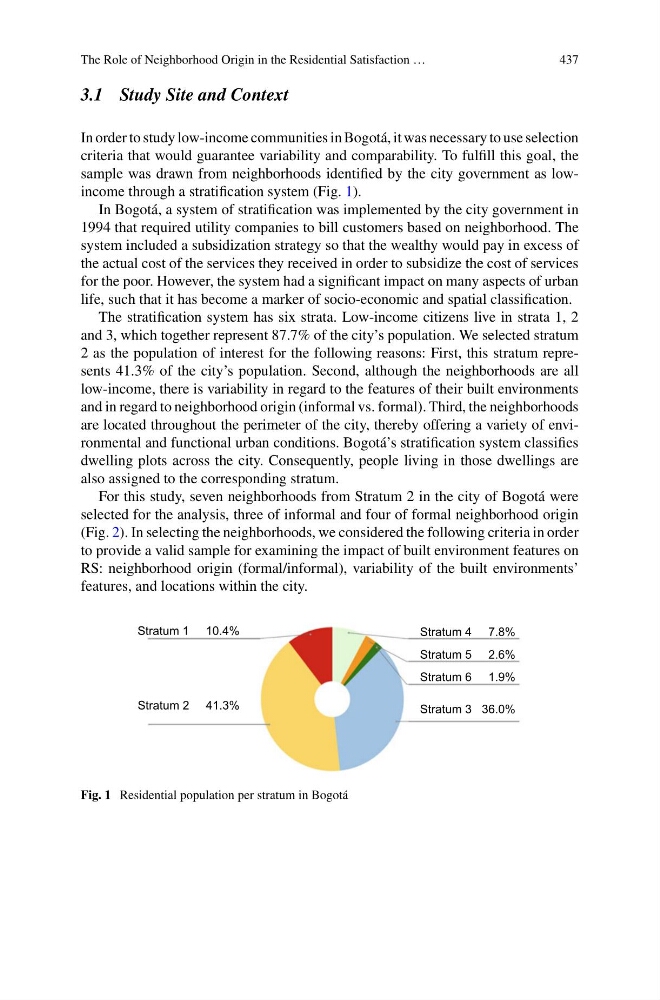
sample was drawn from neighborhoods identified by the city government as lowincome through a stratification system (Fig. 1).
In Bogotá, a system of stratification was implemented by the city government in
1994 that required utility companies to bill customers based on neighborhood. The
system included a subsidization strategy so that the wealthy would pay in excess of
the actual cost of the services they received in order to subsidize the cost of services
for the poor. However, the system had a significant impact on many aspects of urban
life, such that it has become a marker of socio-economic and spatial classification.
The stratification system has six strata. Low-income citizens live in strata 1, 2
and 3, which together represent 87.7% of the city’s population. We selected stratum
2 as the population of interest for the following reasons: First, this stratum represents 41.3% of the city’s population. Second, although the neighborhoods are all
low-income, there is variability in regard to the features of their built environments
and in regard to neighborhood origin (informal vs. formal). Third, the neighborhoods
are located throughout the perimeter of the city, thereby offering a variety of environmental and functional urban conditions. Bogotá’s stratification system classifies
dwelling plots across the city. Consequently, people living in those dwellings are
also assigned to the corresponding stratum.
For this study, seven neighborhoods from Stratum 2 in the city of Bogotá were
selected for the analysis, three of informal and four of formal neighborhood origin
(Fig. 2). In selecting the neighborhoods, we considered the following criteria in order
to provide a valid sample for examining the impact of built environment features on
RS: neighborhood origin (formal/informal), variability of the built environments’
features, and locations within the city.
Stratum 4 7.8%
Stratum 5 2.6%
Stratum 6 1.9%
Stratum 3 36.0%
Stratum 1 10.4%
Stratum 2 41.3%
Fig. 1 Residential population per stratum in Bogotá
437
3.1 Study Site and Context
In order to study low-income communities in Bogotá, it was necessary to use selection
criteria that would guarantee variability and comparability. To fulfill this goal, the
sample was drawn from neighborhoods identified by the city government as lowincome through a stratification system (Fig. 1).
In Bogotá, a system of stratification was implemented by the city government in
1994 that required utility companies to bill customers based on neighborhood. The
system included a subsidization strategy so that the wealthy would pay in excess of
the actual cost of the services they received in order to subsidize the cost of services
for the poor. However, the system had a significant impact on many aspects of urban
life, such that it has become a marker of socio-economic and spatial classification.
The stratification system has six strata. Low-income citizens live in strata 1, 2
and 3, which together represent 87.7% of the city’s population. We selected stratum
2 as the population of interest for the following reasons: First, this stratum represents 41.3% of the city’s population. Second, although the neighborhoods are all
low-income, there is variability in regard to the features of their built environments
and in regard to neighborhood origin (informal vs. formal). Third, the neighborhoods
are located throughout the perimeter of the city, thereby offering a variety of environmental and functional urban conditions. Bogotá’s stratification system classifies
dwelling plots across the city. Consequently, people living in those dwellings are
also assigned to the corresponding stratum.
For this study, seven neighborhoods from Stratum 2 in the city of Bogotá were
selected for the analysis, three of informal and four of formal neighborhood origin
(Fig. 2). In selecting the neighborhoods, we considered the following criteria in order
to provide a valid sample for examining the impact of built environment features on
RS: neighborhood origin (formal/informal), variability of the built environments’
features, and locations within the city.
Stratum 4 7.8%
Stratum 5 2.6%
Stratum 6 1.9%
Stratum 3 36.0%
Stratum 1 10.4%
Stratum 2 41.3%
Fig. 1 Residential population per stratum in Bogotá